

Angel Hernandez is making baseball’s best case for robot umpires
Advertisement
Read this article for free:
or
Already have an account? Log in here »
To continue reading, please subscribe:

Digital Subscription
One year of digital access for only $205*
- Enjoy unlimited reading on winnipegfreepress.com
- Read the E-Edition, our digital replica newspaper
- Access News Break, our award-winning app
- Play interactive puzzles
*First annual payment billed as $205.00 + GST for one year. This annual subscription will automatically renew at $233.00 + GST every 52 weeks (10% off the regular annual price of $259.35). Offer available to new and qualified returning subscribers only. Cancel any time.
To continue reading, please subscribe:
Add Free Press access to your Brandon Sun subscription for only an additional
$1 for the first 4 weeks*
- Enjoy unlimited reading on winnipegfreepress.com
- Read the E-Edition, our digital replica newspaper
- Access News Break, our award-winning app
- Play interactive puzzles
*Your next Brandon Sun subscription payment will increase by $1.00 and you will be charged $17.95 plus GST for four weeks. After four weeks, your payment will increase to $24.95 plus GST every four weeks.
Read unlimited articles for free today:
or
Already have an account? Log in here »
Hey there, time traveller!
This article was published 25/04/2022 (1623 days ago), so information in it may no longer be current.
The arrival of robot umpires may have gotten one large step closer this weekend thanks to, who else, Angel Hernandez.
The often-embattled (and for good reason) 60-year-old, now in his 32nd year as a big-league umpire, was at the centre of controversy again on Sunday night’s national broadcast.
Hernandez may have fooled us all on Wednesday when he worked the plate in the Blue Jays’ 6-1 win over the Red Sox at Fenway Park and was nearly perfect with his ball and strike calls. It might have been the best game he has called in his life.
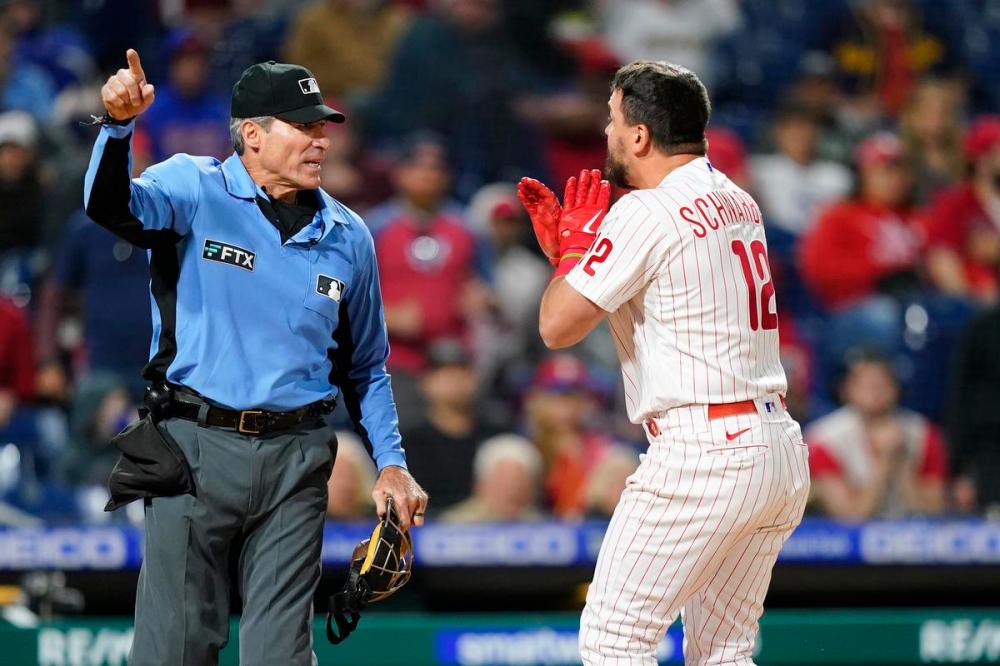
But he was back to being Angel on “Sunday Night Baseball,” calling 48 strikes in the Brewers-Phillies game, only 37 of which were actually in the strike zone. A 77-per-cent success rate is pretty terrible for a major-league umpire, but Hernandez’s worst miss of the night, according to umpscorecards.com, came in the bottom of the ninth inning.
With Milwaukee leading 1-0 and left-hander closer Josh Hader on the mound, Kyle Schwarber fell behind 0-2, worked the count back to full, and then took a pitch down and away for what he thought was ball four. Hernandez had other ideas, rang him up, and Schwarber went absolutely ballistic.
“I think what you saw out of (Schwarber) was just raw emotion,” Blue Jays centre-fielder George Springer said Monday. “He thought he had gotten on base for his team right there in a big spot off arguably one of the best closers in the game, if not the best, and it didn’t go his way. I think everybody on this field can say that they’ve reacted to some degree at a call.”
Former Jays infielder Travis Shaw, now with the Red Sox, saw it, too.
“That’s the ninth inning of a one-run game,” Shaw said. “Those bigger spots, they mean a little bit more. That’s when you see guys freak out a little bit more.”
Schwarber played with the Red Sox last season, and Shaw could put himself in his former teammate’s cleats.
“He’s a gamer, he’s a competitor,” Shaw said. “He was probably seeing the ball really well right there and the frustration of everything that happened over the course of the night just boiled over.”
Among the few printable things that Schwarber screamed at Hernandez in his fit of pique after being called out on strikes were “The whole night!” and “Both sides!”
And Schwarber was right.
“He felt like he worked a really good at-bat against one of the best relievers in baseball and it was taken away from him,” Jays reliever David Phelps said. “He felt like he did his job and it was taken away from him.”
Phelps has a unique perspective on the game, since he pitched for both the Phillies and Brewers in the pandemic-shortened 2020 season. “I’ve seen both those pitching staffs first-hand,” he said, “and guys have absolutely nasty stuff. I think that plays into it. Hitters get fooled, and they’ve been hitting their entire lives. Umpires aren’t perfect.”
Phelps, an 11-year veteran, sympathizes with the men in blue, as well.
“It goes both ways,” Phelps said. “There are times when I’ve made a pitch (and) I’m like, ‘That’s right there,’ and I’ll go in and look and it was a ball. I’ve gotten thrown out of a game because I thought a pitch was a strike.”
The pitch on which Schwarber got rung up wasn’t.
Sure, sometimes the umpires are right and the players are wrong, but we have the technology now to see just how often home-plate umpires miss pitches.
Jeff Nelson, a 23-year-veteran, had an embarrassing afternoon at the Rogers Centre on April 16, when Oakland beat the Jays 7-5. Fully one-third of the pitches he called strikes were outside the zone, according to umpscorecards.com.
His punishment for such an egregious performance? He was working third base the next day, as scheduled.

Umpires aren’t held accountable for poor performance. They’re doing their best, to be sure — though in Hernandez’ case it’s fair to wonder, since he almost always seems to find a way to be part of the story of games he works — but calling balls and strikes accurately is something that seems too difficult for human beings to be able to do these days.
Maybe it always was, but with pitchers throwing harder and with more movement than ever before, and with that strike box conveniently on your television screen every game, it’s more apparent than ever.
People will say they appreciate the human element of the game, but shouldn’t that element be that the players are human? That their successes and failures should make the difference in the games, as opposed to the humanity of the people calling the game, now that the technology exists to be far more accurate than had been possible previously?
Heck, maybe that near-perfect game that Hernandez called behind the plate last week in Fenway was a stealth experiment with an electronic strike zone. A bug is his ear might just be the only way he could have been that good.
Mike Wilner is a Toronto-based baseball columnist for the Star and host of the baseball podcast “Deep Left Field.” Follow him on Twitter: @wilnerness
Related Articles
LEADING OFF: Marlins' López sharp, Braves' Rosario out

Advertisement Advertise With Us
Advertisement Advertise With Us