

In China and Iran, tyrants in retreat
Advertisement
Read this article for free:
or
Already have an account? Log in here »
To continue reading, please subscribe:

Digital Subscription
One year of digital access for only $205*
- Enjoy unlimited reading on winnipegfreepress.com
- Read the E-Edition, our digital replica newspaper
- Access News Break, our award-winning app
- Play interactive puzzles
*First annual payment billed as $205.00 + GST for one year. This annual subscription will automatically renew at $233.00 + GST every 52 weeks (10% off the regular annual price of $259.35). Offer available to new and qualified returning subscribers only. Cancel any time.
To continue reading, please subscribe:
Add Free Press access to your Brandon Sun subscription for only an additional
$1 for the first 4 weeks*
- Enjoy unlimited reading on winnipegfreepress.com
- Read the E-Edition, our digital replica newspaper
- Access News Break, our award-winning app
- Play interactive puzzles
*Your next Brandon Sun subscription payment will increase by $1.00 and you will be charged $17.95 plus GST for four weeks. After four weeks, your payment will increase to $24.95 plus GST every four weeks.
Read unlimited articles for free today:
or
Already have an account? Log in here »
Hey there, time traveller!
This article was published 20/12/2022 (1388 days ago), so information in it may no longer be current.
Retreat is one of the most difficult military operations, for two reasons. One, there is generally no plan for retreat, and there are lots of moving parts that can go wrong. Two, your opponent will be growing in confidence and ambition as you pull back and reveal your weakness.
Exactly the same logic applies to political retreats. Late last month, China’s President Xi Jinping had absolutely no intention of abandoning his fanatical but futile goal of “eliminating” COVID-19, and Iran’s Supreme Leader, Ayatollah Ali Khamenei, was still determined to suppress the anti-hijab protests at all costs.
Both countries have been ruled by self-selecting groups of ideologically driven men (they’re always men) for a long time, and in both cases they have wound up with a single individual becoming de facto dictator-for-life. They are tyrants, in the technical, not-necessarily-pejorative sense of the word.
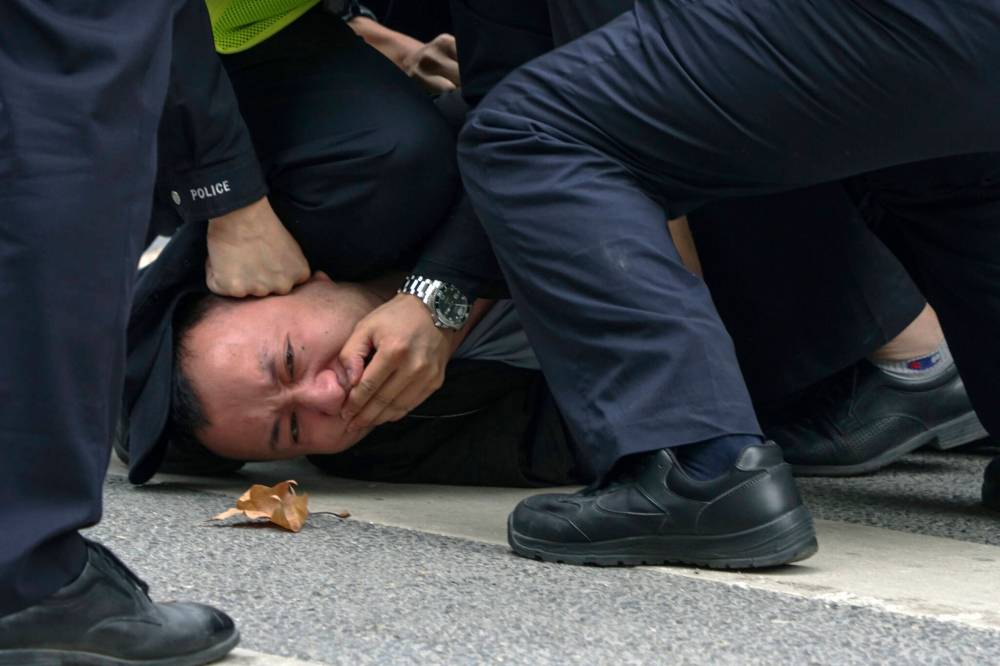
The Associated Press files
Police pin down a protester in Shanghai, China, on Nov. 27. Authorities eased anti-virus rules in scattered areas but affirmed China’s severe “zero-COVID” strategy after crowds demanded President Xi Jinping’s resignation.
“Absolute” power of the sort held by Xi and Khamenei is always a bit of a con game: no one man can compel the obedience of millions of others by sheer physical force. Others must help him to create a facade of omnipotence and invincibility, and they ultimately have a say in how to preserve it.
Even the millions have a say, in the sense that they must tacitly consent to be ruled, if only because they fear the consequences of defying the tyranny. If ever they run out of patience and lose that fear, the whole ramshackle edifice of power begins to shake. At that point, the enablers around the tyrant may start to panic.
They may first advocate a violent “crackdown” on the protesting public: Ayatollah Khamenei’s enforcers have been trying that for months, to no avail. Or, depending on how they assess the public mood, they may go straight to recommending major concessions to the popular demands.
Evidently, Xi or his advisers were spooked by some people chanting “Down with Xi Jinping” and “Down with the Communist Party” in the crowds that were protesting against COVID restrictions. As a result, practically all the COVID controls in place over the past three years have been abolished in less than a week.
This is not an orderly retreat to a prepared position. It is panic flight, and the consequences for the regime may be grave. As Siddharth Sridhar, a clinical virologist at the University of Hong Kong, told the BBC: “A big mistake right now would be to say omicron is harmless, now it’s time to open up.” But that’s exactly what the regime is doing.
It’s high time to end the incessant lockdowns in China, but the population is only partly vaccinated, with under-performing Chinese-made vaccines that have not been tested at all against the omicron variants of the COVID-19 virus. To end all controls in mid-winter, with the mass travel of Chinese New Year coming up next month, is just asking for it.
“It” is a wave of COVID infections that Bloomberg recently estimated could lead to 5.8 million cases requiring intensive care. That’s 15 cases for every ICU bed in China country, so COVID deaths could reach 1.5 million, according to an article in Nature Medicine earlier this year.
There was a right way to do this. First, import more effective mRNA vaccines and spend six months inoculating everybody up to at least two doses, while eliminating only the silliest restrictions on public movement. Then gradually remove the rest over another 12 months, to avoid mass deaths related to an overwhelmed health system.
That is what a well-managed retreat from an untenable position would look like. This is the polar opposite, and we’ll be lucky if Xi doesn’t embark on some rash military adventure to distract public opinion from his deteriorating domestic position.

Whereas the Iranian regime, despite all the violence, is showing a certain tactical skill in retreating from its own untenable position.
The current protests began with a young woman being beaten to death by the “morality police” for wearing her obligatory hijab (head-scarf) too loosely. Many women in the cities are now not wearing hijab at all, and getting away with it — and last month saw a (perhaps deliberately confusing) announcement that the morality police have been “suspended.”
This looks like managed retreat, even if the concession is untrue or only temporary. The Iranian regime has long experience in dealing with these waves of protest, and it has learned how to play the long game.
It could actually lose this time — the protests have lasted far longer than any previous ones — but you can at least discern a strategy behind the Islamic regime’s actions. In China, not so much.
Gwynne Dyer’s new book is The Shortest History of War.