

Will western tanks bring victory to Ukraine?
Advertisement
Read this article for free:
or
Already have an account? Log in here »
To continue reading, please subscribe:

Digital Subscription
One year of digital access for only $205*
- Enjoy unlimited reading on winnipegfreepress.com
- Read the E-Edition, our digital replica newspaper
- Access News Break, our award-winning app
- Play interactive puzzles
*First annual payment billed as $205.00 + GST for one year. This annual subscription will automatically renew at $233.00 + GST every 52 weeks (10% off the regular annual price of $259.35). Offer available to new and qualified returning subscribers only. Cancel any time.
To continue reading, please subscribe:
Add Free Press access to your Brandon Sun subscription for only an additional
$1 for the first 4 weeks*
- Enjoy unlimited reading on winnipegfreepress.com
- Read the E-Edition, our digital replica newspaper
- Access News Break, our award-winning app
- Play interactive puzzles
*Your next Brandon Sun subscription payment will increase by $1.00 and you will be charged $17.95 plus GST for four weeks. After four weeks, your payment will increase to $24.95 plus GST every four weeks.
Read unlimited articles for free today:
or
Already have an account? Log in here »
Hey there, time traveller!
This article was published 31/01/2023 (1324 days ago), so information in it may no longer be current.
Last Tuesday they reset the Doomsday Clock to 90 seconds before midnight. How did they know Germany would agree to give Leopard 2 tanks to Ukraine on Wednesday?
Now we’re all doomed! No time to run! Ninety seconds is barely time to tuck your head between your knees and kiss your rear goodbye.
The Doomsday Clock was thought up in 1947 by the Bulletin of the Atomic Scientists to dramatize the threat of nuclear war. They set it at seven minutes to midnight, and have been moving the minute hand back and forth every year since to tell us how close we were to a nuclear holocaust.
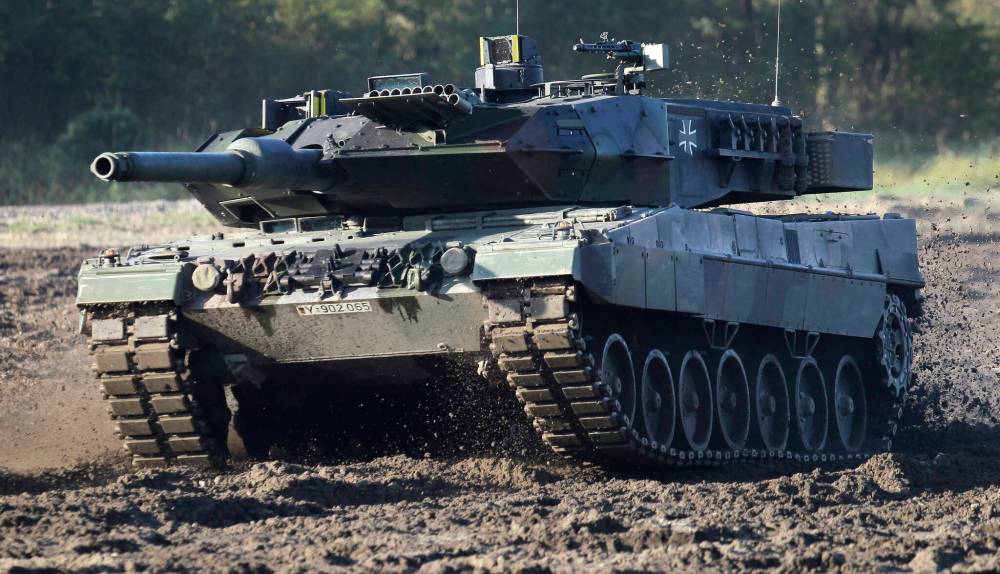
Germany has committed to sending 14 Leopard 2 tanks to Ukraine as part of an effort by western powers to support that country’s defensive military efforts. Other nations sending tanks include the U.S., Britain, Poland, Norway, Finland, Spain and Canada. (Michael Sohn / The Associated Press files)
It dropped to 17 minutes to midnight after the end of the Cold War and the collapse of the Soviet Union in 1991. Now it’s just a minute and a half — the closest it has ever been — but everything else is being affected by inflation now. Maybe it’s just catching.
The Russians are certainly not panicking at the prospect of Leopard tanks with Ukrainian crews showing up to confront them in eastern Ukraine in a month or two (or three). A couple of weeks ago, Moscow was hinting this could be the step that “forced” them to escalate to nuclear war, but that seems to have been just the usual bluff.
Now that the western tanks actually are coming — American M1 Abrams, British Challengers, Leopard 2s from Germany and up to half a dozen other NATO members, probably Leclercs from France — the Russians are playing it cool. Kremlin spokesman Dmitry Peskov said the new tanks “will burn like all the rest.”
Some of them will burn, of course: there’s no such thing as an invulnerable tank. But the current rate of exchange, with old Soviet tanks on both sides, is two- or three-to-one in favour of Ukraine, mainly because its crews are better trained and more committed. With better tanks than the Russians as well, the Ukrainian advantage will obviously widen.
The question is: will it widen enough for Ukraine to take back more Russian-occupied territory, and if so, how much? The new tanks are not wonder weapons, and the fact they will come in four different types is a logistical nightmare: different ammunition, different spare parts, even different fuel in the U.S. case.
There will also not be very many of them, at least in this round of donations. A “company” of tanks is 14 or thereabouts, and Germany, the United Kingdom and Poland will be sending one company each. Smaller countries such as Finland and the Czech Republic are unlikely to give more, and the United States is talking of about 30 M1s – two companies.
That means the total number of western tanks being given to Ukraine now is likely to be less than 100, whereas the Ukrainians have consistently said they need at least 300 to push the Russians back towards their own borders.
Over time they may be given more, but time does not work in Ukraine’s favour. The Ukrainians have roughly matched the Russian invaders in the numbers of troops deployed in Ukraine (because they had to), but that amounts to about four per cent of their population compared to only one per cent for the Russians.
The Russians can therefore afford to squander the lives of their troops (and often do), whereas the Ukrainians only attack when they are confident their casualties will be low. Both the recapture of Kharkiv province and the liberation of Kherson were accomplished last autumn with minimal loss of Ukrainian lives, but such opportunities do not abound.

The long-planned Ukrainian winter offensive may have been cancelled because a) the ground is still not frozen hard and b) the new tanks will be in the hands of trained Ukrainian crews by the spring. The great Russian winter offensive is underway right now, but getting very little notice because it is making so little progress.
Let’s assume for a moment the Ukrainians will wait till spring, that the new tanks make a difference, and that the Russians lose a lot more ground. Would that justify putting the Doomsday Clock ahead to 90 seconds to midnight?
“Winning” in Ukraine may be an existential matter for Russian dictator Vladimir Putin, who has staked his reputation and perhaps even his life on making a success of the invasion, but it’s not a life-or-death issue for the ambitious men around him. They certainly don’t want to die for him, together with their entire families.
So the NATO assessment that a Russian resort to nuclear weapons in Ukraine is most unlikely, which underpins the NATO decision on the tanks, is almost certainly correct. How much of their country the Ukrainians can recapture remains to be seen, but they are at least free to try.
Gwynne Dyer’s latest book is The Shortest History of War.