

‘Not looking for a new Cold War’
Advertisement
Read this article for free:
or
Already have an account? Log in here »
To continue reading, please subscribe:
Monthly Digital Subscription
$0 for the first 4 weeks*
- Enjoy unlimited reading on winnipegfreepress.com
- Read the E-Edition, our digital replica newspaper
- Access News Break, our award-winning app
- Play interactive puzzles
*No charge for 4 weeks then price increases to the regular rate of $19.95 plus GST every four weeks. Offer available to new and qualified returning subscribers only. Cancel any time.
Monthly Digital Subscription
$4.99/week*
- Enjoy unlimited reading on winnipegfreepress.com
- Read the E-Edition, our digital replica newspaper
- Access News Break, our award-winning app
- Play interactive puzzles
*Billed as $19.95 plus GST every four weeks. Cancel any time.
To continue reading, please subscribe:
Add Free Press access to your Brandon Sun subscription for only an additional
$1 for the first 4 weeks*
*Your next subscription payment will increase by $1.00 and you will be charged $16.99 plus GST for four weeks. After four weeks, your payment will increase to $23.99 plus GST every four weeks.
Read unlimited articles for free today:
or
Already have an account? Log in here »
Hey there, time traveller!
This article was published 17/02/2023 (1051 days ago), so information in it may no longer be current.
THE United States has been having “a bit of a floaty-bag problem over its airspace,” as South Africa’s Daily Maverick news site put it.
Indeed it has. Four balloons or other flying “objects” shot down by the U.S. air force over American or Canadian territory in eight days got everybody’s attention, and made the already fragile state of U.S.-Chinese relations a good deal worse. But it all turns out to be an innocent mistake. Sort of.
The first unknown flying object, a big Chinese balloon — 70 metres high, with an instrument payload the size of several buses — was obviously in the wrong place. It was clearly designed to gather “sigint” (signals intelligence), but flying it across the United States, even 20 kilometres up, was just asking for trouble. Are the Chinese really that stupid?
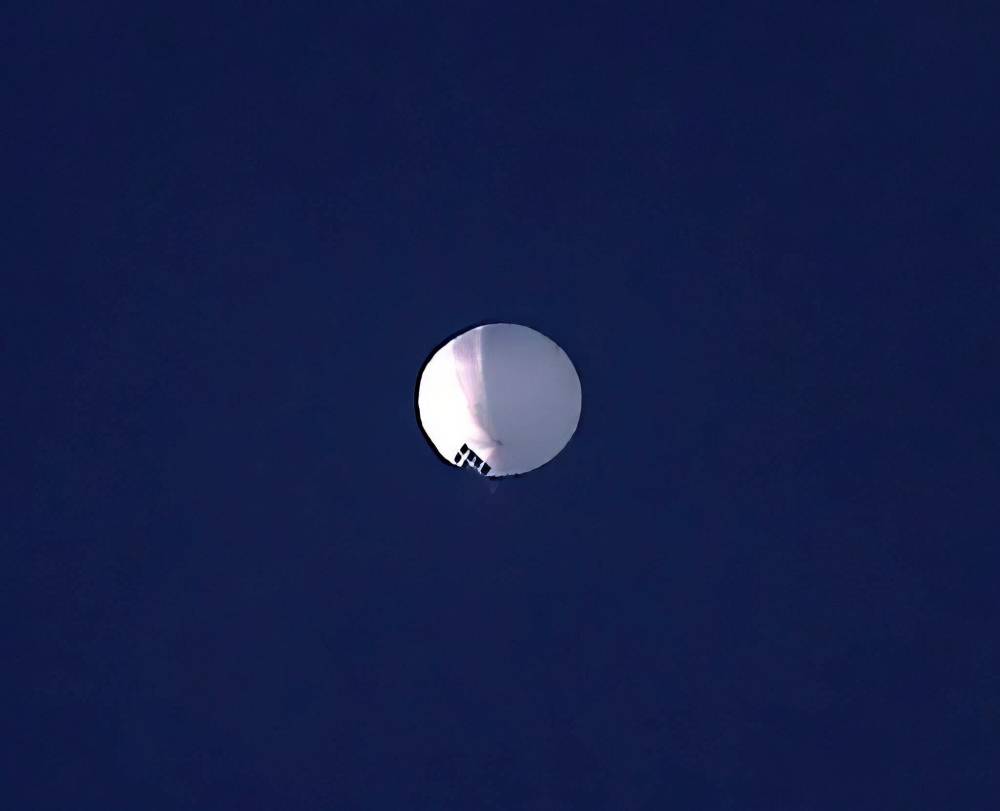
U.S. President Joe Biden order ordered the high-altitude balloon believed to be of Chinese origin to be shot down once it was safely over the Atlantic Ocean. (The Billings Gazette)
No, they aren’t. Mumbled explanations to the Washington Post by embarrassed American officials who must remain nameless have now revealed that the U.S. intelligence services saw the balloon launched from Hainan island off the southern Chinese coast in late January — and it was headed straight east for the U.S.-owned island of Guam.
Guam is the major U.S. air and naval base in the western Pacific, and an obvious target for a military reconnaissance balloon. National airspace only extends 12 nautical miles from a country’s coasts, so a steerable balloon could monitor all communications and other electronic emissions from an island like Guam without crossing the legal boundary.
The Chinese balloon had propellors and a rudder, so it was steerable within limits. China has actually sent balloons past Guam before, and the U.S. didn’t complain, because it does the same sort of thing with its own reconnaissance aircraft, skimming along the edge of Chinese airspace. It’s all part of the Great Game.
However, this time was different. On Jan. 24, when the balloon was passing directly south of Japan, it veered north and began speeding up. Exceptionally cold air over northern China and Japan had drawn the high-altitude jet stream south, and it scooped up the balloon, also high in the stratosphere, and carried it north and east across the Pacific.
The winds were too strong for the Chinese balloon’s limited propulsion system to counter, so on Jan. 28 it entered Alaskan airspace and continued east into Canada, where it was then blown south by more strong winds, entering U.S. airspace again over Montana.
At this point the Chinese also picked up a share of the blame, because when the now manageable wind took their balloon past the American missile fields in Montana, they stopped and hovered for a while to have a longer look and listen. Naughty, naughty.
The U.S. authorities were initially reluctant to shoot the balloon down, because they knew the whole story. But they wouldn’t say what they knew, because that would reveal U.S. surveillance capabilities, so the political pressure to “do something” grew. Finally President Biden gave the shoot-down order — waiting until the balloon was safely over the Atlantic.
So it’s just a simple story of everyday superpower folk getting it wrong, and apologies are due all round. But the Chinese won’t elaborate on their original story that it was just an errant weather balloon, and the U.S. won’t apologize at all. Like the four-year-olds they so often resemble, the Masters of the Universe find it almost impossible to make a real apology.
Meanwhile, what about the other three “objects” that were shot down? They were much smaller, and came in a variety of shapes and shades: “cylindrical, silver grey, with no sign of visible propulsion”; “a small, metallic balloon with a tethered payload below it”; “octagonal, with strings attached.”
They were shot down too, said John Kirby, the National Security Council co-ordinator for strategic communications, “out of an abundance of caution.” But on Tuesday he had to go out on the White House stage again and confess that those three had probably been completely harmless. “Benign,” as he put it.

“These could be balloons that were simply tied to commercial or research entities and therefore benign,” he said. In fact, this was the “leading explanation” under consideration. The “entities” involved will face very serious legal problems if they are ever identified, but we can consider the “floaty-bag problem” to be solved.
Was there any lasting damage? Yes, of course there was.
These incidents have held the U.S. media’s attention for more than an week. The details will quickly fade from the American public’s memory, but the impression will remain that somebody, and probably somebody Chinese, has been spying on them in their own homes.
This will not help in the task of calming the growing hostility between the world’s two greatest powers.
Gwynne Dyer’s new book is The Shortest History of War