

Shedding light on labour trafficking in Canada
Advertisement
Read this article for free:
or
Already have an account? Log in here »
To continue reading, please subscribe:

Digital Subscription
One year of digital access for only $205*
- Enjoy unlimited reading on winnipegfreepress.com
- Read the E-Edition, our digital replica newspaper
- Access News Break, our award-winning app
- Play interactive puzzles
*First annual payment billed as $205.00 + GST for one year. This annual subscription will automatically renew at $233.00 + GST every 52 weeks (10% off the regular annual price of $259.35). Offer available to new and qualified returning subscribers only. Cancel any time.
To continue reading, please subscribe:
Add Free Press access to your Brandon Sun subscription for only an additional
$1 for the first 4 weeks*
- Enjoy unlimited reading on winnipegfreepress.com
- Read the E-Edition, our digital replica newspaper
- Access News Break, our award-winning app
- Play interactive puzzles
*Your next Brandon Sun subscription payment will increase by $1.00 and you will be charged $17.95 plus GST for four weeks. After four weeks, your payment will increase to $24.95 plus GST every four weeks.
Read unlimited articles for free today:
or
Already have an account? Log in here »
Hey there, time traveller!
This article was published 22/02/2023 (1263 days ago), so information in it may no longer be current.
Many migrant workers expect the Canadian dream upon arriving in Canada: a welcoming land of opportunity with fair pay, safe accommodation and working conditions. While many have a favourable experience, it’s not equal opportunity for all.
Annually, hundreds of thousands of migrant workers come to Canada, prepared to work hard in jobs Canadians refuse to do. They leave the comfort of loved ones and communities to provide for their families. These migrant workers are essential to our economy.
While Canadians may think they are treated fairly, an increasing number, particularly those who grow and harvest our food, are not. Once in Canada, many face exploitation and labour trafficking, yet new research by the Canadian Centre to End Human Trafficking reveals more than half of Canadians (55 per cent) either don’t believe or don’t know this is a major Canadian issue.
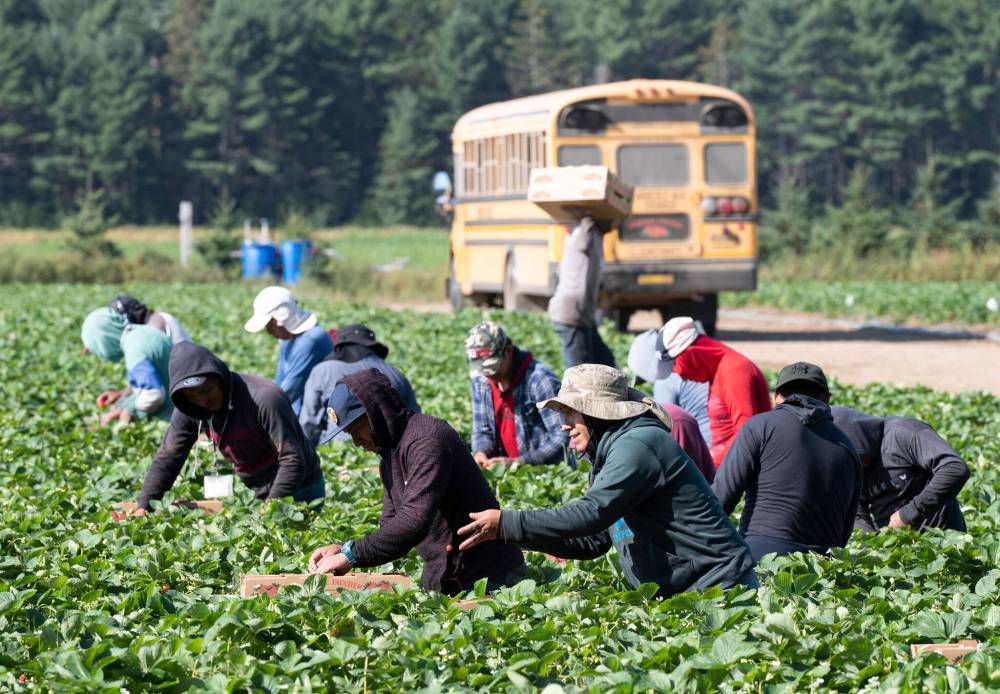
Jacques Boissinot / The Canadian Press files
Mexican and Guatemalan workers pick strawberries at a berry farm in Pont Rouge, Que.
Today marks National Human Trafficking Awareness Day, created to help increase awareness and understanding of this extreme human rights violation. Labour trafficking and exploitation are serious issues, often hiding in plain sight in Canadian hotels, restaurants, construction sites and farms. While anyone can be a victim, migrant workers are at higher risk, owing to precarious immigration status, isolation and language barriers. Agricultural workers are even more vulnerable, because they live and work in rural locations.
Many Canadians picture labour trafficking strictly as smuggling immigrants across borders; however, countless victims arrive through legitimate pathways and are exploited once here.
Experiences vary, but labour trafficking often includes false promises, intimidation and abuse, with migrants forced to work long hours under unsafe and poor working conditions for little or no money. Victims can feel trapped by illegitimate pay deductions and illegal practices, and can be forced to live in substandard housing.
In some cases, employers seize workers’ documentation and threaten migrants with deportation if they report their circumstances.
Victims often feel as if there’s nowhere to turn and do as they are told. Some are not aware that what they are experiencing is human trafficking, believing instead that their experiences are “normal.”
Those working on the ground to combat labour trafficking knew exploitation was occurring before the pandemic, yet few official steps were taken to address it. Now, Canada is dramatically increasing the number of migrant workers entering Canada through the Temporary Foreign Worker program, putting thousands more into a system that has already been shown to foster exploitation.
Migrants need better access to information. Not knowing their rights, who to trust or where to go for help are major barriers to change.
We are all affected by the treatment of migrant workers. The majority of workers who come to Canada come to work on our farms. They plant crops, tend to fields, and pick fruits and vegetables. They make it possible for you to “buy Canadian” at the grocery store.
The future of Canada’s food security rests on the backs of these migrant agricultural workers. They must be treated with dignity, fairness and respect.

The centre’s research reveals 93 per cent of Canadians support the fair treatment of migrant workers, yet 85 per cent don’t know how to make a difference if they suspect someone is experiencing labour trafficking. This lack of knowledge allows abuse to flourish and leaves migrant labourers susceptible to exploitation.
As a nation that wants to do the right thing and depends on these essential workers, we all need to do better.
We can make a difference by educating ourselves. Learn how to recognize the signs of exploitation, which include showing signs of fear and intimidation, having passports and ID documents confiscated, and being denied services such as health care by an employer. And most importantly, speak up! If you suspect something’s not right, share resources such as the Canadian Human Trafficking Hotline (1-833-900-1010 or via chat at canadianhumantraffickinghotline.ca) — a year-round, confidential and multilingual national service operating 24 hours per day.
This National Human Trafficking Awareness Day, I urge you to think about how we can step up, as a nation, to shed light on this important issue. And next time you’re at the grocery store picking out produce, consider how it got there.
Julia Drydyk is the executive director of the Canadian Centre to End Human Trafficking, a national charitable organization dedicated to ending human trafficking.