

UN climate report is clutching at straws
Advertisement
Read this article for free:
or
Already have an account? Log in here »
To continue reading, please subscribe:
Monthly Digital Subscription
$1 per week for 24 weeks*
- Enjoy unlimited reading on winnipegfreepress.com
- Read the E-Edition, our digital replica newspaper
- Access News Break, our award-winning app
- Play interactive puzzles
*Billed as $4.00 plus GST every four weeks. After 24 weeks, price increases to the regular rate of $19.95 plus GST every four weeks. Offer available to new and qualified returning subscribers only. Cancel any time.
Monthly Digital Subscription
$4.99/week*
- Enjoy unlimited reading on winnipegfreepress.com
- Read the E-Edition, our digital replica newspaper
- Access News Break, our award-winning app
- Play interactive puzzles
*Billed as $19.95 plus GST every four weeks. Cancel any time.
To continue reading, please subscribe:
Add Free Press access to your Brandon Sun subscription for only an additional
$1 for the first 4 weeks*
- Enjoy unlimited reading on winnipegfreepress.com
- Read the E-Edition, our digital replica newspaper
- Access News Break, our award-winning app
- Play interactive puzzles
*Your next Brandon Sun subscription payment will increase by $1.00 and you will be charged $17.95 plus GST for four weeks. After four weeks, your payment will increase to $24.95 plus GST every four weeks.
Read unlimited articles for free today:
or
Already have an account? Log in here »
Hey there, time traveller!
This article was published 25/03/2023 (1145 days ago), so information in it may no longer be current.
The final report of the United Nation’s climate body, the Intergovernmental Panel on Climate Change (IPCC), has come out at last. The desperate optimism that characterized the last few volumes (this is Part 4 of four) has frayed away to almost nothing.
UN Secretary-General Antonio Guterres bluntly called it a “survival guide.” But it’s not even that, really.
It lists all the things the world’s countries could and should be doing, but so did every previous report and most countries are still falling far short of the minimum requirement.
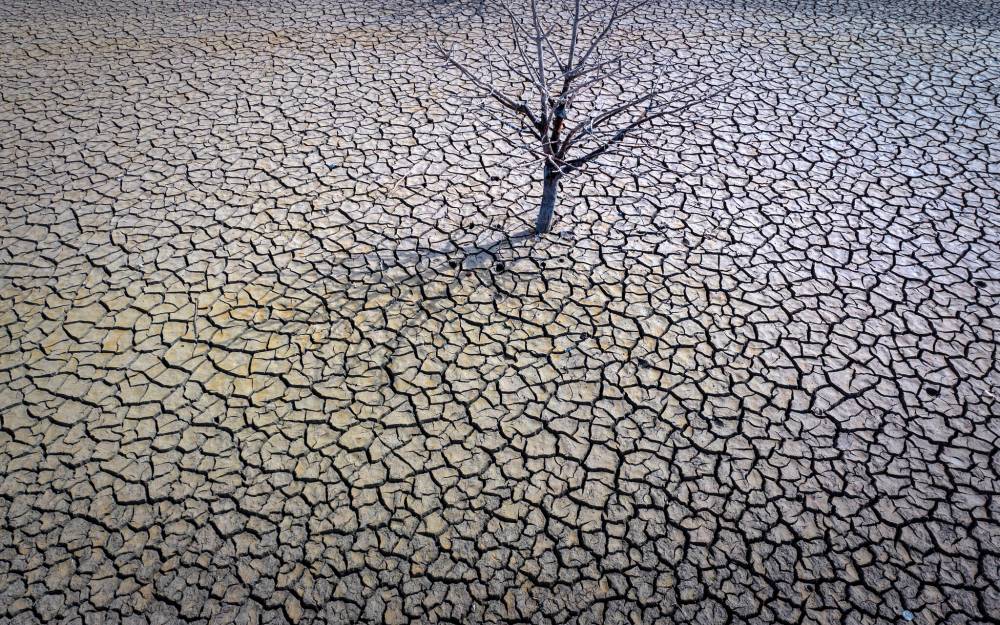
Climate change results in extreme weather events, such as the drought affecting the Sau reservoir in Spain. (Emilio Morenatti / The Associated Press files)
The report’s authors even admit the “aspirational” goal of never letting the average global temperature exceed 1.5 degrees Celcius higher than the pre-industrial level will definitely be missed. It was formally adopted by the IPCC only five years ago, but it’s already too late to stop the warming short of that benchmark.
“It has always been clear in the IPCC and in climate science that it’s not very likely that we will always stay below 1.5 degrees Celsius,” said Dr. Oliver Geden, who was on the report’s core writing group. Well, it was always clear to me, too, but I don’t remember the IPCC ever officially admitting it before last weekend.
The new buzzword is “overshoot,” as in “Yes, we’re going to overshoot 1.5 C for a while, but don’t despair. We’ll get back down below that level as fast as we can.’” Good luck with that.
They’re clutching at straws. The scientists pull their punches and sound positive because they have to keep the governments committed to the process. The governments can’t afford to get too far ahead of public opinion in their own home countries. And the last exits on the highway to hell are flashing by right now.
We already have all the technology, wealth and knowledge we would need to cut emissions fast now and stay below 1.5 C, but the political will is not there and even the IPCC now implicitly recognizes that. People aren’t yet suffering enough to give the issue their full attention.
By the mid-2030s, when we’re in “overshoot,” the political will and the sense of urgency will certainly be available, because wild weather of every sort will be hitting people hard. However, by then we will have left it so late that we will urgently need a technology that delivers results very fast and holds the heating down.
Carbon dioxide removal (CDR), also confusingly known as “negative emissions,” is the IPPC’s preferred “saviour” technology at the moment. It can theoretically pull huge amounts of greenhouse gases back out of the atmosphere and it may be a big part of the solution in the long run, but it cannot save us in the short run.
CDR is slow-acting and expensive; the very opposite of a quick fix. By all means, build some full-scale facilities to work the bugs out of the various proposed CDR processes, but unless there is a miraculous fall in emissions, the amount of CO2 in the air will commit us to breaking through the “never exceed” level by 2030.
Committing to it is not the same as actually experiencing it. There is always a lag between when you put a given volume of carbon dioxide into the atmosphere and when its full warming effect is felt. Let’s say that gives us another five years, but by 2035 the extra heat will probably be activating several of the more sensitive tipping points.

If we are really expecting the heating to rise past 1.5 degrees so soon, there is only one thing that can temporarily hold the heat down, avoid crossing tipping points, and enable us to keep on with the essential work of cutting emissions is geoengineering. It is solar radiation management (SRM).
Reflecting one or two per cent of incoming sunlight sounds dangerous and expensive, but it would actually be quite cheap, at least compared to the cost of CDR. Any intervention into the workings of the Earth system is bound to have some undesirable side effects, but so far no major showstoppers have been identified.
The IPCC is creeping towards a reluctant acceptance that SRM measures may be necessary, but like America in the alleged Winston Churchill quote, it will only do the right thing after it has exhausted all the alternative policies. It is forgetting that the research and hardware for any SRM technique will require at least 10 years before deployment.
A large number of big, well-funded research projects should be underway right now to confirm SRM’s potential and identify any risks, so that it is available to deploy by the mid-2030s if we need it (and it looks like we will). Yet any open-air research on it, even at the smallest scale, is still effectively banned. The Puritans still rule.
Gwynne Dyer’s new book is The Shortest History of War.