

Winners, losers and politics
Advertisement
Read this article for free:
or
Already have an account? Log in here »
To continue reading, please subscribe:

Digital Subscription
One year of digital access for only $205*
- Enjoy unlimited reading on winnipegfreepress.com
- Read the E-Edition, our digital replica newspaper
- Access News Break, our award-winning app
- Play interactive puzzles
*First annual payment billed as $205.00 + GST for one year. This annual subscription will automatically renew at $233.00 + GST every 52 weeks (10% off the regular annual price of $259.35). Offer available to new and qualified returning subscribers only. Cancel any time.
To continue reading, please subscribe:
Add Free Press access to your Brandon Sun subscription for only an additional
$1 for the first 4 weeks*
- Enjoy unlimited reading on winnipegfreepress.com
- Read the E-Edition, our digital replica newspaper
- Access News Break, our award-winning app
- Play interactive puzzles
*Your next Brandon Sun subscription payment will increase by $1.00 and you will be charged $17.95 plus GST for four weeks. After four weeks, your payment will increase to $24.95 plus GST every four weeks.
Read unlimited articles for free today:
or
Already have an account? Log in here »
Hey there, time traveller!
This article was published 25/04/2023 (1233 days ago), so information in it may no longer be current.
Playoffs in any sport generate intensity among both players and fans. Either you support the home team, or you don’t — close friendships can be paused until the playoffs are over, depending on how fierce that team loyalty might be.
After all, there are winner or losers. There is no third option. The winners take it all — there is no prize for the runners-up.
Psychologists make easy money commenting on the ferocity of such sports, as a throwback to the days when humans had to fight for their survival, or as satisfying some primeval combat urges that wars no longer provide to privileged populations.
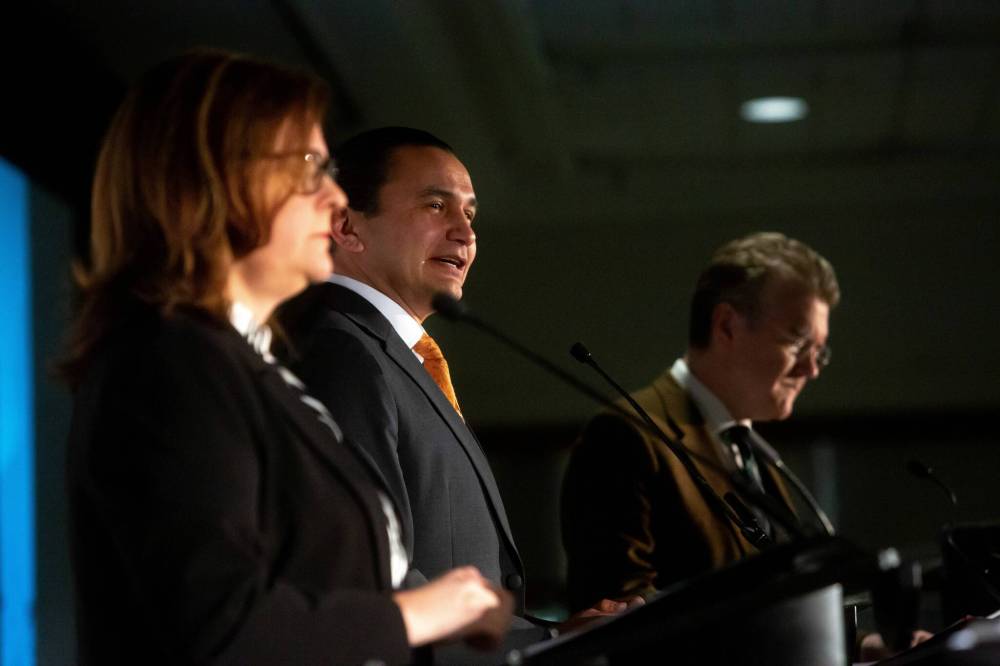
Mike Deal / Winnipeg Free Press Files
Opposition Leader Wab Kinew, speaks during the AMM leaders forum April 4. (From left) Premier Heather Stefanson, Opposition Leader Wab Kinew, and MB Liberal Leader, Dugald Lamont.
In 21st-century politics, however, as we struggle with the existential survival issues that the climate crisis presents, we need that third option. We are running out of time. Continuing the current binary language of “winners or losers” in our election campaigning will lead to disaster for everyone.
It is easier to think of politics in binary terms. Black or white. On or off. In fact, you could argue that older generations have been groomed to see the world in this binary way. Better dead than Red, during that Cold War between us and Them. Axis or Allies. Capitalists or Communists. Democratic or totalitarian. Male or female.
Political parties that want to capitalize on this binary world view, this duality between good guys and bad guys, accordingly play to their base among the older generations. There is a built-in cultural soundtrack that urges the importance of winning, and your need to make individual sacrifices “for the sake of the team.” There are winners and losers — why would you want to be a loser in the game of politics, unless you were already a loser in the game of life?
If the health of democracies is measured by the number of people engaged in the political process, however, then it is on life-support, here and elsewhere. Voter turnout continues to plummet.
Generationally, this is even more of a problem for people under 40. Senior citizens (still) will risk their life and health to go out to vote, whereas many younger people won’t even get out of bed to mark a ballot.
Not voting for a candidate, however mediocre, is actually voting against the democratic system, however. As the numbers of non-voters grows, so does the potential for addressing the social and economic problems of our time in other ways than through democratic elections.
Populist movements (on the far-right, especially) are gaining strength everywhere. In these movements, you are not expected to think; you simply need to raise your fist in the air, shout (or honk) loudly when the leader calls for it, and accept whatever their message happens to be at the moment. It’s a fight, and you have to do whatever you are told it takes so that your team can win.
Here in Manitoba, we are apparently headed into a “honk and shout” election campaign like this. When the first real “scrum” takes place between NDP leader Wab Kinew and Minister of Sport ex-football player Obby Khan, it doesn’t require much imagination to see what lies ahead.
Nor is it a surprise to learn the Progressive Conservative slogan will be “Fighting for Manitobans.” With a slight word change, that conflictual slogan accurately depicts what the Pallister/Stefanson government has contributed to Manitoba politics for the last seven years:
Their slogan instead, however, should be “Fighting with Manitobans.”
On a good day, Brian Pallister was merely combative about everything; on other days, his goal seemed to be to pick a fight with as many Manitobans as he could, preferably those whom he could run over without much opposition. He needed to win, always.

So, the PCs declared war on those young Manitobans who either stayed home or voted for the bad guys. The tax breaks (for tuition) that post-secondary graduates enjoyed, as a way of keeping them in Manitoba, were removed immediately. Collective bargaining was attacked at every opportunity. Post-secondary education funding was cut, and threats were made to favour political outcomes, instead of good education. Cut public school funding, too.
Environmental sustainability and the climate crisis? Trees don’t vote. Neither do future generations.
Health care? I haven’t the words to describe that ongoing trauma, but dead people don’t vote, either.
Call me radical or naïve, but what if politicians worked together for all Manitobans, instead of trying to win the political playoffs? A non-binary outcome, a coalition for the planet, instead of claiming some meaningless political “win”?
Peter Denton is an activist, writer and teacher, based in rural Manitoba.