

Crucial diagnostic equipment sits idle
Advertisement
Read this article for free:
or
Already have an account? Log in here »
To continue reading, please subscribe:
Digital Subscription
One year of digital access for only $1.44 a week*
- Enjoy unlimited reading on winnipegfreepress.com
- Read the E-Edition, our digital replica newspaper
- Access News Break, our award-winning app
- Play interactive puzzles
*Billed as $5.77 plus GST every four weeks. After 52 weeks, price increases to the regular rate of $19.95 plus GST every four weeks. Offer available to new and qualified returning subscribers only. Cancel any time.
To continue reading, please subscribe:
Add Free Press access to your Brandon Sun subscription for only an additional
$1 for the first 4 weeks*
- Enjoy unlimited reading on winnipegfreepress.com
- Read the E-Edition, our digital replica newspaper
- Access News Break, our award-winning app
- Play interactive puzzles
*Your next Brandon Sun subscription payment will increase by $1.00 and you will be charged $17.95 plus GST for four weeks. After four weeks, your payment will increase to $24.95 plus GST every four weeks.
Read unlimited articles for free today:
or
Already have an account? Log in here »
Hey there, time traveller!
This article was published 05/05/2023 (1267 days ago), so information in it may no longer be current.
No excuse can justify why a badly needed — and expensive — machine used to detect and analyze cancer has been sitting idle next door to Winnipeg’s Health Sciences Centre since it was installed four months ago.
The hospital invested about $3 million to buy this valuable piece of equipment but has not hired staff to run it. And it has burned up four months of the scanner’s warranty while it sits idle, costing Manitobans a full-service agreement equivalent of up to $100,000.
The machine is a PET/CT (positron emission tomography/computed tomography) scanner, which was installed last December in the John Buhler Research Centre next to Health Sciences Centre.
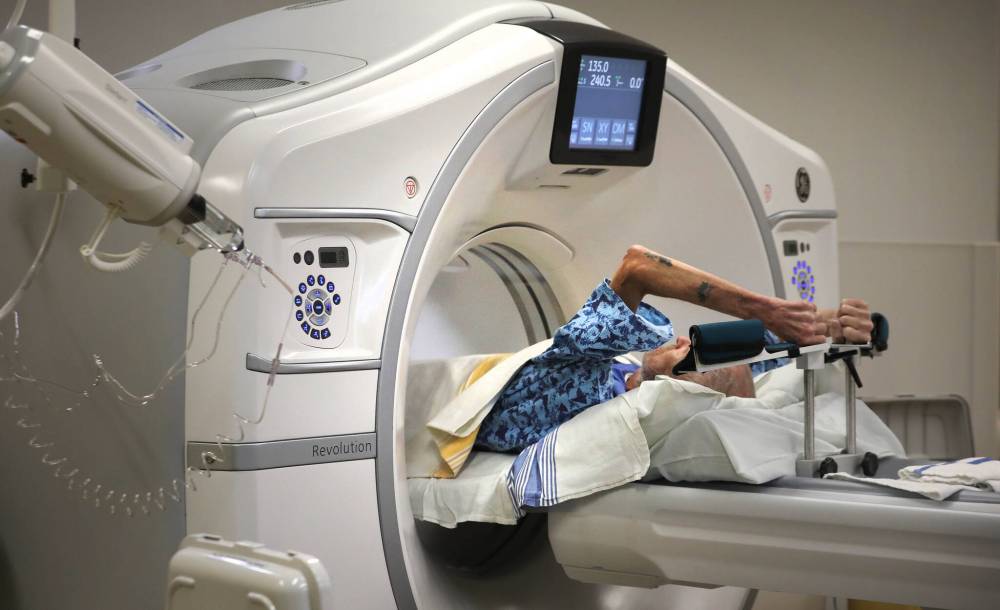
RUTH BONNEVILLE / WINNIPEG FREE PRESS Files
A patient is prepped to receive a CT scan at Misericordia Health Centre in April 2019. Diagnostic scanning equipment needs to be staffed; a PET/CT scanner at Health Sciences Centre has been sitting idle for months, writes Sandor Demeter.
For the sake of patient care, and as one of the physicians who established the Winnipeg PET/CT program, I feel compelled to dispel the smoke screen of ambiguity that is being spread by those who should be held accountable for this debacle.
PET/CT scanning is life-changing technology, a special form of nuclear medicine imaging that uses trace amounts of injectable radiotracers, such as radioactive sugar, to detect cancer. It helps determine if cancer is present, how far it has spread (staging), if it has responded to therapy or if it has returned.
PET/CT scanning is the standard of care for many types of cancer, helping doctors decide what treatment to pursue — whether it be surgery, chemotherapy or radiation therapy.
There have been three PET/CT scanners in Winnipeg.
The first PET/CT scanner was installed more than 18 years ago next door to Health Sciences Centre in the University of Manitoba’s John Buhler Research Centre. The first patient was scanned in July 2005.
In 2020 a second PET/CT scanner was installed, on the first floor of Health Sciences Centre, to replace the original scanner.
Patient volumes rose from 1,981 scans in 2017-18 to 2,456 scans in 2022-23, according to Shared Health.
Demand for PET/CT continues to grow and more patients cannot be scanned on one scanner and with current staffing resources.
The third PET/CT scanner replaced the original John Buhler scanner in December 2022 and was ready to image patients by January 2023.
At that point, Winnipeg had two PET/CT scanners available for patient care.
Staff recruitment should have started weeks, if not months, before the new John Buhler scanner was installed. But the hospital, which had invested almost $3 million on this valuable piece of equipment, has yet to hire staff to run it.
“Staffing recruitment efforts for three nuclear medicine positions and administrative support is underway,” according to a Shared Health spokesperson.
Part of Health Science Centre’s mantra is “Patients First: Your care is our priority.”
What part of having a PET/CT scanner sit idle for more than four months is “patients first”?
In addition, Shared Health has squandered scarce health-care resources by leaving the new scanner to sit idle.
The full-warranty period for PET/CT scanners is usually one year. After that, either in-house repair services, which are becoming scarce, or a vendor service agreement is used.
Vendor full-service agreements are not cheap. They usually cost about 10 per cent of the initial purchase price. Using a ballpark purchase price of $3 million, a full warranty would cost Shared Health approximately $300,000 a year. Burning up four months of full warranty while the scanner sat idle cost Manitobans the equivalent of about $100,000.
When asked to comment on whether cancer patients were being negatively impacted by growing demand for PET/CT services, CancerCare Manitoba responded: “Your request for information has been forward to Shared Health as they are in the best position to answer your questions.”
It is bizarre that CancerCare Manitoba would reroute the question to Shared Health.
CancerCare Manitoba is a separate entity from Shared Health and part of its mandate is to provide quality care to cancer patients. By not commenting, CancerCare Manitoba is avoiding the question and, perhaps, avoiding being transparent about how limited PET/CT services are impacting cancer patients.
As for wait times, “While wait times will vary depending on the reason a scan was requested and how an individual patient’s case is prioritized, most scans occur within five weeks. Elective scans may take longer, with safe alternatives explored in many cases to ensure patients get the care they need in a timely manner,” according to a Shared Health spokesperson.
However, the devil is in the details. If you have a new diagnosis of lymphoma and require a standard-of-care baseline PET/CT scan, you don’t want to wait up to five weeks before starting therapy. In fact, you may start therapy without the baseline scan, which is less than ideal.

Upon general inquiry the Winnipeg PET/CT centre stated that urgent PET/CT slots are available but, as of May 1, there were only three such slots available for the rest of the month.
New PET/CT radiotracers are becoming available and the next slot for those with rare neuroendocrine tumors is August 2023.
And if you are being worked up for early dementia, the next brain PET/CT slot is in 2024. Yes, 2024.
Shared Health needs to be held accountable for botched program planning, wasting valuable health-care resources and not putting “patients first.”
Dr. Sandor Demeter is a Winnipeg physician, an associate professor in the department of community health sciences at the University of Manitoba and a former fellow in the Dalla Lana School of Public Health Global Journalism program at the University of Toronto.
Related Articles
More than 1,700 surgeries cancelled in city after pandemic restrictions lifted, NDP says


Advertisement Advertise With Us
Advertisement Advertise With Us