

The Red River Métis will defend their rights
Advertisement
Read this article for free:
or
Already have an account? Log in here »
To continue reading, please subscribe:

Digital Subscription
One year of digital access for only $205*
- Enjoy unlimited reading on winnipegfreepress.com
- Read the E-Edition, our digital replica newspaper
- Access News Break, our award-winning app
- Play interactive puzzles
*First annual payment billed as $205.00 + GST for one year. This annual subscription will automatically renew at $233.00 + GST every 52 weeks (10% off the regular annual price of $259.35). Offer available to new and qualified returning subscribers only. Cancel any time.
To continue reading, please subscribe:
Add Free Press access to your Brandon Sun subscription for only an additional
$1 for the first 4 weeks*
- Enjoy unlimited reading on winnipegfreepress.com
- Read the E-Edition, our digital replica newspaper
- Access News Break, our award-winning app
- Play interactive puzzles
*Your next Brandon Sun subscription payment will increase by $1.00 and you will be charged $17.95 plus GST for four weeks. After four weeks, your payment will increase to $24.95 plus GST every four weeks.
Read unlimited articles for free today:
or
Already have an account? Log in here »
Hey there, time traveller!
This article was published 03/06/2023 (1211 days ago), so information in it may no longer be current.
In a May 8, 2023 press release, the Assembly of Manitoba Chiefs (AMC) expressed support for the First Nations of the Wabun Tribal Council in their judicial review of the federal government’s decision to enter a Métis Government Recognition and Self-Government Agreement with Métis Nation of Ontario.
The territory in question, in northeastern Ontario, lies far beyond the territory in which the Red River Métis originated, and the alleged “Métis” group in question has never been a part of the Red River Métis.
The Manitoba Métis Federation (MMF) — the National Government of the Red River Métis — has publicly opposed the appropriation of our cultural identity, history, and symbols, by groups with whom we have no historical or contemporary connection.
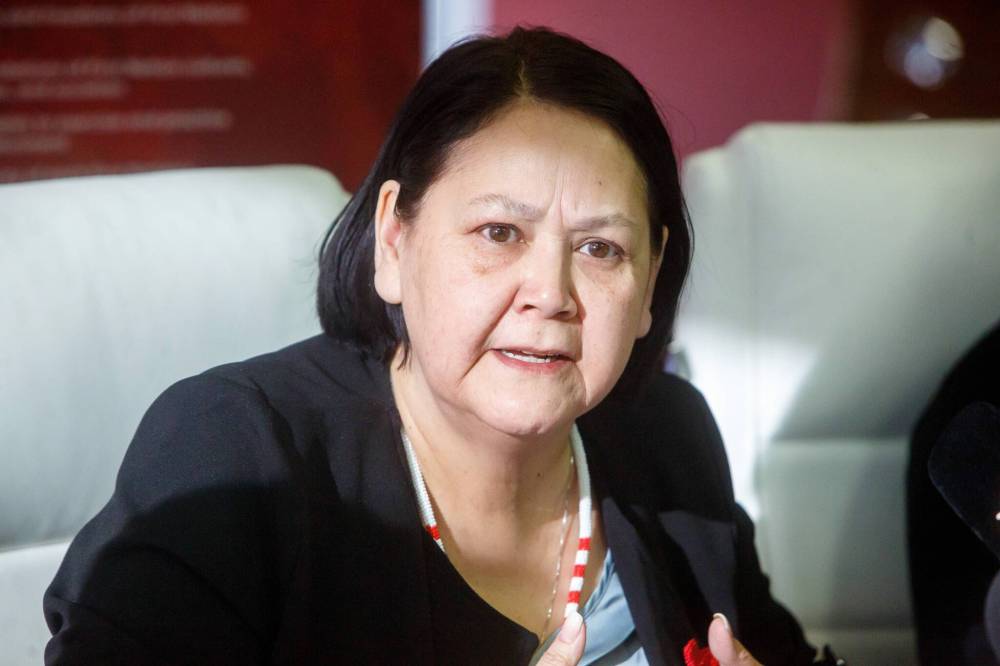
MIKE DEAL / WINNIPEG FREE PRESS FILES
Assembly of Manitoba Chiefs (AMC) Grand Chief Cathy Merrick.
Unfortunately, in expressing support for the Wabun First Nations, AMC Grand Chief Cathy Merrick makes incorrect and unnecessary statements about Métis in Manitoba. After voicing concern that the “Historic Métis Homeland” includes Manitoba, AMC incorrectly states: “The Métis claim to territory or homeland is relatively new, benefiting from the concept of the Doctrine of Discovery, and lacks the historical significance that First Nations share with the land.”
The AMC statement complains that by recognizing the “Historic Métis Homeland,” Canada creates further grounds to justify consulting with the Métis before providing additional lands to First Nations to fulfil unsatisfied treaty obligations. Canada has already recognized its legal requirement to consult with the Red River Métis before additional lands are transferred to First Nations. While AMC may not like this, it cannot deny that the Red River Métis have section 35 rights and have used and continue to use the same lands as many First Nations.
If Grand Chief Merrick suggests the Red River Métis do not have Indigenous rights or territory in Manitoba, and elsewhere, she is simply incorrect. We have occupied our territory long before Europeans established effective legal control. Such control did not occur until after 1870.
The Red River Métis’ territorial possession and establishment of self-governing institutions began with the emergence of the “nouvelle nation,” or “New Nation,” in the late 18th century.
Our self-determination and rights to the land have nothing whatsoever to do with the Doctrine of Discovery.
To the contrary, the Red River Métis have consistently asserted and protected our rights to land and identity as a distinct and self-governing Indigenous people. This reality underlay the unveiling of our national flag, the 1816 Battle of Seven Oaks — known to the Métis as la Victoire de la Grenouillère — and the 1849 Sayer Trial.
In 1869, in the face of the proposed transfer of our Homeland to Canada, and the prospect of being swamped by the influx of non-Indigenous newcomers, the Red River Métis took power and established the National Committee of the Red River Métis or le Comité national des Métis de la Rivière-Rouge which led to the provisional government in 1869 under the leadership of Louis Riel.
In 2013, the Supreme Court of Canada ruled in MMF v Canada that “To resolve the conflict and assure peaceful annexation of the territory, the Canadian government entered into negotiations with representatives of the Métis-led provisional government of the territory. The result was the Manitoba Act, 1870, which made Manitoba a province of Canada”.
The negotiations resulted in our treaty expressed, in part, in the Manitoba Act which received royal assent on May 12, 1870. This provided the basis for our Red River Métis traditional homeland, the historic Northwest, to become part of Canada. On the other hand, the first treaty with First Nations in Manitoba, Treaty One, was entered into more than one year later in August 1871.
The Red River Métis’ tradition is one of respecting First Nations, while at the same time insisting our own rights also be respected. Indeed, our List of Rights, used as the foundation for our treaty negotiations with Canada, included the requirement that Canada enter into treaties with the First Nations of the territory.
Grand Chief Merrick is similarly incorrect in suggesting that Manitoba First Nations would need to be consulted before a self-government agreement is entered into with MMF on behalf of the Red River Métis.

On July 6, 2021 the MMF and the Crown in right of Canada entered into the Manitoba Métis Self-Government Recognition and Implementation Agreement under which Canada recognized, among other things, that the MMF is already the democratic representative government of the Manitoba Métis, also known as the Red River Métis, and has the responsibility for providing responsible and accountable self-government.
Canada also recognized MMF jurisdiction in respect of key areas of governance, such as citizenship, selection of representatives, structures and procedures, and accountability. Mechanisms for future negotiations and agreements about other areas of jurisdiction are included. The Agreement expressly provides that it does not affect any Aboriginal or treaty rights of other Indigenous peoples.
In accordance with the Agreement, MMF and Canada have been negotiating a treaty, which will include the provisions of the agreement, adapted as agreed, and addressing a number of specified matters. Our treaty is close to conclusion. It includes provisions to ensure the Aboriginal and treaty rights of other Indigenous peoples will not be affected.
AMC need not be troubled that First Nations have not been consulted about the Red River Métis’ Self-Government Agreement or the forthcoming treaty. It will not adversely affect their treaty rights and, in any event, the existence of the Red River Métis as a self-determining and self-governing Indigenous people has been an established fact for over 200 years despite all historic and contemporary efforts to deny or suppress it.
Allan D. Benoit is chief of staff of MMF — the national government of the Red River Métis.