

Russia: what just happened?
Advertisement
Read this article for free:
or
Already have an account? Log in here »
To continue reading, please subscribe:

Digital Subscription
One year of digital access for only $205*
- Enjoy unlimited reading on winnipegfreepress.com
- Read the E-Edition, our digital replica newspaper
- Access News Break, our award-winning app
- Play interactive puzzles
*First annual payment billed as $205.00 + GST for one year. This annual subscription will automatically renew at $233.00 + GST every 52 weeks (10% off the regular annual price of $259.35). Offer available to new and qualified returning subscribers only. Cancel any time.
To continue reading, please subscribe:
Add Free Press access to your Brandon Sun subscription for only an additional
$1 for the first 4 weeks*
- Enjoy unlimited reading on winnipegfreepress.com
- Read the E-Edition, our digital replica newspaper
- Access News Break, our award-winning app
- Play interactive puzzles
*Your next Brandon Sun subscription payment will increase by $1.00 and you will be charged $17.95 plus GST for four weeks. After four weeks, your payment will increase to $24.95 plus GST every four weeks.
Read unlimited articles for free today:
or
Already have an account? Log in here »
Hey there, time traveller!
This article was published 27/06/2023 (1161 days ago), so information in it may no longer be current.
Up until late afternoon Moscow time on Saturday, Russia was in a state of acute crisis, with Yevgeny Prigozhin pulling his Wagner army of mercenary soldiers out of Ukraine and sending some of them racing up the highway towards Moscow instead. Their task was to force Russia’s military leadership to quit for corruption and incompetence.
Machines were digging tank traps across the main roads on the outskirts of Moscow, protected by machine-gun emplacements, and the population was being told to stay home. Several Russian air force helicopters that tried to attack the Wagner convoy coming up the M4 were shot down over the course of the day.
Putin had already been on national television Saturday morning denouncing the “traitors” in the strongest terms. “All those who consciously chose the path of betrayal… will suffer an inevitable punishment,” he vowed — but 12 hours later he cut a deal that involved no punishment whatever.
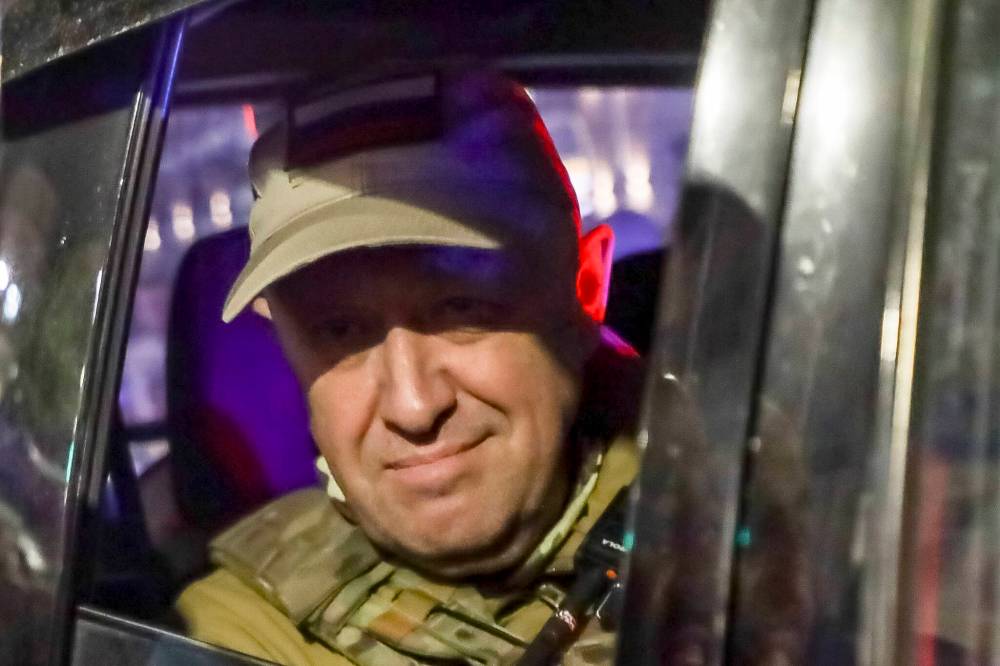
Yevgeny Prigozhin, the owner of the Wagner Group military company, looks out from a military vehicle on a street in Rostov-on-Don, Russia, on June 24. (The Associated Press)
Or rather, Aleksandr Lukashenko, the president of Belarus and Europe’s longest-ruling dictator, announced that he had cut a deal in which Prigozhin would order all the Wagner troops to return to their bases and then go into exile himself in Belarus. Both Prigozhin and his 25,000-odd Wagner soldiers would get an amnesty: nobody would be punished.
The only explanation Prigozhin offered for his about-turn was that he didn’t want to shed “Russian blood.” That seems unlikely, given that he has already said (a) that 20,000 Wagner fighters were killed in the battle of Bakhmut, and (b) that he knows the invasion of Ukraine was justified on entirely false pretenses.
So the prospect of a few more Russian deaths to rid the country of the two men he blames for both provoking and bungling the war in Ukraine, Defence Minister Sergei Shoigu and Chief of Defence Staff Valery Gerasimov, seems unlikely to have made him change his mind at the last moment. Maybe there was some other calculation in play, but what was it?
Hundreds of analysts in a dozen countries are working on that mystery right now because Russia is still an important place, and Putin’s power has clearly been damaged by this bizarre incident.
At the very least, the lack of popular resistance to Prigozhin’s attempted coup (if that’s what it was) is deeply worrying for Putin. The populations of the Russian cities that the Wagner troops occupied, Rostov-on-Don and Voronezh, were generally welcoming to them, and even applauded and cheered as they pulled out again on Sunday.
And why on Earth did Putin let the tinpot Belarusian dictator Lukashenko do his negotiating with Prigozhin for him? It makes Putin look even weaker, when the appearance of strength is a dictator’s most important asset.
I realize that I’m asking questions here and not providing answers, but it’s at least clear that there’s a lot more going on within the Russian elite than is visible to outsiders. Loyalties and expectations are shifting, and even the “window of opportunity” that the Ukrainian leaders have been hoping for may open some time soon.
In the meantime, consider this: Yevgeny Prigozhin put a spray of angry messages up on Telegram during the crisis, and one in particular will circulate and resonate among the younger Russians whose lives the war in Ukraine is blighting. Prigozhin’s people have been fighting in the Donbas since 2014, and he knows where the bodies are buried.

“We were hitting (the Ukrainians), and they were hitting us. That’s how it went on for those eight long years, from 2014 to 2022. Sometimes the number of skirmishes would increase, sometimes decrease.
“On 24 February (2022, the day of the invasion), there was nothing extraordinary happening in Ukraine. Now the Ministry of Defence is trying to deceive the public, deceive the president and tell a story that there was some crazy aggression by Ukraine; that — together with the whole NATO bloc — Ukraine was planning to attack us.
“The war was needed so that Shoigu could (get a promotion). The war wasn’t for ‘demilitarising’ or ‘de-nazifying’ Ukraine. It was needed for an extra star.”
One should add that it was also needed as Putin’s legacy project (reuniting at least the Slavic bits of the old Soviet Union), but you wouldn’t expect Yevgeny Prigozhin to get into that.
Gwynne Dyer’s new book is The Shortest History of War.