

Politically possible doesn’t mean acceptable
Advertisement
Read this article for free:
or
Already have an account? Log in here »
To continue reading, please subscribe:
Monthly Digital Subscription
$1 per week for 24 weeks*
- Enjoy unlimited reading on winnipegfreepress.com
- Read the E-Edition, our digital replica newspaper
- Access News Break, our award-winning app
- Play interactive puzzles
*Billed as $4.00 plus GST every four weeks. After 24 weeks, price increases to the regular rate of $19.95 plus GST every four weeks. Offer available to new and qualified returning subscribers only. Cancel any time.
Monthly Digital Subscription
$4.99/week*
- Enjoy unlimited reading on winnipegfreepress.com
- Read the E-Edition, our digital replica newspaper
- Access News Break, our award-winning app
- Play interactive puzzles
*Billed as $19.95 plus GST every four weeks. Cancel any time.
To continue reading, please subscribe:
Add Free Press access to your Brandon Sun subscription for only an additional
$1 for the first 4 weeks*
*Your next subscription payment will increase by $1.00 and you will be charged $16.99 plus GST for four weeks. After four weeks, your payment will increase to $23.99 plus GST every four weeks.
Read unlimited articles for free today:
or
Already have an account? Log in here »
Hey there, time traveller!
This article was published 21/07/2023 (1004 days ago), so information in it may no longer be current.
For some time now, the standing of the federal parties has been fairly stable. Pierre Poilievre’s Conservatives are ahead of Prime Minister Justin Trudeau’s Liberals in the polls. But, because of the way the parties’ votes are distributed across the country, the actual result of the upcoming election could be quite close, with Poilievre or Trudeau scoring only a slight lead in seats.
Of course, campaigns matter, and events may see Poilievre or Trudeau take a firm lead before the next election. But, if the polls don’t change significantly, the results of the next federal election might present a significant challenge to our electoral institutions.
This is because there is a chance the Conservatives will win the highest number of seats on election night but still not form a government. Trudeau might well turn to Jagmeet Singh and the NDP — which has propped up the current Liberal minority government — to keep him in the prime minister’s office.
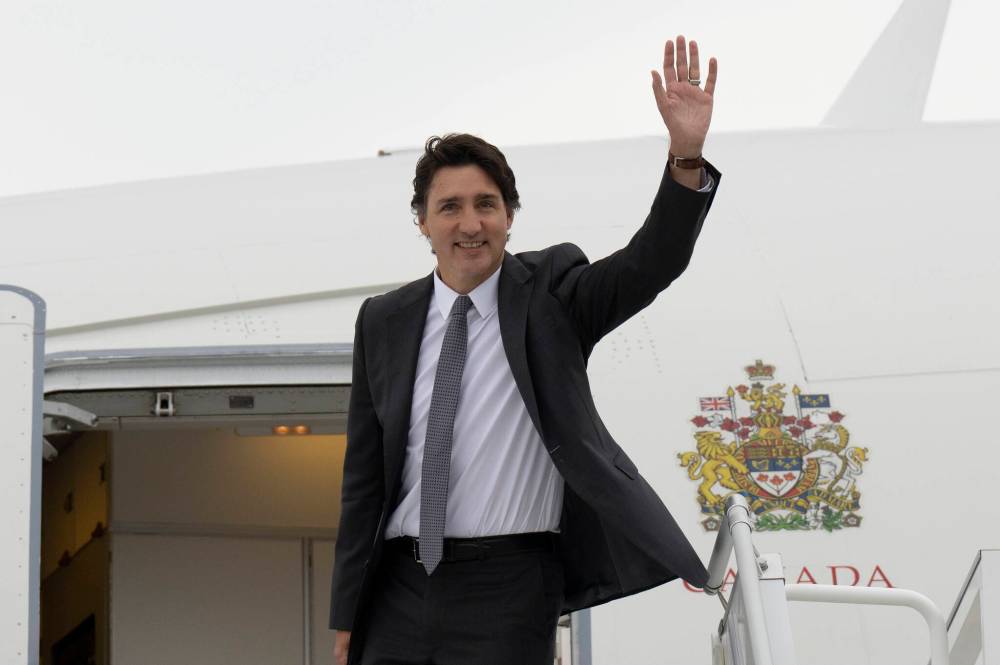
Adrian Wyld / The Canadian Press
Just because Justin Trudeau could find a way to hold on to power after coming second in a federal election, doesn’t mean he should.
Adrian Wyld / The Canadian Press
Just because Justin Trudeau could find a way to hold on to power after coming second in a federal election, doesn’t mean he should.
If the combined number of Liberal and NDP MPs exceeds the Conservative count, this ploy could potentially be successful. This is because Trudeau could convince the Governor General that the Liberal-NDP tag-team has a better chance than the Conservatives at maintaining the confidence of the House of Commons.
When this possibility broke out among Canada’s chattering classes over the past two weeks, political scientists were quick to argue that such a manoeuvre would be constitutionally sound, and that there was some historical precedent for it.
In fact, there have been hundreds of federal and provincial elections throughout Canadian history, but we have seen this manoeuvre only a handful of times. In 1985, for example, the Ontario Liberals won four fewer seats than the governing Tories, but teamed up with the NDP to seize power.
More recently: the 2017 British Columbia election resulted in 43 seats for the BC Liberals, 41 for the NDP, and three for the Greens. Despite coming in second, NDP leader John Horgan became premier with the support of the Greens.
The vast majority of the time throughout Canadian history, the party with the most seats following an election has formed a government.
But there is one inauspicious example of when second-place finishers have tried to form government.
In 2008, the Liberals, NDP, and Bloc Quebecois came together to defeat Stephen Harper’s Conservative minority government and replace him as prime minister with then-Liberal Leader Stephane Dion. Harper controversially prorogued the House of Commons to short-circuit the threat. While the opposition leaders could have waited for the House to reconvene to defeat Harper, the Liberal-NDP-Bloc grand coalition instead fell apart before they could take power.
It was clear the opposition leaders had not considered how their actions would be construed as an undemocratic usurpation of the results of the last election which Harper had won, fair and square. Petrified by public opinion and browbeaten by the Conservatives who condemned the “coalition of losers” and argued Dion had no democratic mandate to become prime minister, the opposition leaders cut bait and Harper survived.
So there are rules, and then there is politics. Could Trudeau cling to power with the support of the NDP after the next election, even if Poilievre wins the most seats? Formally speaking, yes.
But should he? In Canada, there is a clear democratic understanding that the party that wins the most seats should get a chance to form a government. If you don’t believe me, do an experiment: walk up to 10 random people on the street and ask whether they agree or disagree with that statement. I guarantee a majority will agree.

So Trudeau might hold on to power by citing constitutional conventions and historical precedents. While he could convince constitutional scholars with these arguments, it is likely Trudeau would have a tougher time convincing regular Canadians that he should remain in power despite coming in second place behind another party.
Indeed, Trudeau would be swimming against mighty democratic currents in trying to re-establish his legitimacy as prime minister after such a manoeuvre. There is a possibility we would see mass protests as Canadians took to the streets to condemn what they would view as a democratically illegitimate government clinging to power despite an election loss.
And, in holding on to power for the short term, Trudeau might be relegating his party to a wipeout in the subsequent election when Canadians have an opportunity to cast judgment on his actions.
As Reese Bobby told his son Ricky in the Will Ferrell NASCAR comedy Talladega Nights, “if you ain’t first, you’re last.” That’s not formally true for the results of Canadian elections. But, democratically-speaking, it might well be the new reality that politicians need to recognize for the good of the country.
Royce Koop is a professor of political studies at the University of Manitoba and academic director of the Centre for Social Science Research and Policy.