

France’s culinary counteroffensive
Advertisement
Read this article for free:
or
Already have an account? Log in here »
To continue reading, please subscribe:

Digital Subscription
One year of digital access for only $205*
- Enjoy unlimited reading on winnipegfreepress.com
- Read the E-Edition, our digital replica newspaper
- Access News Break, our award-winning app
- Play interactive puzzles
*First annual payment billed as $205.00 + GST for one year. This annual subscription will automatically renew at $233.00 + GST every 52 weeks (10% off the regular annual price of $259.35). Offer available to new and qualified returning subscribers only. Cancel any time.
To continue reading, please subscribe:
Add Free Press access to your Brandon Sun subscription for only an additional
$1 for the first 4 weeks*
- Enjoy unlimited reading on winnipegfreepress.com
- Read the E-Edition, our digital replica newspaper
- Access News Break, our award-winning app
- Play interactive puzzles
*Your next Brandon Sun subscription payment will increase by $1.00 and you will be charged $17.95 plus GST for four weeks. After four weeks, your payment will increase to $24.95 plus GST every four weeks.
Read unlimited articles for free today:
or
Already have an account? Log in here »
Hey there, time traveller!
This article was published 13/09/2023 (1099 days ago), so information in it may no longer be current.
The French government has just published a decree banning the use of terms like “steak,” “spare ribs” and “ham” on plant-based foods. Sausages and “poultry nuggets” will escape the ban so long as the plant protein content is less that six per cent.
It’s not that the French are so stupid that they don’t know which is meat from dead cattle and which is ‘plant-based steak,’ a label that has been used in French supermarkets for at least 40 years.
It’s about handicapping the fake meat industry: if you can’t say ‘plant-based steak’, how do the customers know what it’s meant to be a replacement for?
JEFF MCINTOSH / CANADIAN PRESS FILES
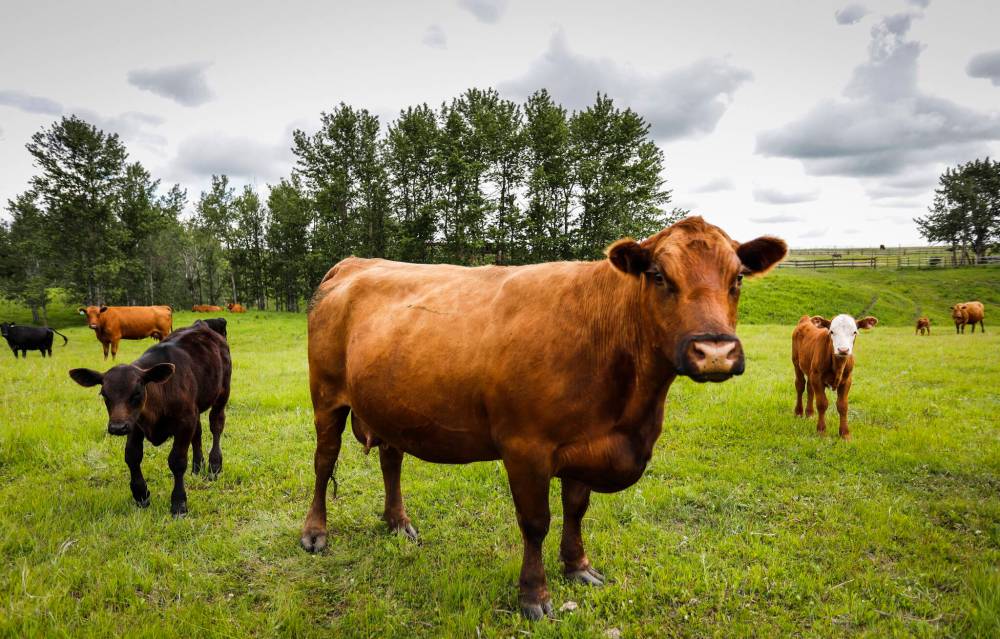
Half of the world’s agricultural land is used to raise cattle feed, and cows belch up great amounts of methane, a fast-acting greenhouse gas.
Cows and their calves graze in a pasture on a farm near Cremona, Alta., on June 26, 2019. A national farm organization is asking the federal government to pitch in with efforts to move hay from the East Coast to struggling farmers and ranchers in Western Canada. THE CANADIAN PRESS/Jeff McIntosh
Well, those customers are vegans, or at least people trying to cut down on the amount of meat in their diets. They deserve to be confused because they are betraying and undermining the meat industry. Let them buy their ‘plant-based X,’ and choke on it.
Governments are playing the same game all over the West. The journal One Earth analyzed U.S. and European Union agricultural policies 2014-2020 and found that only one-thousandth of the public money spent on helping the meat and dairy industry went to plant-based alternatives.
EU cattle farmers, by contrast, get at least 50 per cent of their income from direct government subsidies. “The power of the animal farming sector, both in the U.S. and in Europe, and the political influence they have is just gigantic,” said Dr. Eric Lambin of Stanford University, the co-author of the study.
But don’t people in the meat industry understand that meat production will have to shrink drastically as climate change accelerates? That cattle specifically are responsible for almost one-tenth of all greenhouse-gas emissions, more than all other food production combined? Don’t they realize that they are a ‘Sunset industry’?
Of course they do. Not your average cattle farmer, of course: most of them are in denial. But the techs and the bosses of ‘Big Meat’ — the transnationals like Tyson Foods and Cargill (headquartered in the United States), JBS and BRF (Brazil), Vion Food Group (Netherlands) and the WH Group (China) — know exactly what the future holds.
They know that humankind has appropriated 40 per cent of the land surface of the planet for its agriculture (up from seven per cent in 1700), removing both the trees and most of the original wildlife and replacing them with our own crops and food animals.
They know that half of the world’s agricultural land is devoted just to growing food for cattle. Yes, half. And they know that those cattle burp out enormous quantities of methane, the fastest-acting greenhouse gas.
They know that the pressure to return that half of the farmland to nature (‘rewild it’) will grow and grow, because it’s the last hope for preserving a reasonable range of biodiversity on the planet. When those activists eventually get together with the people who are trying to cut emissions, beef and dairy production will go into retreat — but the question is when?
Because Big Meat also knows that Big Oil managed to go on making huge profits for 50 years after it knew the writing was on the wall. Only now, finally, is it being forced into a managed retreat.

Way back in 1977, ExxonMobil’s scientists accurately predicted a global temperature rise of 0.2 degrees Celsius per decade if fossil fuel use continued on its present trajectory. They also understood what that meant for the climate. Knowing all that, they nevertheless waged a campaign of denial and distraction that prevented any serious action for half a century.
Big Meat’s senior execs doubtless think that way too, so stand by for a long campaign of slander against plant-based protein and its far more formidable rival, ‘food from the air’ or ‘farm-free’ food, based on protein produced by ‘precision fermentation.’
But Big Meat will lose a lot quicker, because farm-free food requires no land beyond the hardstand that the bioreactor sits on, and it is almost infinitely flexible.
This nascent industry may concentrate on animal feed at first to build up volume production and bring the price down, but it’s high-quality tasteless protein that can be given any texture and taste cooks can think of. Here comes the Revolution. Again.
Gwynne Dyer’s new book is The Shortest History of War.