

The evolution of our city
Advertisement
Read this article for free:
or
Already have an account? Log in here »
To continue reading, please subscribe:

Digital Subscription
One year of digital access for only $205*
- Enjoy unlimited reading on winnipegfreepress.com
- Read the E-Edition, our digital replica newspaper
- Access News Break, our award-winning app
- Play interactive puzzles
*First annual payment billed as $205.00 + GST for one year. This annual subscription will automatically renew at $233.00 + GST every 52 weeks (10% off the regular annual price of $259.35). Offer available to new and qualified returning subscribers only. Cancel any time.
To continue reading, please subscribe:
Add Free Press access to your Brandon Sun subscription for only an additional
$1 for the first 4 weeks*
- Enjoy unlimited reading on winnipegfreepress.com
- Read the E-Edition, our digital replica newspaper
- Access News Break, our award-winning app
- Play interactive puzzles
*Your next Brandon Sun subscription payment will increase by $1.00 and you will be charged $17.95 plus GST for four weeks. After four weeks, your payment will increase to $24.95 plus GST every four weeks.
Read unlimited articles for free today:
or
Already have an account? Log in here »
Hey there, time traveller!
This article was published 06/11/2023 (1021 days ago), so information in it may no longer be current.
One hundred and fifty years ago, on Nov. 8, 1873, Winnipeg was incorporated as a city, though its first official election was not held until early in 1874. The city, with roughly 3,700 citizens was not much to look at. A few years earlier, George Young, a Methodist minister from Ontario who was visiting the area, commented on “what a sorry sight” the hamlet of Winnipeg was, “a mass of soft, black, slippery and sticky Red River mud was everywhere.”
Nonetheless, it citizens were both arrogant and optimistic (as historian Alan Artibise has described them) about Winnipeg’s enormous potential. When the provincial government — kowtowing to large property owners like the Hudson’s Bay Company which feared civic taxation — became a barrier to incorporation, Winnipeggers refused to take no for an answer.
Over the next century and half as the city’s population, boosted by immigration, grew more diverse, there were good and bad times and many obstacles to overcome.
Here are five memorable and significant historical moments that for better or worse shaped the city’s development and character.
The Canadian Pacific Railway passes through Winnipeg — If the original plan for the CPR had been followed, we would all be living 40 kilometres north in and around Selkirk, which would have become the central city in Manitoba. Long before there was a floodway, the geography of Selkirk, with its higher elevation, made it a much safer bet than Winnipeg, which was prone to spring flooding. The situation appeared bleak for the city. But intense lobbying and Winnipeg city council’s promise to spend up to $300,000 (about $9.2 million today) toward the construction of a bridge across the Red River ultimately changed the federal government’s mind. By September 1883, the completed Prairie section was done, linking Winnipeg with Calgary, and Winnipeg’s status as a key hub in a transcontinental network was secured — at least for a time.
The building of the Panama Canal — The canal (as I wrote in an August 2014 column), a wonder of inventiveness and determination, was completed in 1914 and was a boon for western ports like Vancouver. It had a much different effect on Winnipeg, contributing to the city’s economic decline as Canada’s railway, grain trade and wholesale centre. In full operation in 1920, the canal made Vancouver and other Pacific ports more than 8,000 kilometres closer to European ports than they had been. The combination of the canal and lower freight rates enhanced Vancouver’s economy, but it had the opposite effect on Winnipeg, curtailing the city’s supremacy over the multimillion-dollar western Canadian grain economy.
Archives of Manitoba R v. Ivens exhibit 897 Crowd at Portage and Main, depicting the Winnipeg General Strike, June 10, 1919.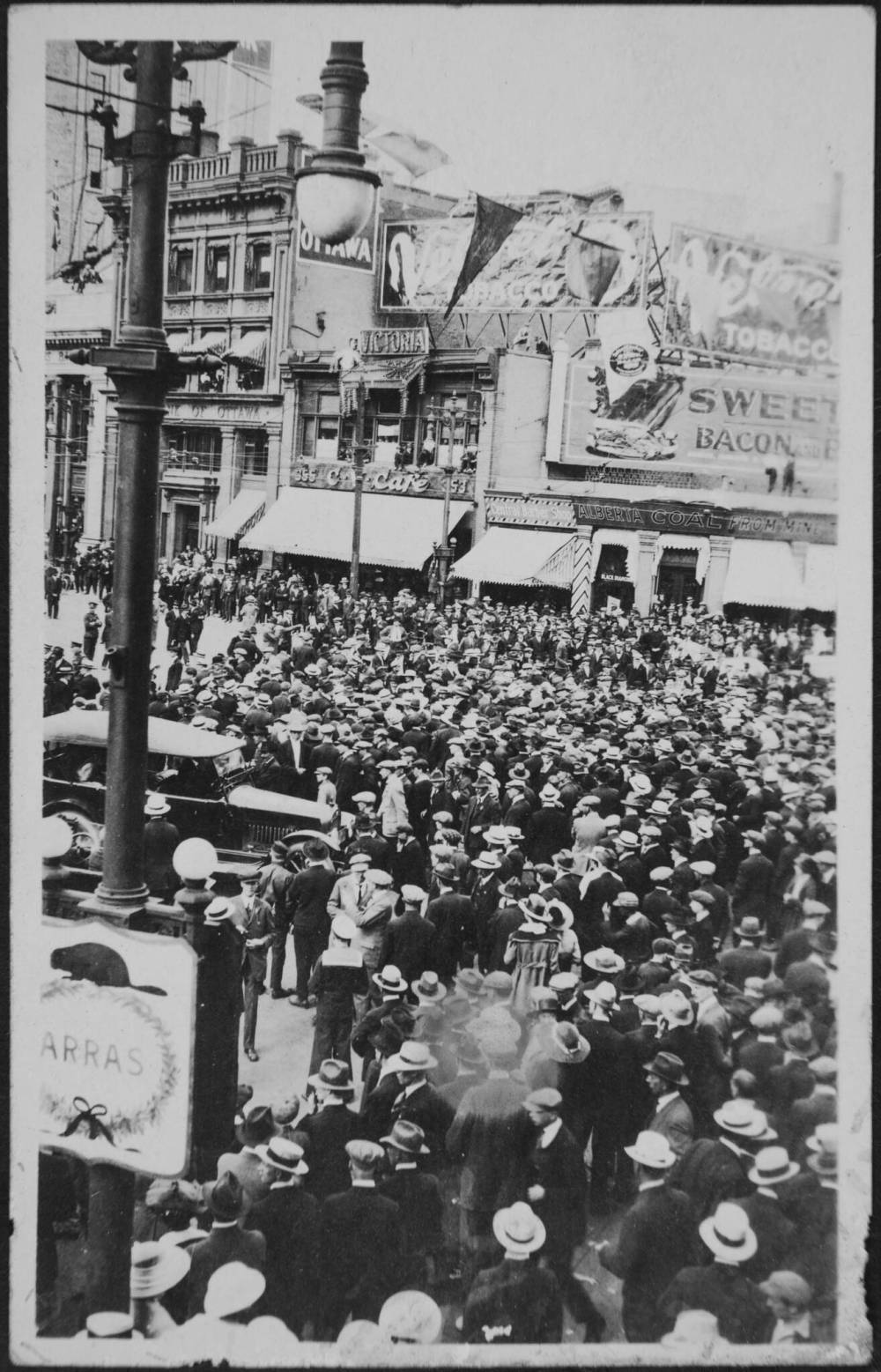
The Winnipeg General Strike — On May 15, 1919, an estimated 30,000 workers, approximately 20 per cent of the city’s total population at the time, walked off their jobs in sympathy with metal and building trades workers who were already on strike. The workers were fighting for union recognition, collective bargaining and “a more equitable share of the wealth of the world,” in the words of labour leader James Winning. The city’s business and professional leaders, who organized the Citizens’ Committee of One Thousand, perceived the strike as a radical left-wing threat. For nearly six weeks, the city erupted in protests, violence and the arrests of its key leaders on charges of seditious conspiracy. While the strikers did not achieve their goals, the massive labour protest impacted city politics for decades and its legacy lives on to the present.
The federal government “temporarily” closes the wheat market: From its inception in the mid-1880s until its demise in 2008, the Winnipeg Grain Exchange, which became the Winnipeg Commodity Exchange in 1972, was the city’s most important business institution. In its heyday during the first few decades of the 20th century, trading on the Exchange floor played a key role in establishing the price of wheat and other grains and commodities around the world. The beginning of the end came during the Second World War on Sept. 27, 1943, when the federal government, fearing that it would not have sufficient wheat to meet its commitments to Britain, shut down trading at the Winnipeg Exchange. It was supposed to be a temporary measure. It never reopened, and the Exchange never recovered from the loss.
The rise and fall and rise of the Winnipeg Jets — On June 27, 1972, thousands of Winnipeggers (me included) gathered at the corner of Portage Avenue and Main Street to witness NHL superstar Bobby Hull sign his million-dollar contract to play for the Winnipeg Jets in the newly created World Hockey Association. Seven years later, when the WHA folded and the Jets became part of the NHL, the opportunity was a great moment in the city’s history. But it was not to be. In 1996, much to the tremendous disappointment of Winnipeg hockey fans, the team relocated to Phoenix. Then in 2011, in a true miracle that boosted civic pride like few events in the city’s past, True North Sports & Entertainment purchased the ailing Atlanta Thrashers and moved the team back to Winnipeg and the Winnipeg Jets 2.0. were born. As the Free Press put it, “we’re back where we always felt we belonged and most Manitobans are pretty damn happy about it.”
Now & Then is a column in which historian Allan Levine puts the events of today in a historical context.