

Alberta’s loss, our gain?
Advertisement
Read this article for free:
or
Already have an account? Log in here »
To continue reading, please subscribe:
Digital Subscription
One year of digital access for only $1.44 a week*
- Enjoy unlimited reading on winnipegfreepress.com
- Read the E-Edition, our digital replica newspaper
- Access News Break, our award-winning app
- Play interactive puzzles
*Billed as $5.77 plus GST every four weeks. After 52 weeks, price increases to the regular rate of $19.95 plus GST every four weeks. Offer available to new and qualified returning subscribers only. Cancel any time.
To continue reading, please subscribe:
Add Free Press access to your Brandon Sun subscription for only an additional
$1 for the first 4 weeks*
- Enjoy unlimited reading on winnipegfreepress.com
- Read the E-Edition, our digital replica newspaper
- Access News Break, our award-winning app
- Play interactive puzzles
*Your next Brandon Sun subscription payment will increase by $1.00 and you will be charged $17.95 plus GST for four weeks. After four weeks, your payment will increase to $24.95 plus GST every four weeks.
Read unlimited articles for free today:
or
Already have an account? Log in here »
Hey there, time traveller!
This article was published 14/11/2023 (928 days ago), so information in it may no longer be current.
Seldom does a huge challenge so quickly and seamlessly match up with a potential solution, but this may be one of those rare occasions.
On July 28, the Stefanson government issued a news release that said, “The Manitoba government has launched a new clean energy roadmap that will deliver on a commitment to ensure a secure supply of affordable, reliable, and sustainable power for people and businesses today and into the future.”
At the bottom of the press release was a link to a PowerPoint presentation entitled Manitoba’s Energy Roadmap. That document says that “Manitoba currently has an installed generating capacity of 6,600 MW” and “by the early 2040s growing demand for electricity in MB could require 10,000 MW to 16,000 MW of generating capacity.” It adds that there are currently “4,400 MW in new requests from 18 energy-intensive industrial projects.”
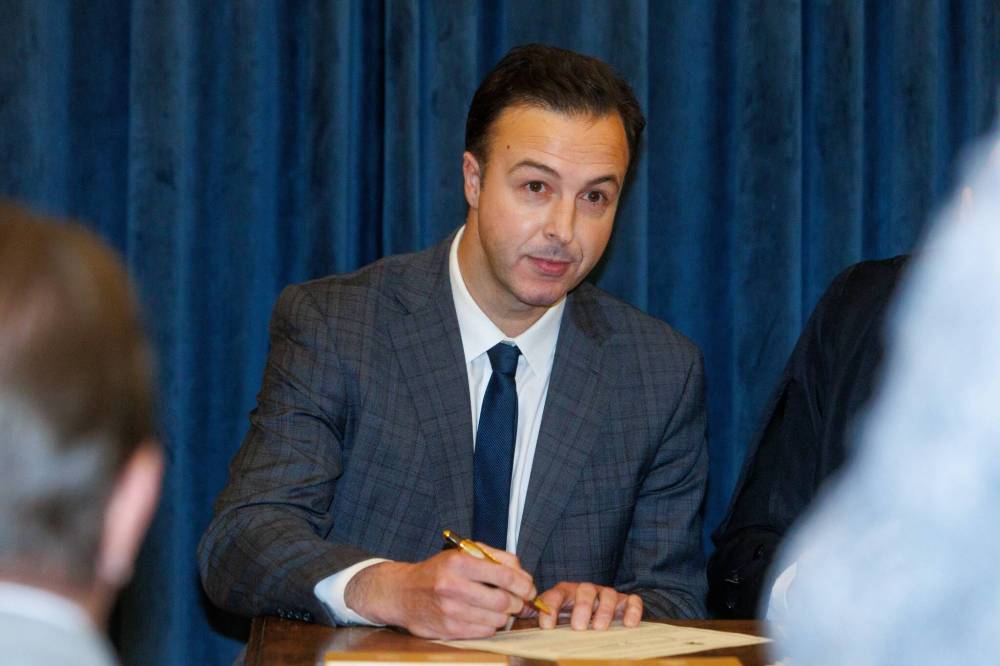
MIKE DEAL / WINNIPEG FREE PRESS
The minister responsible for Manitoba Hydro, Adrien Sala, might find a way for this province to benefit from renewable power hiccups two provinces to the west of us.
In simple language, the Energy Roadmap disclosed that Manitoba does not have sufficient generating capacity to provide enough electricity for projects currently waiting to come to Manitoba, let alone satisfy the higher demand that is anticipated over the next two decades.
This is an enormous problem, with little time to solve it. Indeed, Manitoba Hydro would need to build at least 10 additional Keeyask-sized generating stations to meet the expected demand, with each station costing more than $10 billion.
That “solution” rests on the very shaky assumptions that there are at least 10 viable locations in the province for those stations, that the required environmental reviews would proceed quickly and favourably, and that Manitoba Hydro would be able to borrow the massive amount of money needed to pay for those projects.
While the Energy Roadmap paints a troubling portrait of Manitoba’s energy future, a potential solution — or at least partial solution — may have materialized just days after its release.
On Aug. 3, the Government of Alberta announced that it was suspending approvals for renewable energy projects over one megawatt, including wind, solar, and geothermal projects. The Alberta Utilities Commission was directed to hold an inquiry and prepare recommendations for new regulations in seven months. What happens after that is anybody’s guess.
According to a study by the Pembina Institute, “there are 118 projects impacted by the moratorium on renewable energy development. The projects are comprised of 12.7 gigawatts (GW) of solar, 5.3 GW of wind, and 1.5 GW of battery energy storage (as part of solar projects) and have been proposed by 64 different development companies or partnerships.”
The report adds that “The total investments supporting the projects are estimated to be just over $33 billion, with an additional $263 million per year of revenue from municipal taxes and land leases spanning 27 different municipalities. The planning, development, and construction of these projects would generate an estimated 24,000 full-time job-years.”
Finally, the report states that “Alberta’s proven, economic, and available wind and solar resources position it to become Canada’s renewable energy capital… Since 2019, projects have drawn nearly $5 billion in investments, creating close to 5,500 jobs.”

Let’s do the math. Manitoba needs 10,000 MW to 16,000 MW of generating capacity. One gigawatt equals 1,000 megawatts, meaning that we need 10 to 16 gigawatts of power. There are currently almost 20 gigawatts worth of shovel-ready projects in Alberta, sitting in limbo because of an arbitrary, unexpected decision by the Alberta government.
This may sound too good to be true, but the projects are real and so are the dollars and jobs. Alberta can claim to have “proven wind and solar resources”, but Manitoba also has the land, wind and sunshine necessary to host the suspended Alberta projects — and we have an immediate use for all the electricity those projects would generate.
Manitoba has a once-in-a-lifetime opportunity to solve its future electricity requirements, attract billions of dollars in new investment, create thousands of good-paying jobs and add millions of dollars in annual tax revenue. It could put our province on a path to clean, green and sustainable prosperity.
Let’s hope that Manitoba Hydro Minister Adrien Sala and his Kinew government colleagues are paying attention, recognize the massive opportunity before them, and are moving quickly to convince the owners of the affected Alberta projects that Manitoba is a more viable, stable and reliable place for their projects.
Deveryn Ross is a political commentator living in Brandon. deverynrossletters@gmail.com X: @deverynross