

Sovereignty can be a mixed blessing
Advertisement
Read this article for free:
or
Already have an account? Log in here »
To continue reading, please subscribe:

Digital Subscription
One year of digital access for only $205*
- Enjoy unlimited reading on winnipegfreepress.com
- Read the E-Edition, our digital replica newspaper
- Access News Break, our award-winning app
- Play interactive puzzles
*First annual payment billed as $205.00 + GST for one year. This annual subscription will automatically renew at $233.00 + GST every 52 weeks (10% off the regular annual price of $259.35). Offer available to new and qualified returning subscribers only. Cancel any time.
To continue reading, please subscribe:
Add Free Press access to your Brandon Sun subscription for only an additional
$1 for the first 4 weeks*
- Enjoy unlimited reading on winnipegfreepress.com
- Read the E-Edition, our digital replica newspaper
- Access News Break, our award-winning app
- Play interactive puzzles
*Your next Brandon Sun subscription payment will increase by $1.00 and you will be charged $17.95 plus GST for four weeks. After four weeks, your payment will increase to $24.95 plus GST every four weeks.
Read unlimited articles for free today:
or
Already have an account? Log in here »
Hey there, time traveller!
This article was published 06/12/2023 (973 days ago), so information in it may no longer be current.
Premier Danielle Smith is invoking the Alberta Sovereignty Act of 2023 to exempt Alberta power companies from federal clean energy proposals. Donald Trump regularly invokes American sovereignty against all manner of “trumped-up” boogeymen from globalism to immigration to religion. Ukraine and Israel have claimed a right to defend their sovereignty as nation states.
In Manitoba we now count 64 First Nations and the Red River Metis among the sovereign entities in our province. And, from time to time, militia groups and even individuals declare certain spaces and even their homes and bodies as sovereign places. Everywhere sovereignty seems to be a coveted objective.
However sought after, sovereignty is a mixed blessing.
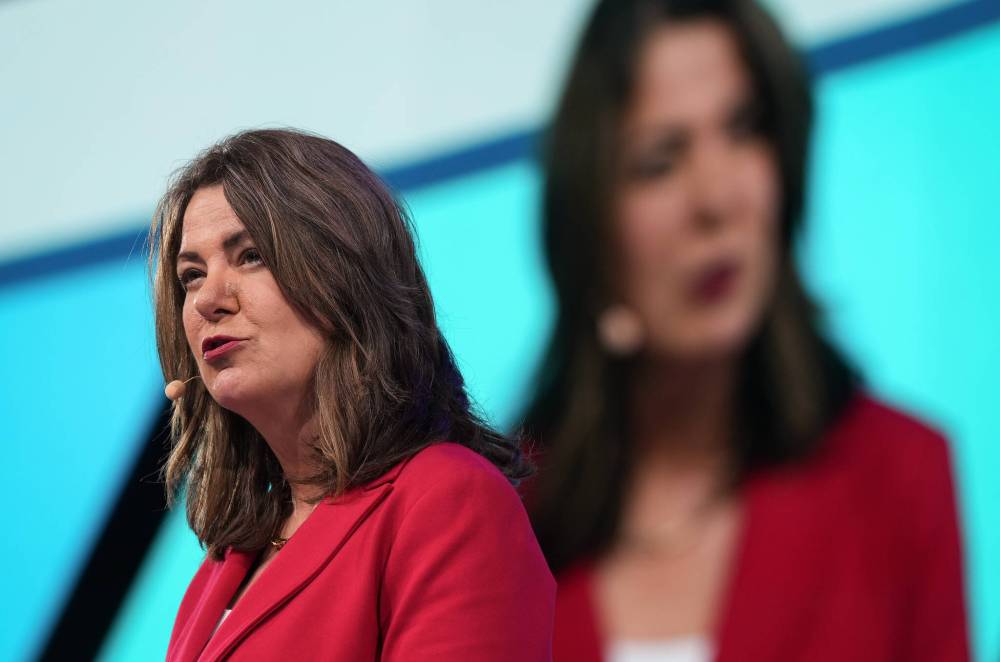
Darryl Dyck / Canadian Press Files
Alberta Premier Danielle Smith gives an address at a July conference in Vancouver, B.C.
In some cases, sovereignty provides a sense of ethical-political order, while in others it poses a major socio-political threat. Sovereignty in democracies, defined as dominant power or supreme authority, rests with the electorate through representative bodies like the U.S. Congress, the Canadian parliament, provincial legislatures, and Indigenous governments.
“Who has power over what” in democracies is always somewhat contested and can only be determined by political means, the very means by which all are included equally. The very opposite exists in today’s populist anti-government environments, in which calls to extreme sovereignty turn into non-political destructive weapons.
On a political level, how will the Alberta government convince skeptical Canadians that this is not just another crass, partisan political ploy by a provincial government notorious for opposing virtually every federal government proposal?
On a legal level, Alberta’s claims to overriding authority are likely to suffer the same court challenge fate as previous attempts to thwart federal actions over matters of global concern. The first seems pernicious; the second looks irresponsible.
At the same time, however, while Alberta’s actions show similarities to the extreme partisan divide in the United States, its consequences for democracy don’t seem nearly as dire or imminent. And this is, at least in part, a result of the political role a particular religion now exercises in many parts of America and, currently, only in a few places in Canada.
Trump is manipulating and exploiting a predominantly white evangelical Christian crusade as the means to his nationalism-turned-authoritarian-turned-fascist ends.
On his social media platform recently, he promised “to cast out communists, Marxists and fascists,” “demolish the deep state,” “expel warmongers,” and “drive out globalists.”
He denigrated his political opponents, calling them “radical left thugs who live like vermin.” And he continued his familiar barrage of election lies, his attacks on the court system, and his implicit calls for violence against his detractors. He talked about calling out the army on his enemies and setting up detention camps, threats not to be taken lightly.
Trump claimed that immigrants are “poisoning the blood of our country.”
He promised that those who do not like “our religion” will not get in. This holds huge appeal for his followers who act as if they have privileged exclusive relationship with God, one not available to those who are not of “their” religion. He invokes the ultimate weapon, a supreme and sovereign God, promising to save America from ruin.
Historians call this phenomenon “tribal nationalism,” which feeds on populist discontent. It perceives its own people as surrounded by enemies. It claims that its people are unique, and incompatible with others, and threatened by all outsiders.
At its most extreme, it is hostile to the sovereignty of the nation-state, portrayed as a threat to God’s kingdom. Violent overthrow is justified as necessary.
In that picture, an angry vengeful God’s sovereignty will make America a Christian nation ruled by whites again. No means are off limits — lying, conspiracy mongering, breaking the law, dehumanizing insults, threats of violence and violence itself are all permissible — if perpetrated by a self-proclaimed leader who enables these religionists’ unhappiness. And there is no room or empathy for people who do not join their ranks or fall into line.

Sovereignty played out this way is harmful, destructive, and cause for alarm.
And yet sovereignty has a positive side when individual and mob extremes are judiciously avoided.
Democracy, sovereignty possessed by citizens, is not weak and defenseless in the face of these exclusionary claims of Trumpism or Premier Smith. Individual authority, which implies creativity, critical thinking, self-regulation, and self determination, is the perfect antidote to mass mentality.
Responsive, representative governments use the authority implied by sovereignty to protect their citizens, guarantee their rights and privileges, and provide them with essential services. Those are sovereignties worth upholding and protecting!
John R. Wiens is dean emeritus at the faculty of education, University of Manitoba.