

Hate and consequences
Advertisement
Read this article for free:
or
Already have an account? Log in here »
To continue reading, please subscribe:
Monthly Digital Subscription
$1 per week for 24 weeks*
- Enjoy unlimited reading on winnipegfreepress.com
- Read the E-Edition, our digital replica newspaper
- Access News Break, our award-winning app
- Play interactive puzzles
*Billed as $4.00 plus GST every four weeks. After 24 weeks, price increases to the regular rate of $19.95 plus GST every four weeks. Offer available to new and qualified returning subscribers only. Cancel any time.
Monthly Digital Subscription
$4.99/week*
- Enjoy unlimited reading on winnipegfreepress.com
- Read the E-Edition, our digital replica newspaper
- Access News Break, our award-winning app
- Play interactive puzzles
*Billed as $19.95 plus GST every four weeks. Cancel any time.
To continue reading, please subscribe:
Add Free Press access to your Brandon Sun subscription for only an additional
$1 for the first 4 weeks*
*Your next subscription payment will increase by $1.00 and you will be charged $16.99 plus GST for four weeks. After four weeks, your payment will increase to $23.99 plus GST every four weeks.
Read unlimited articles for free today:
or
Already have an account? Log in here »
Hey there, time traveller!
This article was published 07/12/2023 (873 days ago), so information in it may no longer be current.
Like most Jewish kids growing up in Canada during the 1960s and 1970s, I experienced a few ugly antisemitic incidents. Mostly it was name-calling like “dirty Jew” and “kike” by ignorant bullies.
But on one occasion when I was about 12 or 13, one of my friends and I were attacked by two older, bigger boys in downtown Winnipeg after they followed us off a bus. They knew we were Jewish. The assault lasted only a minute or two as they punched and kicked us, before running away.
I thought of this attack a few weeks ago when I watched a short video clip on X (Twitter) of a young woman at a pro-Palestinian rally at Concordia University in Montreal screaming at a female Jewish student (who you cannot see) who was presumably supporting Israel. According to what I heard upon listening to it at least 10 times, the woman appears to yell at the Jewish student: “F…ing kike…F…ing bitch,” she says thrusting the middle finger of her right hand forward.
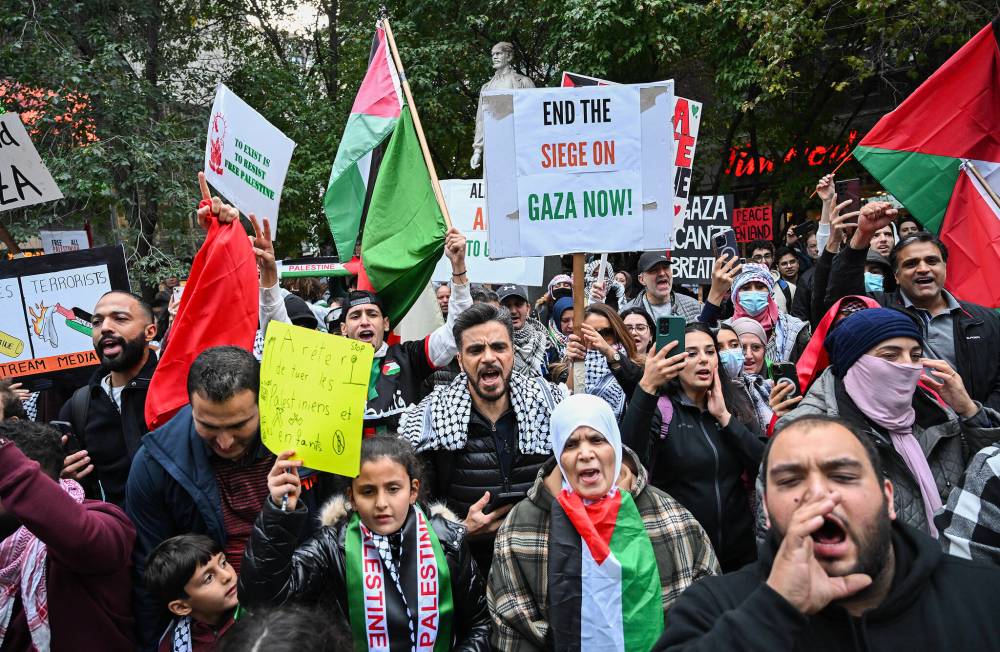
Graham Hughes / The Canadian Press Files
People take part in a demonstration in support of Palestinians in Montreal on Oct. 13. The RCMP says it is aware of social media posts threatening the Jewish community in Canada, calling it a time for increased vigilance.
Other commentators have argued that she uses the word “c—t” rather than kike. In any event, as the clip ends, a friend comforts her, kissing her cheek, treating her as if she has done something worthy. (Several writers on X justified her speech by suggesting that the woman in question was responding to a threat.)
Prime Minister Justin Trudeau and other Canadian political leaders have denounced the recent antisemitic violence and harassment. Up until the barbaric attack by Hamas on Israel on Oct. 7 — which broke a ceasefire agreement, led to Israel’s declaration of war on Hamas in Gaza and the predictable and tragic consequences of that action — I would have argued that antisemitism in Canada was in the decline, even considering the rise of online hate and occasional vandalism.
Yet, these events and the eruption of this visceral hatred at Canadian universities and at rallies where the line between being an anti-Zionist and antisemite is pretty well non-existent, shows how wrong my assessment was.
There was a time in Canada, from before Confederation to at least the 1960s, when antisemitism was part of Canadian society.
While violent attacks were not unknown, antisemitism was more discriminatory and institutionalized. There were restrictions on employment and professional opportunities, university quotas were imposed (infamously at the University of Manitoba Medical College from 1932 to 1944), property covenants were used to prevent Jews and other minorities from purchasing homes and cottages, and sports and social clubs had “Gentile Only” policies and no qualms about advocating and publicizing these rules.
Human rights legislation and changing attitudes after the full extent of the Holocaust was known in the late 1940s and early 1950s, gradually eliminated this blatant discrimination. Prejudice against Jews has remained, if under the surface, though Israel has been a target for criticism and hate from day it declared its independence in May of 1948.
During its first two decades, there was general sympathy in Canada and the U.S. as Israel fought wars in 1948 and 1956 against much larger Arab enemies, who refused to accept the United Nations’ 1947 partition of Palestine into two states, one for Jews and the other for Palestinian Arabs, and were intent to “wipe Israel off the map,” as Iraqi president Abdel-Rahman Aref later put it.
Some of that sympathy vanished after Israel’s miraculous victory in the Six-Day War of June 1967, with its territorial acquisitions, and the subsequent controversial decision of Israeli governments to permit settlements on the occupied West Bank territory where Palestinians resided. This led to the demonization of Israel at the United Nations, university campuses and elsewhere; and Zionism was denounced as racism.
No doubt that young woman at Concordia believes the history of Israel and the Middle East is black and white, with Israel, in her view and the view of others like her, an illegitimate state which has allegedly “stolen” land from Palestinians. In fact, she and her ilk do not appreciate that this history is complicated and grey. Suffice it to say that neither side in this long conflict is totally innocent.
Choices have consequences, however. Israel has made some questionable ones, and so have the Palestinians and their leaders.
Think of history as having forks in a long road: take one path and events unfold much differently than they might have if another path is taken instead. If the Arabs had accepted the 1947 partition, the world today would arguably be different.
Similarly, if in 2000 Palestinian Authority chairman Yasser Arafat or in 2008 his successor, Mahmoud Abbas, had accepted the generous — though admittedly far from perfect — terms offered to both of the establishment of a Palestinian state on the West Bank (94 per cent of the West Bank in the 2008 deal), there might be a thriving Palestinian state today and relative peace in the region. Instead, for various reasons Arafat and Abbas both refused and extremists like Hamas, as well as far-right Israelis, grew stronger rather than weaker.

Now, it is all part of an action-reaction self-perpetuating cycle of hate and violence.
Hamas made a deliberate choice on Oct. 7 to attack, rape and murder Israelis and take more than 200 as hostages.
Its leaders wanted to “change the entire equation and not just have a clash,” Khalil al-Hayya, a member of Hamas’s top leadership body, recently told the New York Times.
And “change it” they have at a tremendous cost to their own people.
Now & Then is a column in which historian Allan Levine puts the events of today in a historical context.