

2024 a pivotal year for Ukraine
Advertisement
Read this article for free:
or
Already have an account? Log in here »
To continue reading, please subscribe:

Digital Subscription
One year of digital access for only $205*
- Enjoy unlimited reading on winnipegfreepress.com
- Read the E-Edition, our digital replica newspaper
- Access News Break, our award-winning app
- Play interactive puzzles
*First annual payment billed as $205.00 + GST for one year. This annual subscription will automatically renew at $233.00 + GST every 52 weeks (10% off the regular annual price of $259.35). Offer available to new and qualified returning subscribers only. Cancel any time.
To continue reading, please subscribe:
Add Free Press access to your Brandon Sun subscription for only an additional
$1 for the first 4 weeks*
- Enjoy unlimited reading on winnipegfreepress.com
- Read the E-Edition, our digital replica newspaper
- Access News Break, our award-winning app
- Play interactive puzzles
*Your next Brandon Sun subscription payment will increase by $1.00 and you will be charged $17.95 plus GST for four weeks. After four weeks, your payment will increase to $24.95 plus GST every four weeks.
Read unlimited articles for free today:
or
Already have an account? Log in here »
Hey there, time traveller!
This article was published 12/01/2024 (979 days ago), so information in it may no longer be current.
Entering its third year of an existential war, Ukraine faces serious challenges. The West’s focus on defending both the nation and the principle of national sovereignty against Vladimir Putin’s imperialist land grab has been diverted by fresh turmoil in the Middle East. After committing a slew of errors early on, Russian forces have adapted. Military and financial lifelines to Kyiv are withering, too.
Over 40 countries, plus EU agencies, have so far sent more than US$262 billion in military, monetary and humanitarian assistance to Ukraine. That aid is now almost exhausted. Meanwhile, legislative bills meant to authorize over US$100 billion in new support are being blocked by populist lawmakers in Europe and America.
Critics of further aid to Ukraine claim it’s a losing cause. They point to how its much-anticipated counteroffensive last year mostly fizzled out. Indeed, Russia still occupies around one-fifth of Ukrainian land — an amount that hasn’t changed much since late 2022. However, experts blame that outcome on a lack of strategic clarity from Kyiv and its NATO allies dragging their feet on providing more advanced weapons systems.
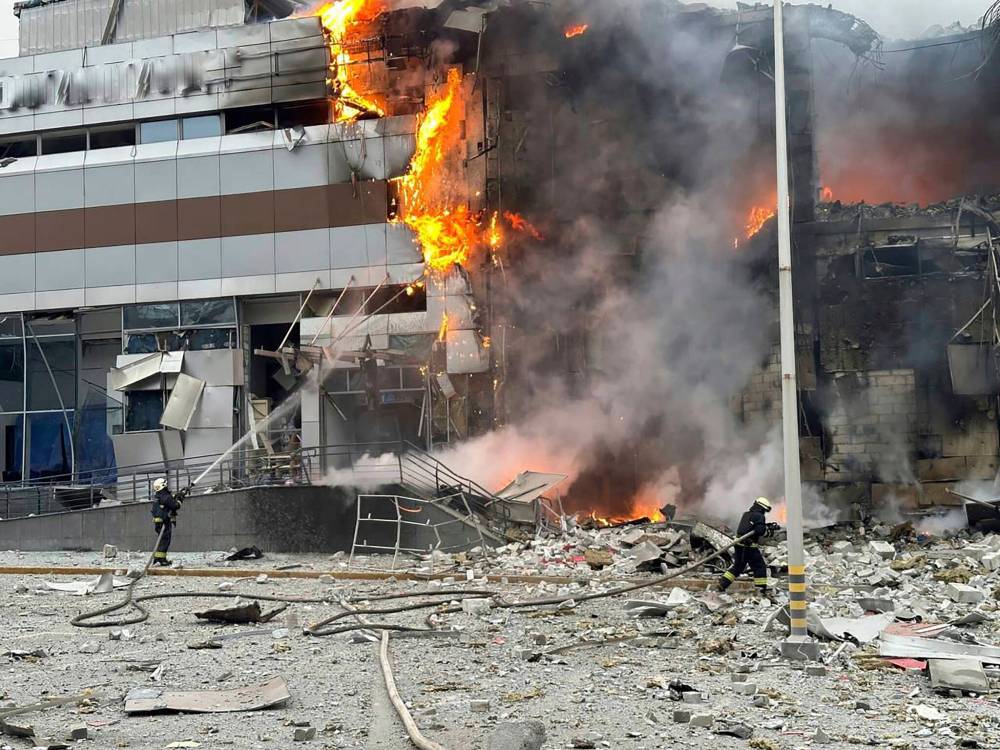
Ukrainian Emergency Service / Associated Press files
In this photo provided by the Ukrainian Emergency Service, firefighters work on a site of a building damaged after a Russian attack in Kyiv, Ukraine on Dec. 29.
The counteroffensive also suffered from inflated expectations. Russian forces have long dug in behind a buffer zone they’ve built along the 1,000-km front line in eastern Ukraine. It runs several kilometres deep; the ground is among the most heavily land-mined places on Earth. The area is also dotted with surveillance equipment and roadblocks, alongside a patchwork of anti-tank and anti-air defences.
In other words, for Ukraine to breach significant Russian-held territory using conventional weapons and tactics became near impossible a while ago. Sheltered from danger, Russian artillery is ramping up its bombardment of Ukraine’s cities and infrastructure using missiles from North Korea and kamikaze drones from Iran.
Above all though, Vladimir Putin remains hell-bent on restoring Russian greatness through conquest. Unfazed by the estimated loss of 315,000 of his soldiers — many of them used as human cannon fodder — Putin has reorganized Russia’s economy and society to support his illegal war. Up to one-third of Russia’s state spending this year, for example, is being allocated toward defence.
“There will be peace when we achieve our goals,” said the Russian president during a marathon year-end news conference. Those goals — the fabricated “denazification of Ukraine,” along with Kyiv adopting “demilitarization” and a “neutral status” — essentially amount to Ukraine accepting total subjugation to Moscow.
By comparison, Western resolve appears to be fraying. The Conservatives under opposition leader Pierre Poilievre in November voted against updating Canada’s free trade agreement with Ukraine in blinkered protest of a clause that promoted carbon pricing. Ukraine’s President Volodymyr Zelenskyy then left Washington empty-handed in mid-December thanks to gridlock in Congress.
Polls suggest roughly half of Republican voters now feel the U.S. is being too generous toward Ukraine. GOP representatives are peddling false tropes of foreign aid by calling it a blank cheque, demanding any new funding for the embattled nation be matched with stronger action to stem migrant flows across America’s southern border. Donald Trump has boasted that if he wins the presidency this fall, he’d end the war “in 24 hours” — presumably by abandoning Ukraine to force Kyiv’s capitulation.

Munitions on Ukraine’s side are already running dangerously low. Front-line units are reportedly having to ration artillery shells to account for dwindling stockpiles, with little more on offer. The Pentagon is currently relying on a legislative loophole to supply Ukraine with arms by drawing from U.S. military assets — something it can only sustain for a few more weeks. Meanwhile, Germany’s defence minister admitted months ago the EU will miss its target of supplying Ukraine with one million new artillery shells by March.
There are political fissures building within Ukraine as well. President Zelenskyy and his military chief have publicly disagreed about whether the conflict is reaching a stalemate. Kyiv’s mayor has claimed that Zelenskyy’s administration is suppressing dissent. Citizens are tuning out government media coverage of the war, calling it “state propaganda.”
Nevertheless, Ukraine is far from defeated — and Putin cannot be trusted to honour any ceasefire agreement. Analysts have suggested this year should thus be focused on rebuilding Ukraine’s military capacity rather than expending more blood and treasure on offensive operations. This should include bolstering protection of the port of Odessa to ensure that Ukraine can still export products to sustain its economy.
Ukraine will not win the war in 2024. However, without renewed support from its allies, there is a risk this may be the year the country starts to lose it.
Kyle Hiebert is a Winnipeg-based researcher and analyst, and former deputy editor of the Africa Conflict Monitor.