

Did Cuba really affect the 2022 U.S. midterms?
Advertisement
Read this article for free:
or
Already have an account? Log in here »
To continue reading, please subscribe:

Digital Subscription
One year of digital access for only $205*
- Enjoy unlimited reading on winnipegfreepress.com
- Read the E-Edition, our digital replica newspaper
- Access News Break, our award-winning app
- Play interactive puzzles
*First annual payment billed as $205.00 + GST for one year. This annual subscription will automatically renew at $233.00 + GST every 52 weeks (10% off the regular annual price of $259.35). Offer available to new and qualified returning subscribers only. Cancel any time.
To continue reading, please subscribe:
Add Free Press access to your Brandon Sun subscription for only an additional
$1 for the first 4 weeks*
- Enjoy unlimited reading on winnipegfreepress.com
- Read the E-Edition, our digital replica newspaper
- Access News Break, our award-winning app
- Play interactive puzzles
*Your next Brandon Sun subscription payment will increase by $1.00 and you will be charged $17.95 plus GST for four weeks. After four weeks, your payment will increase to $24.95 plus GST every four weeks.
Read unlimited articles for free today:
or
Already have an account? Log in here »
Hey there, time traveller!
This article was published 18/01/2024 (977 days ago), so information in it may no longer be current.
Washington officialdom is now claiming that Cuban authorities interfered in the 2022 U.S. midterm elections. I have to say that’s pretty rich coming from a country that has inserted itself into Cuba’s internal affairs ever since the last Cuban Revolutionary War against Spain in 1898.
Nevertheless, the intelligence community maintains that Havana conducted so-called “influence operations” so as to undermine “U.S. candidates in Florida.” It went on to state the obvious: “Public Cuban government statements indicate that Havana views Cuban-Americans in Miami as having an outsized influence on U.S. policy in Cuba.”
Accordingly, the Office of the Director of National Intelligence highlighted in a December report that the Cuban government — besides seeking to establish fruitful relationships with members of the U.S. media — sought to use social media accounts to damage the reputations of U.S. politicians in Congress viewed as unfriendly to Cuba.
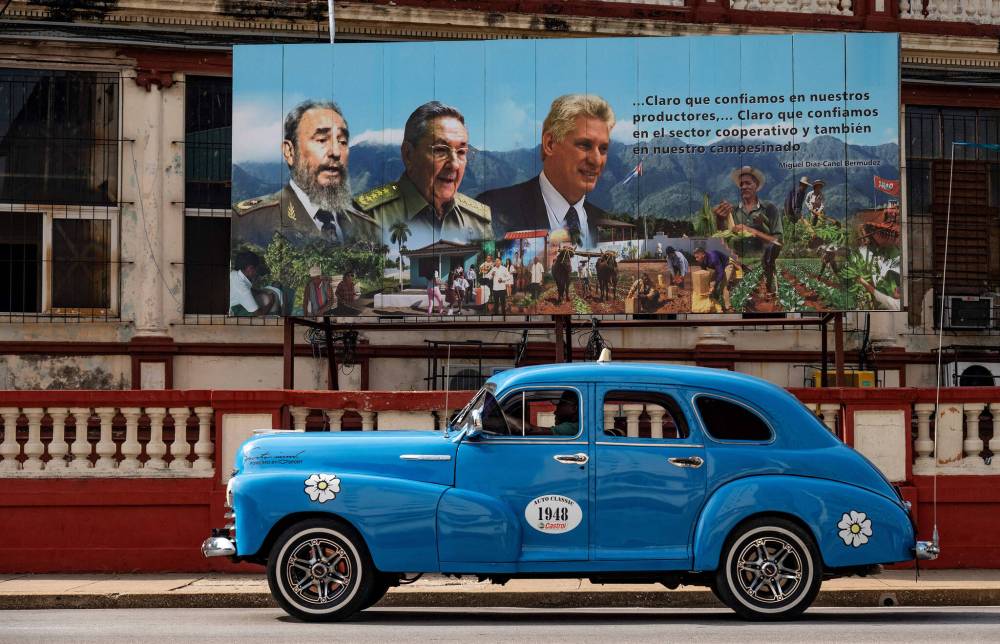
Yamil Lage/AFP/Getty Images/TNS
An old American car passes near a poster of Cuban late leader Fidel Castro (left), Former President Raul Castro (center) and current President Miguel Diaz-Canel (right) in Havana, on Aug. 17, 2023.
The intelligence assessment, however, does observe that the covert efforts of the Cuban government were “smaller in scale and more narrowly targeted” on those seeking to jeopardize Cuban national interests. The Office of the DNI report goes on to note: “We assess that Cuba attempted to undermine the electoral prospects of specific U.S. congressional and gubernatorial politicians that it viewed as hostile.”
It is worth pointing out that the names of allegedly targeted U.S. politicians are missing from these reports. Nor is there any evidence provided to demonstrate whether the Cubans actually influenced the electoral fates of 2022 congressional candidates in Florida.
Still, it was not a shock to see decidedly anti-Cuba Republican members of Congress in South Florida (such as María Elvira Salazar, Carlos Giménez and Mario Díaz-Balart, and all re-elected in 2022) calling for a tightening of the U.S. economic strangulation of Cuba.
Never one to miss an opportunity to slander Cuba, often falsely, so too was Florida Sen. Marco Rubio quick to pounce. He issued a statement that said: “The Biden administration must immediately condemn these actions, make clear they will not be tolerated, and expel Cuban diplomats from U.S. soil.”
Hardline Miami congresswoman Salazar remarked that “this blatant interference in American elections must not be permitted and must be met by an immediate response from the United States government.” Not satisfied to leave things there, she went on to posit wildly: “The Cuban regime seeks to topple their enemies and plant their allies and agents in positions of power in the United States.”
One could easily argue that successive U.S. governments have been orchestrating precisely what Representative Salazar claims the Cubans have been doing for hundreds of years. One should not forget that powerful U.S. business interests in various sectors of the Cuban economy, prior to the 1960s economic blockade, were never shy about calling upon U.S. administrations to pressure Cuban governments to alter their industrial, agricultural and taxation policies. Nor should we forget that the Americans intervened militarily in Cuba — in a quest to install a U.S.-friendly government in the country — in 1906, 1912, 1917, 1923 and 1961.
Beginning with the 1903 Platt Amendment, which effectively gave Washington the right to intervene or even invade Cuba whenever it felt like it, the U.S. government has sought to aggressively insinuate itself into the Cuban domestic environment. And that has even included supporting like-minded conservative political parties and anti-reform opposition movements inside the country.
But it took matters to a whole other level once Fidel Castro came to power in 1959 and triggered agrarian reform and a social revolution. Ever since, I have always maintained that there is an office somewhere in the U.S government labyrinth that is solely dedicated to finding ways — however bizarre and misguided — to precipitate dramatic internal change in Cuba.

Since at least the 2000s, U.S. governments — irrespective of political party stripe — have implemented what have become known as “democracy assistance programs” in Cuba. For the most part, they have involved large dollops of U.S. cash being allocated to various opposition movements, public critics/dissidents and democracy-promoting groups.
Not surprisingly, this blatant intervention into the island’s domestic political ecosystem has always been an especially sore point for the Cuban government. No matter. U.S. governments, including the Joe Biden White House, have continued to funnel tens of millions of dollars into fomenting internal dissent and needlessly poking Havana in the eye.
These intelligence reports, then, simply highlight what has been a long-standing U.S. tradition of singling out Cuba for the thinnest violation of diplomatic etiquette, and then having its critics blow it all out of proportion so as to justify punishing Cuba even further.
This is particularly objectionable given the fact that the U.S. governments have had a centuries-long and deadly history (over 3,500 Cuban civilians have been killed since 1960) of seeking to radically change facts on the ground in Cuba by relentlessly interfering in its domestic politics.
Peter McKenna is professor of political science at the University of Prince Edward Island in Charlottetown.