

Following a road map of the heart

Advertisement
Read this article for free:
or
Already have an account? Log in here »
To continue reading, please subscribe:

Digital Subscription
One year of digital access for only $205*
- Enjoy unlimited reading on winnipegfreepress.com
- Read the E-Edition, our digital replica newspaper
- Access News Break, our award-winning app
- Play interactive puzzles
*First annual payment billed as $205.00 + GST for one year. This annual subscription will automatically renew at $233.00 + GST every 52 weeks (10% off the regular annual price of $259.35). Offer available to new and qualified returning subscribers only. Cancel any time.
To continue reading, please subscribe:
Add Free Press access to your Brandon Sun subscription for only an additional
$1 for the first 4 weeks*
- Enjoy unlimited reading on winnipegfreepress.com
- Read the E-Edition, our digital replica newspaper
- Access News Break, our award-winning app
- Play interactive puzzles
*Your next Brandon Sun subscription payment will increase by $1.00 and you will be charged $17.95 plus GST for four weeks. After four weeks, your payment will increase to $24.95 plus GST every four weeks.
Read unlimited articles for free today:
or
Already have an account? Log in here »
Hey there, time traveller!
This article was published 07/02/2024 (982 days ago), so information in it may no longer be current.
I often read Alzheimer’s-related websites, hoping irrationally that one day I will find the perfect guide to what to expect with my mother’s condition.
Like an ever-hopeful library patron that keeps inquiring about a book that will never appear on the shelves, I keep searching for a detailed road map that will show me all the twists and turns to come before mom reaches her final destination.
But the path of Alzheimer’s disease, and of dementia generally, is different in every person, though there are common markers along the way.
I try to slot my mother’s behaviours into textbook timelines and they don’t always fit. I know that trying to prepare for the inevitable is a means of self-preservation. I also know that there is no way to steel myself for the dozens of deteriorations that could occur in the coming months and years.
Alzheimer’s is often referred to as “the long goodbye,” because the person who has it can lose elements of their personality as well as most of their memory long before the disease ultimately claims them. But I tend to think of it as a million goodbyes, because with every visit I am stopped in my tracks when I have to mourn something my mother used to be able to do.
While I try to make the most of the time I have with her, and to cherish the here and now, it is impossible not to notice small progressions as the disease marches on.
Now and then, I am surprised to see that some ability I thought was gone for good has returned, and that is always a relief, but I often wonder if this pattern of flagging and rallying is tiring and disorienting for her.
How frightening it must be to exist in this land of confusion, where your brain no longer heeds your direction.
Before Christmas, my uncle created a fun YouTube video featuring animated photos of my mother’s relations appearing to sing It’s the Most Wonderful Time of the Year. Most of the photos were old, so some of relatives are long gone, and others much older now.
When I played it for my mother, she only recognized one person in the video. Not herself, not her siblings or her parents. Only her grandfather.
It was a startling indication of how diminished her memory is — at least it was in that moment. That’s not to say that she will never know the faces of her family again — she could suddenly call them all to mind tomorrow. But it is a reflection of how fragile those memories have become, and that is sad to contemplate.
There are times when she knows us, and times when she thinks my siblings and I are staff or fellow residents in her long-term care home.
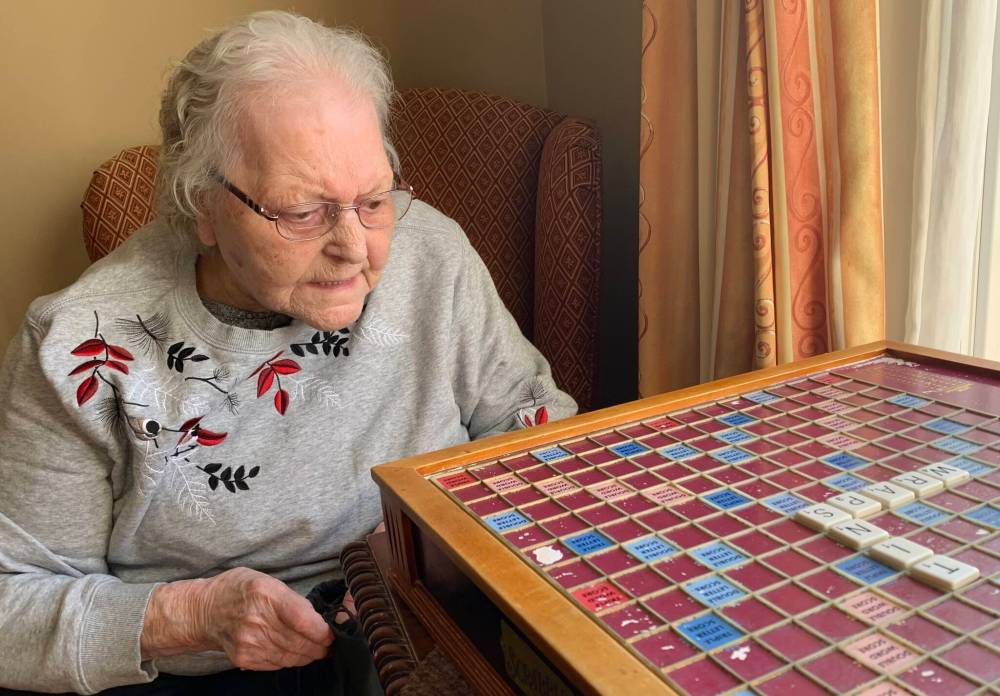
“I’m sorry, I’ve forgotten your name,” she told me politely on a recent visit, as I was setting up the Scrabble board.
“Pam,” I say.
“Oh?” she says. “I have a daughter named Pam.”
“I am your daughter,” I say.
She laughed uproariously at that, laughed as loud and as long as she has always done at her own gaffes, and I couldn’t help but smile, too.
Yet it’s difficult to adjust sometimes to this in-focus/out-of-focus sphere my mother inhabits; a circus mirror world where she lives alone.
One of the best pieces about Alzheimer’s I have read is a 2014 article by Brad Hundt from the Pennsylvania daily newspaper The Observer-Reporter, a piece that was reproduced on the University of Pittsburgh’s Alzheimer’s Disease Research Centers website.
Hundt wrote about the progression of the disease; about how “Friends and family of the individual with Alzheimer’s disease become strangers, and, in a sense, the individual with Alzheimer’s disease becomes a stranger to family and friends.”
He also referenced a 2008 study on how grief affects the loved ones of those with Alzheimer’s that was conducted at the University of Indianapolis.
“The study focused on the idea of ‘anticipatory grief,’ and mourning the loss of someone before they actually die…” he writes.
Those words were the first time anyone has articulated exactly what I’ve been feeling.
But I don’t want to be consumed by anticipatory grief, nor have it mar visits with my mother.
For as long as I can I will sit with her and quietly rejoice when she breaks into one of her precious, spontaneous acts of softly singing:

“If you ever go across the sea to Ireland
Then maybe at the closing of your day
You will sit and watch the moonrise over Claddagh…
And see the sun go down on Galway Bay.”
Pam Frampton is a freelance writer and editor who lives in St. John’s. Email pamelajframpton@gmail.com X: pam_frampton
Pam Frampton is a columnist for the Free Press. She has worked in print media since 1990 and has been offering up her opinions for more than 20 years. Read more about Pam.
Pam’s columns are built on facts, but offer her personal views through arguments and analysis. Every column Pam produces is reviewed by an editing team before it is posted online or published in print — part of the Free Press‘s tradition, since 1872, of producing reliable independent journalism. Read more about Free Press’s history and mandate, and learn how our newsroom operates.
Our newsroom depends on a growing audience of readers to power our journalism. If you are not a paid reader, please consider becoming a subscriber.
Our newsroom depends on its audience of readers to power our journalism. Thank you for your support.
Pam Frampton is a columnist for the Free Press. She has worked in print media since 1990 and has been offering up her opinions for more than 20 years. Read more about Pam.
Pam’s columns are built on facts, but offer her personal views through arguments and analysis. Every column Pam produces is reviewed by an editing team before it is posted online or published in print — part of the Free Press‘s tradition, since 1872, of producing reliable independent journalism. Read more about Free Press’s history and mandate, and learn how our newsroom operates.
Our newsroom depends on a growing audience of readers to power our journalism. If you are not a paid reader, please consider becoming a subscriber.
Our newsroom depends on its audience of readers to power our journalism. Thank you for your support.
Advertisement Advertise With Us
Advertisement Advertise With Us