

Disappearing childhood: expendable children
Advertisement
Read this article for free:
or
Already have an account? Log in here »
To continue reading, please subscribe:

Digital Subscription
One year of digital access for only $205*
- Enjoy unlimited reading on winnipegfreepress.com
- Read the E-Edition, our digital replica newspaper
- Access News Break, our award-winning app
- Play interactive puzzles
*First annual payment billed as $205.00 + GST for one year. This annual subscription will automatically renew at $233.00 + GST every 52 weeks (10% off the regular annual price of $259.35). Offer available to new and qualified returning subscribers only. Cancel any time.
To continue reading, please subscribe:
Add Free Press access to your Brandon Sun subscription for only an additional
$1 for the first 4 weeks*
- Enjoy unlimited reading on winnipegfreepress.com
- Read the E-Edition, our digital replica newspaper
- Access News Break, our award-winning app
- Play interactive puzzles
*Your next Brandon Sun subscription payment will increase by $1.00 and you will be charged $17.95 plus GST for four weeks. After four weeks, your payment will increase to $24.95 plus GST every four weeks.
Read unlimited articles for free today:
or
Already have an account? Log in here »
Hey there, time traveller!
This article was published 14/02/2024 (931 days ago), so information in it may no longer be current.
When in 1982, Neil Postman wrote The Disappearance of Childhood, he lamented the fact that technology exposed, and did not differentiate, between children and adults at the cost of inviting children into the adult world before they were equipped to deal with it. He was talking about childhood as a social construct that emphasized the importance of protected childhoods to yield healthy adults.
The recent U.S. Senate hearings with the American “tech giants,” whose social media platforms place children at risk, were an unwelcome reminder that he was probably right. Recent events suggest that there exists a real threat not only to the idea of childhood, but also to the disappearance of real children’s lives and their hope for becoming well-adjusted contributing adults.
Hidden in all the current war rhetoric is one of the greatest violations of our humanity that we have experienced since childhood was first recognized as a distinct and special time of life and human development. Lost in the constant conflicts over who is to blame, what actions are justifiable, who is more justified — all suggestions that we need to decide whose side we’re on — are the children whose side I am on. By this, I mean not only the children directly impacted by war but also children and childhood everywhere. A cause for mass, collective, and universal adult shame.
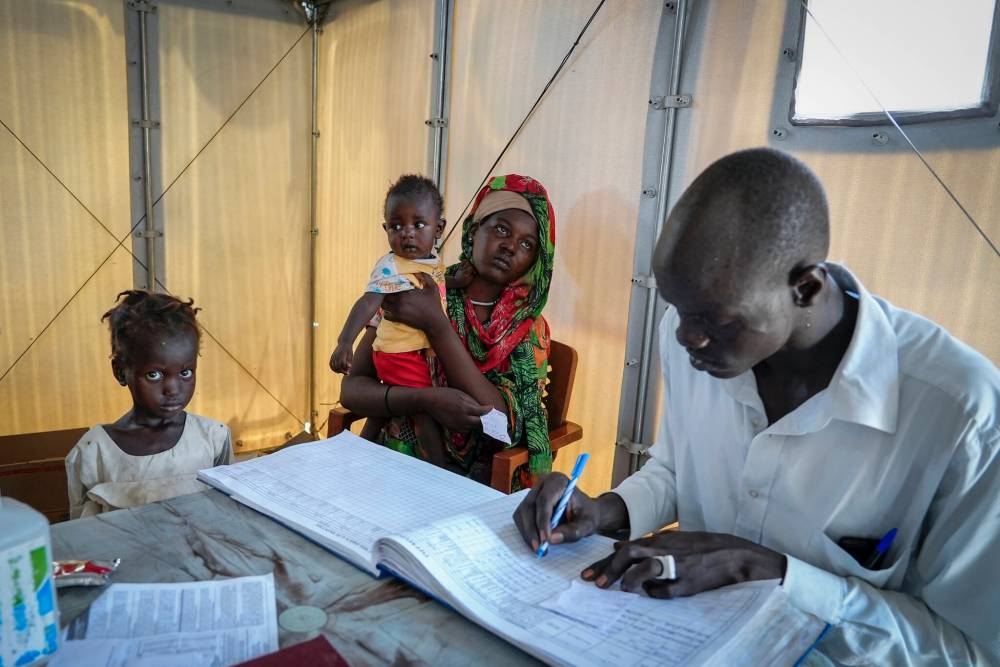
Sam Mednick / AP Files
A health worker assesses malnourished South Sudanese children at a clinic in a transit centre in Renk, South Sudan, May 17, 2023. Tens of thousands of South Sudanese fled neighbouring Sudan, which erupted in violence in April of tht year.
My heart weeps for the children of the world.
My heart weeps for the child survivors of the Oct. 7 Hamas attacks in Israel who will be haunted for the rest of their lives by the images of their siblings and parents being killed, brutalized and taken hostage, some of them becoming hostages themselves, one child under the age of one. No child should bear witness to such atrocities, let alone be haunted by the reminders the rest of their lives. And that includes all the other children living in Israel.
My heart weeps for the nearly one million children under 18 living in Gaza. Some have already experienced four wars; many have watched as more than 10,000 other children have been killed or lost under rubble, 18,000 more have been injured and 24,000 have lost one or both parents. Their futures look bleak.
My heart weeps for the children of Ukraine where more than 1,700 children have been killed, another 1,700 have been injured; thousands have fled the country without their fathers, and at least 20,000 children have been illegally deported to Russian-controlled territories, with Russia reporting that they have moved over 700,000 children. I am gratified to hear that Canada is trying to help with their repatriation but have difficulty imaging their trauma.
These numbers, of course, do not account for another 13 million refugee children, almost seven million in camps, and over 43 million forcibly displaced children in the world today. It appears that children as individuals are of no consequence; we can virtually pretend they do no exist other than as numbers. No matter what we might call it, we might say that wars are being unleashed on children and childhood.
“War is stupid, and I want it to end,” declared a young girl from Gaza in a plea which echoed around the Western world. It would be hard to disagree with her, nor the implication that adults need to rally to offer children the possibility of a childhood, because it’s adults who are waging war. We adults who cannot pretend that they don’t know the historical consequences of war on future human security and well-being.
War is stupid — it is immoral, indiscriminate and reckless — and absurd in that it is not necessarily branded as illegal.
We might also remind ourselves that the explanations given as reasons for the way things are do not serve as justifications for the actions of war, and UN resolutions and declarations on children’s freedom from fear and rights to education seem to be of little consequence in wars.
Meanwhile what is happening to our children, and not just those in the war zones?
It’s hard to imagine that Israeli children and their parents feel safer than they did before, knowing the brutality, randomness, and unpredictability of past attacks. And they are now being conditioned to consider all Palestinian children as potential threats.
Estimates of children suffering from PTSD range in the 50 per cent range in Gaza — many have lost siblings, one or both parents and numerous other relatives and friends. And no children have been attending school since the beginning of November because most of the schools, including UN-run schools, have been destroyed. A similar situation is happening in Ukraine, where it’s either too dangerous to go to school or the schools no longer exist as whole towns have been razed. And millions of children in refugee camps have spent their whole lives without the benefits of schooling.
The distress felt by the direct victims of the assault also extends to most other children. Canadian teachers know that, since our children view the images of children in war zones and see the devastation that is caused by ongoing attacks, they are also traumatized by what they see and hear, sometimes from their classmates who have arrived from war zones or refugee camps.
Children know that war means they are asked to abandon all the lessons they have learned about settling disputes and conflicts they have learned in school — lessons like violent retribution is never okay, that it just leads to a never-ending cycle of escalating violence. They learn that, as they get older, they may be called on to go to wars started by leaders who never place themselves at risk.
History reveals that the consequences of war last lifetimes and spill over to future generations. Scores of children are maimed and injured physically in ways that will affect them for the rest of their lives. Psychologically, children inherit fear, helplessness, and hopelessness which often turn into resignation followed by hate, resentment, and retaliation. Wars help create, almost ensure, future generations of haters.

And I have not even mentioned the wars forgotten in the West: to mention a few, Congo, millions of children raped, murdered, displaced, fending for themselves; Somalia and the Sudan, also in the millions including many who starved to death. The list is also never-ending in other parts of the world.
Is it a surprise that wars are caused mostly by political leaders with fragile egos who react instantaneously without much second thought, other than getting even, to any threat, perceived or real? Their answers always seem to be immediate and violent retaliation even with the full knowledge that violence seemingly only breeds another cycle of more severe violence. We are currently witness to a frightening escalation in the Middle East. And too often these so-called leaders remain unscathed socially, politically, and economically.
The questions remain: do we care enough, and when might we learn that immediate gratification or retribution at all costs just makes things worse? We who live in democracies truly must find ways to hold our leaders more accountable for the devastation they visit on the world, and particularly on children.
“If every child really mattered,” we adults would curb our aspirations for conquest and find alternatives to war to settle our differences. I can’t contain my outrage, and barely my rage!
John R. Wiens is dean emeritus at the faculty of education, University of Manitoba.