

Insurance companies’ pragmatism a tough pill
Advertisement
Read this article for free:
or
Already have an account? Log in here »
To continue reading, please subscribe:

Digital Subscription
One year of digital access for only $205*
- Enjoy unlimited reading on winnipegfreepress.com
- Read the E-Edition, our digital replica newspaper
- Access News Break, our award-winning app
- Play interactive puzzles
*First annual payment billed as $205.00 + GST for one year. This annual subscription will automatically renew at $233.00 + GST every 52 weeks (10% off the regular annual price of $259.35). Offer available to new and qualified returning subscribers only. Cancel any time.
To continue reading, please subscribe:
Add Free Press access to your Brandon Sun subscription for only an additional
$1 for the first 4 weeks*
- Enjoy unlimited reading on winnipegfreepress.com
- Read the E-Edition, our digital replica newspaper
- Access News Break, our award-winning app
- Play interactive puzzles
*Your next Brandon Sun subscription payment will increase by $1.00 and you will be charged $17.95 plus GST for four weeks. After four weeks, your payment will increase to $24.95 plus GST every four weeks.
Read unlimited articles for free today:
or
Already have an account? Log in here »
Hey there, time traveller!
This article was published 07/03/2024 (945 days ago), so information in it may no longer be current.
Actions speak louder than words.
Always have, always will.
Banking is a competitive business, but it often looks like things happen in lockstep.
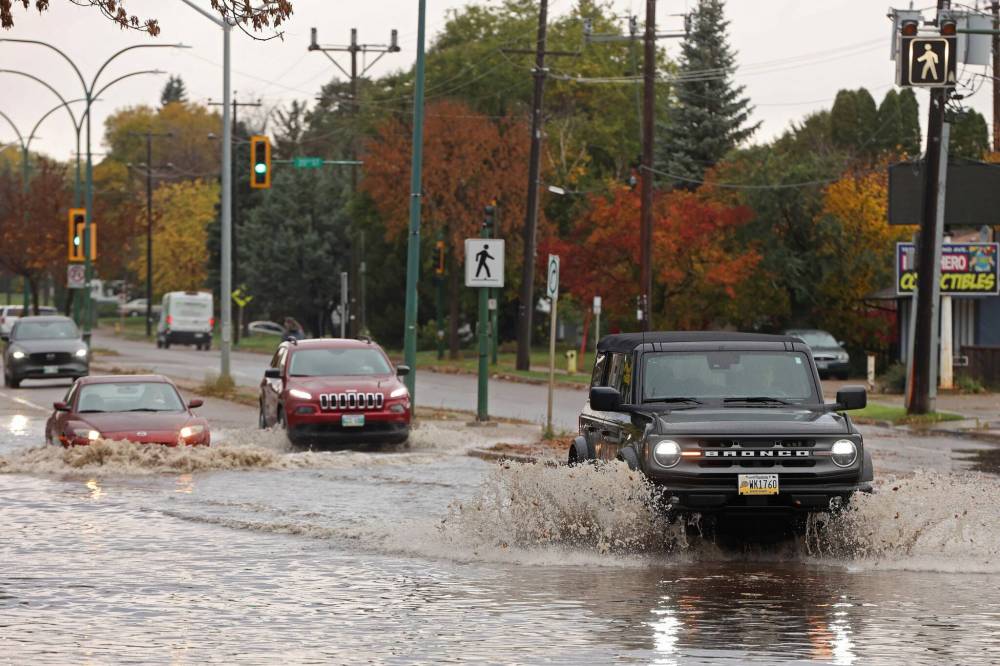
Tim Smith / The Brandon Sun
Vehicles drive through deep water flooding Richmond Avenue west of 18th Street after a thunderstorm and downpour on Thursday morning.
When one major Canadian bank shifts its interest rates, the others seem to follow suit almost in hours.
Now, there are fears that a decision by a large Quebec-based credit union may have a similar knock-on impact, one that could reverberate throughout the Canadian real estate market.
Desjardins Group has announced it will no longer write new mortgages for houses facing significant overland flooding risks, saying “the impacts of climate change, including water damage, are growing in importance and causing substantial damage.” The houses in question are those that are located in zero- to 20-year floodplains.
The decision comes as a result of changes in the Canadian home insurance marketplace.
Overland flooding insurance after major floods in Alberta in 2013. Since then, as risks have grown, about one in 10 Canadian homes have become uninsurable for that particular risk — insurance companies simply won’t write policies for homeowners who have high risks of flooding.
There have been efforts to have the federal government take on additional responsibility for overland flooding insurance — partnering to some degree with the private insurance sector to provide low-cost flood insurance and even “strategic relocation” for areas with the risk of recurrent flooding — but the federal plan is not moving quickly.
And without the federal plan, the issue could grow in size dramatically.
The concern is that, as often happens (and has happened in the insurance industry) other financial institutions may follow Desjardins’ lead. If that were the case, it could affect the ability of homeowners to get new mortgages for homes comprising about 10 per cent of the housing market, something like 1.5 million homes. It might make the houses lose value as buyers look elsewhere — or it could drive prospective owners to pay substantially more for mortgages from lenders willing to take the flooding risk.
That also creates a concentration problem for lenders: if there are fewer players in a particular kind of mortgage market, those willing to carry the risk will end up carrying a higher proportion of those higher-risk customers in their mortgage portfolios.
The likely end result is that, if you can even get it, a home in a risky area will cost more both to insure, and to mortgage.
The knee-jerk response from some people reading this editorial might be that the companies “are just trying to make more money.”
Well, that’s absolutely true — using evidence and experience, they’re taking a route that they believe will keep more money in their pockets.

MIKAELA MACKENZIE / WINNIPEG FREE PRESS/File
At least one major Canadian lender is stopping mortgages in flood zones.
It isn’t because insurance companies — and now, a major Quebec mortgager — are cashing in on a vast climate conspiracy.
If climate change simply was a conspiracy, there would be much more money to be made by staying in the market and charging customers premium prices for a risk that didn’t actually exist. Exiting the market would be like turning away free money.
But that’s not the case.
It’s actually a decision being made as a result of pragmatic, dollars-and-cents financial realities — and one made by watching the ever-increasing size and number of insurance payouts for events directly related to climate in Canada.

The companies simply can’t afford to stick their heads in the sand, ignore the facts and pay larger and larger amounts for ignoring obvious risks.
Scientists have been saying for years that climate change will lead to more frequent, more intense weather events.
Insurance companies, and now a home financer, are saying the exact same thing
Don’t want to follow the science?
Then follow the money.

Advertisement Advertise With Us
Advertisement Advertise With Us