

A tale of two taxes
Advertisement
Read this article for free:
or
Already have an account? Log in here »
To continue reading, please subscribe:

Digital Subscription
One year of digital access for only $205*
- Enjoy unlimited reading on winnipegfreepress.com
- Read the E-Edition, our digital replica newspaper
- Access News Break, our award-winning app
- Play interactive puzzles
*First annual payment billed as $205.00 + GST for one year. This annual subscription will automatically renew at $233.00 + GST every 52 weeks (10% off the regular annual price of $259.35). Offer available to new and qualified returning subscribers only. Cancel any time.
To continue reading, please subscribe:
Add Free Press access to your Brandon Sun subscription for only an additional
$1 for the first 4 weeks*
- Enjoy unlimited reading on winnipegfreepress.com
- Read the E-Edition, our digital replica newspaper
- Access News Break, our award-winning app
- Play interactive puzzles
*Your next Brandon Sun subscription payment will increase by $1.00 and you will be charged $17.95 plus GST for four weeks. After four weeks, your payment will increase to $24.95 plus GST every four weeks.
Read unlimited articles for free today:
or
Already have an account? Log in here »
Hey there, time traveller!
This article was published 09/04/2024 (920 days ago), so information in it may no longer be current.
Political mudslinging, budgets, and a rising carbon tax — all signs that spring has finally arrived.
Along with a blast of sunshine and the beginning of a spring thaw, Manitobans got a sense of the NDP government’s priorities with its first budget, plus a sneak peak of some federal initiatives expected in its upcoming budget on April 16.
We also saw increases of two separate taxes — one that incurred widespread protests, blockades, and even stylish new T-shirt slogans — and the other flew quietly under the radar, even though it will undoubtedly hit many homeowners harder.
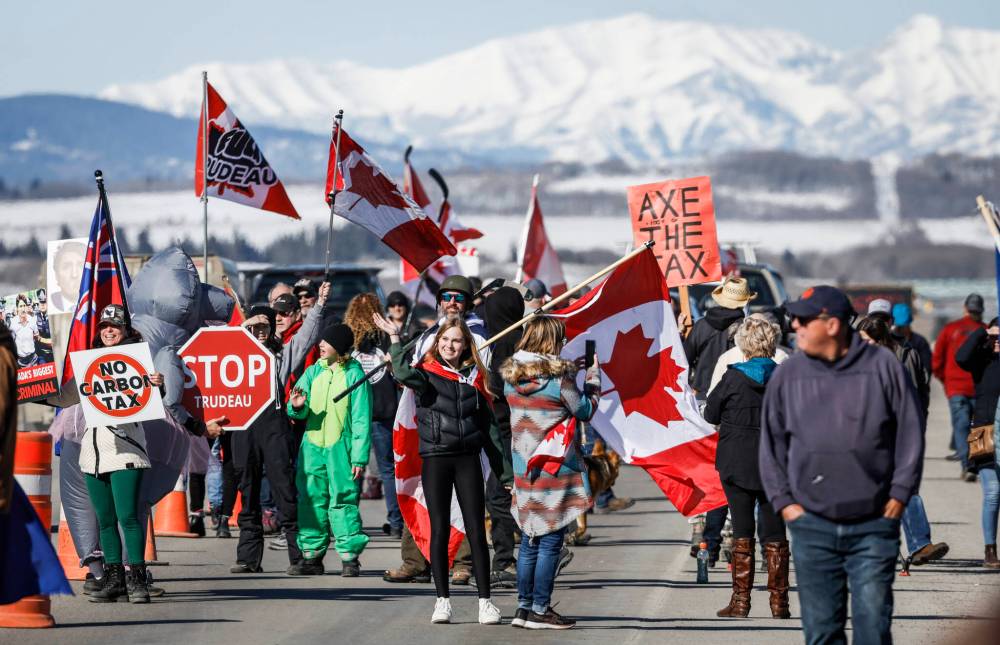
The Canadian Press
Carbon tax increases have generated opposition and protests, like this one near Cochrane, Alberta on April 1: new provincial taxes in Manitoba haven’t, at least not yet.
The first tax increase, the much-maligned carbon tax, increased by $15 per tonne on April 1, and will add about three cents a litre at the pumps, increase the cost of filling a propane tank for your barbecue by 40 cents, and add about $70 per year to the average home-heating bill. No small amount, for sure, plus this accelerating tax will increase the price of groceries and all goods reliant on distribution.
Having said that, in less than a week, the quarterly instalment of the carbon tax rebate will also get deposited into our bank accounts or mailed to our homes, making the average fossil-fuel consumer “whole,” so to speak. The spin is that for folks like us, this is a “revenue neutral” tax and shouldn’t negatively impact the “affordability” of our daily lives.
Nonetheless, it still prompted countrywide outrage. At intersections along the Trans-Canada highway and on street corners throughout the country, people were trumpeting Conservative leader Pierre Poilievre’s slogan, “axe the tax” and “spike the hike” while wearing T-shirts and hoodies like the one he wore when visiting our city last week.
To put it mildly, people hate this tax. The outrage proves it’s less about the dollars and more about the sense. People either haven’t bought into its purpose and don’t see how it’s going to have impact on carbon pollution, or they don’t believe in the climate science behind the tax, or, for some, don’t believe in climate science period. Whatever the reason, people are outraged, even with the rebate.
Let’s look at the second tax increase, unveiled in the NDP budget last week: the education property tax.
Strictly speaking, the government will say it’s not a tax increase. At least not in the same way as the despised carbon tax. But when government takes money out of your household budget — or as my former boss Brian Pallister liked to say, off the kitchen table — it’s a tax increase. In this case, to the tune of about $150 million.
Many people say education taxes don’t belong on our properties in the first place, and that it should be funded directly out of provincial revenues in the same way as health care, child care, and social housing. To that end, our PC government had begun the process of removing it with a 50 per cent tax rebate. Whether we would’ve removed it entirely if we had formed another mandate is anyone’s guess, but the rebate scheme was not without challenge.
It resulted in a smaller tax burden for commercial property owners and sent gigantic rebates to some people living out-of-province. It also reduced the tax load for more expensive homeowners disproportionate to those with smaller homes, and renters were cut short. To even things out, affordable housing initiatives were increased, namely rent assist, yet still, it was a stretch.

Unsurprisingly, the NDP government is scrapping it. Next year, the 50 per cent reduction will be gone, along with a $350 provincial credit. In its place will be a flat $1,500 rebate for every homeowner. Less expansive homeowners will see more with this rebate than they did under the other scheme, but many homeowners in the suburbs, commercial property owners, landlords and farmers — largely the same people protesting the carbon tax — will undoubtedly pay more.
Further, as property values increase and the rebate remains flat, the NDP government will take in more, resulting in an even larger tax burden and making home ownership less affordable.
If the carbon tax increase is expected to hit us hard in our pocketbooks, so too will this accelerating cost of home ownership. Yet it’s unlikely we’re going to see any snappy new T-shirt slogans or protestors in the streets, proving once again that it all comes down to political showmanship and less about the dollars and cents.
A politician high in the polls can get away with a lot more than one that is not.
Rochelle Squires is a recovering politician after 7 1/2 years in the Manitoba legislature. She is a political and social commentator whose column appears Tuesdays. rochelle@rochellesquires.ca
Related Articles
NDP broke election promise and it’s probably a good thing
Advertisement Advertise With Us
Advertisement Advertise With Us