

Feds should respect provincial jurisdiction
Advertisement
Read this article for free:
or
Already have an account? Log in here »
To continue reading, please subscribe:

Digital Subscription
One year of digital access for only $205*
- Enjoy unlimited reading on winnipegfreepress.com
- Read the E-Edition, our digital replica newspaper
- Access News Break, our award-winning app
- Play interactive puzzles
*First annual payment billed as $205.00 + GST for one year. This annual subscription will automatically renew at $233.00 + GST every 52 weeks (10% off the regular annual price of $259.35). Offer available to new and qualified returning subscribers only. Cancel any time.
To continue reading, please subscribe:
Add Free Press access to your Brandon Sun subscription for only an additional
$1 for the first 4 weeks*
- Enjoy unlimited reading on winnipegfreepress.com
- Read the E-Edition, our digital replica newspaper
- Access News Break, our award-winning app
- Play interactive puzzles
*Your next Brandon Sun subscription payment will increase by $1.00 and you will be charged $17.95 plus GST for four weeks. After four weeks, your payment will increase to $24.95 plus GST every four weeks.
Read unlimited articles for free today:
or
Already have an account? Log in here »
Hey there, time traveller!
This article was published 12/04/2024 (900 days ago), so information in it may no longer be current.
Living in a federation like Canada means that people in other provinces will do things differently than we do in Manitoba. That’s a good thing. It means that other provincial governments are responding to local needs and challenges that differ from the ones we face here.
A one-size-fits-all approach rarely makes sense in a big and diverse country like Canada.
Instead, important powers are held by provincial governments which allow them to adapt their approaches to local concerns.
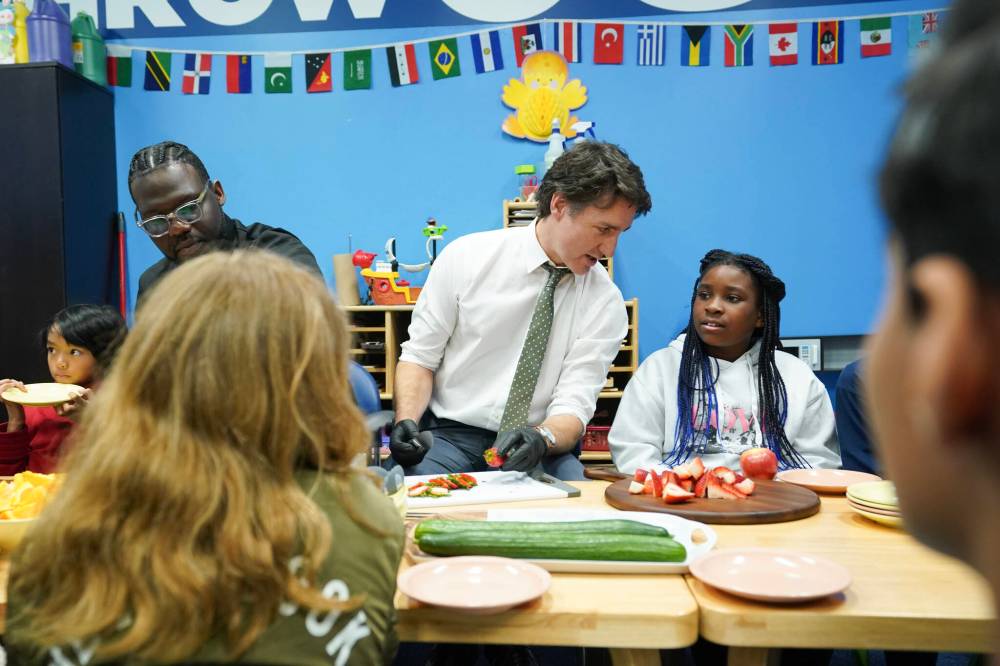
The Canadian Press FILES
Prime Minister Justin Trudeau talks to 10-year-old Chakai on April 1 as they prepare food for a lunch program at the Boys and Girls Club East Scarborough, in Toronto, before an announcement to launch a national school food program.
Ideally, the federal government should only hold responsibility for matters that necessarily relate to the country as a whole (such as commerce, defence and foreign affairs) and leave as much policy room as possible for provincial innovation and responsiveness.
Canada’s constitutional division of powers does this by guaranteeing jurisdiction to the provinces in a whole range of areas. The idea in a federation is that the provinces are sovereign in their areas of jurisdiction, not subject to the shifting whims of their lords in the federal government.
But the Constitution also provides a power to the federal level of government that has been twisted beyond recognition, in particular by the current Liberal government under Prime Minister Justin Trudeau: the federal spending power.
This power allows the federal government to spend money on whatever it wants to, including areas in provincial jurisdiction. Because the federal government has substantially more revenue power and thus money than the provincial governments, this has meant that the federal government has been able to impose itself into provincial jurisdiction through spending its money rather than by administering programs.
The present Liberal government has been particularly activist in this respect, dangling money in front of provincial governments to fund Trudeau’s priorities, and then imposing conditions on that money. It is nearly impossible for cash-strapped provincial governments facing voters to turn down the cash, even if the spending does not align with their own priorities.
But the provinces are then on the hook for administering and partially funding programs that may have little local support, and which they might be stuck with if the federal government decides to unilaterally claw back or cancel its contributions.
The result of this bull-in-a-china-shop approach under Trudeau is, by this point, pretty clear: a series of badly planned and mismanaged federal initiatives that are almost universally failing to meet their goals, and the worst federal-provincial relations in Canada since at least the 1980s.
But that hasn’t stopped the Trudeau government from finding new ways to intrude into provincial jurisdiction. The most recent example is the federal government’s promise to create a national school meal program. While short on details, the federal government will surely demand provincial administration of the program in the way Ottawa wants if they are to receive the money on offer.
Never mind that education issues are firmly in provincial jurisdiction. Never mind that the federal government has as much business intruding in this policy area as the government of Manitoba has in christening a provincial air force to patrol our borders or introducing a Manitoba-only currency.
Never mind that Manitoba has long had a patchwork of school lunch programs that were funded by a combination of charity groups, parent groups and governments, and which grew under the previous PC government. Never mind that Premier Wab Kinew’s NDP was elected just a few months ago with a clear mandate to create a provincial school meal program, and which the provincial government is proceeding with.
Never mind that this proposal to negotiate 13 bilateral federal-provincial agreements arrives about a year-and-a-half before a federal election that Trudeau will almost surely lose.
Never mind that we have no idea if the program will target the low-income kids who need it most or if, like the federal government’s “universal” 10-dollar-a-day daycare program, the wealthy will benefit first and most.

Never mind any of that. To hear defenders of the government, any opposition to the federal government’s latest intrusion into provincial jurisdiction is a clear statement in favour of keeping kids hungry. Contra this rubbish argument, I have been advocating for school meal programs in these pages for years, and am deeply concerned that the federal government’s back-of-a-napkin approach will only imperil these programs.
But that’s an argument for another day.
For today: living in a federation requires a certain maturity in the sense that one must recognize that other provinces will make decisions that we may not agree with. Provincial electorates from B.C. to Newfoundland and Labrador have the right to elect provincial governments with priorities that may include funding school lunch programs or introducing new tax cuts. That’s their right, however much I may disagree with the decisions made.
What isn’t right is a federal government which thinks it can continually impose its own views on the country as a whole despite the Constitution.
Royce Koop is a professor of political studies at the University of Manitoba and academic director of the Centre for Social Science Research and Policy.