

Don’t bury the tree bylaws
Advertisement
Read this article for free:
or
Already have an account? Log in here »
To continue reading, please subscribe:

Digital Subscription
One year of digital access for only $205*
- Enjoy unlimited reading on winnipegfreepress.com
- Read the E-Edition, our digital replica newspaper
- Access News Break, our award-winning app
- Play interactive puzzles
*First annual payment billed as $205.00 + GST for one year. This annual subscription will automatically renew at $233.00 + GST every 52 weeks (10% off the regular annual price of $259.35). Offer available to new and qualified returning subscribers only. Cancel any time.
To continue reading, please subscribe:
Add Free Press access to your Brandon Sun subscription for only an additional
$1 for the first 4 weeks*
- Enjoy unlimited reading on winnipegfreepress.com
- Read the E-Edition, our digital replica newspaper
- Access News Break, our award-winning app
- Play interactive puzzles
*Your next Brandon Sun subscription payment will increase by $1.00 and you will be charged $17.95 plus GST for four weeks. After four weeks, your payment will increase to $24.95 plus GST every four weeks.
Read unlimited articles for free today:
or
Already have an account? Log in here »
Hey there, time traveller!
This article was published 29/04/2024 (880 days ago), so information in it may no longer be current.
Ever wondered what kind of rules and regulations are in place to protect the city’s mature trees from the ongoing assault of road repairs, building demolition and construction?
Well, if you wanted to find out, you’d need to do a day’s worth of digging through a raft of bylaws, because the ones governing tree protection are buried inside a host of others pertaining to everything from public works and property development to a document entitled, somewhat obscurely, “Neighbourhood Livability.”
Small wonder that the guys working on roadways park their trucks and heavy machinery on top of tree roots and infill developers roll their massive diggers over boulevards without permission or permits.
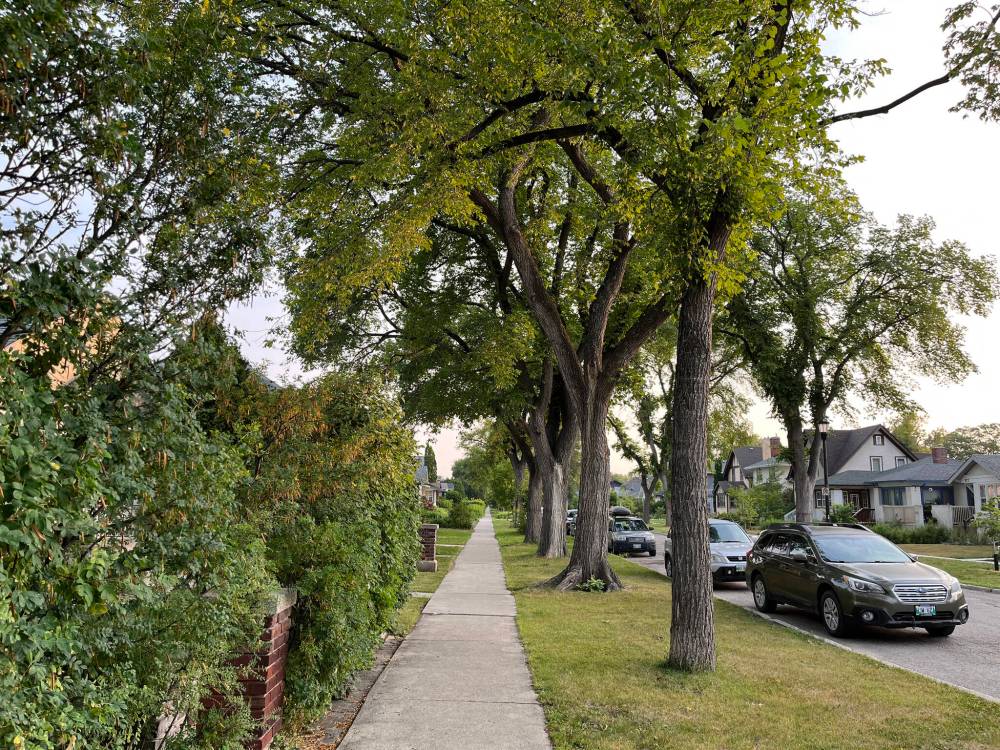
If it took me the better part of a day, and a lot of help from the folks at urban forestry, to figure out how we’re supposed to be protecting our public trees, then how is a small contractor, never mind an ordinary citizen, supposed to know not only where to find the bylaws, but also what they mean and why they’ve been enacted?
Take the boulevard crossing permit. That permit needs to be obtained by builders and even cross-country moving companies who have been known to drive their massive vehicles onto boulevards and park them there, simply for convenience sake.
So why do you need a permit and why might you be denied one? Because, low and behold, you can damage or kill one of those magnificent boulevard elms or ash trees just by compacting the soil their roots need to move through to find food and water. Park a heavy vehicle or constantly drive one across a boulevard et voila — you got a dead tree standing.
But if tree protection bylaws are tough to find and sort out, the way they’re enforced, or rather not enforced, is nothing short of depressing.
That’s why the city’s 20-year urban forestry strategy calls for a consolidated tree bylaw itemizing every rule and regulation pertaining to public tree protection, preservation and safety, especially during development and construction, plus the teeth to enforce them. And why public works has finally designated money in their budget to better protect our trees during city construction projects.
But the strategy’s bylaw recommendations don’t stop there. The authors also call for the new tree bylaw to cover the protection and preservation of trees on private land.
That part of the equation is critical, because 2.7 million trees, more than two-thirds of our mature canopy, currently sits on privately owned land with absolutely no protection whatsoever.
So essentially, while the city is busy planting saplings to replace the mature public trees we’ve lost to disease and planting more on public land to increase our canopy cover, thousands of our most valuable trees — the mature ones — have been and are being indiscriminately mowed down to make way for development on private property.
Indeed, since the 1970s Winnipeg development and construction has eaten up tens of thousands of our mature trees — entire intact forests in fact — simply because it was more convenient to clearcut thousands of trees rather than build around even a portion of them.
This, when it’s our mature trees that save us the most money in terms of pollution reduction, heat and storm water mitigation and carbon capture.
And if that isn’t painfully ironic, I don’t know what is.
Worse still, according to sources at city hall, there doesn’t seem to be much of “an appetite” among councillors for bylaws governing tree protection and preservation on private land.
Well, all I can say is this — those councillors better activate their taste buds quickly unless they want to see our few remaining intact forests wiped out or watch a slow war of attrition being waged against our mature trees on infill sites.
If that happens, then no matter how many new trees we plant, we’ll never reach even the modest canopy cover goal of 24 per cent by 2065, unlike Toronto which is already at 40 per cent and plans to be at 50 per cent by 2050. In fact without private tree bylaws, we’re much more likely to stay where we are, or worse, wind up with less than the current 17 per cent tree cover.

Look, I’ve said this before, and I’ll say it again. I am not arguing that we can save every tree on private property.
But surely the city can come up with a reasonable, financially sound compromise which results in bylaws designed to protect as many mature trees as possible, wherever possible.
If you agree, take a minute to call or email your councillor and tell them to support a consolidated bylaw that includes tree protection on private land.
And tell them to do it now.
Erna Buffie is a writer and filmmaker. Read more at https://www.ernabuffie.com/
Related Articles
Seine River environmental group looking for help to transform small park in weekend planting-palooza
Advertisement Advertise With Us
Advertisement Advertise With Us