

Will ‘quiet diplomacy’ work against a disruptive Trump?
Advertisement
Read this article for free:
or
Already have an account? Log in here »
To continue reading, please subscribe:
Monthly Digital Subscription
$1 per week for 24 weeks*
- Enjoy unlimited reading on winnipegfreepress.com
- Read the E-Edition, our digital replica newspaper
- Access News Break, our award-winning app
- Play interactive puzzles
*Billed as $4.00 plus GST every four weeks. After 24 weeks, price increases to the regular rate of $19.95 plus GST every four weeks. Offer available to new and qualified returning subscribers only. Cancel any time.
Monthly Digital Subscription
$4.99/week*
- Enjoy unlimited reading on winnipegfreepress.com
- Read the E-Edition, our digital replica newspaper
- Access News Break, our award-winning app
- Play interactive puzzles
*Billed as $19.95 plus GST every four weeks. Cancel any time.
To continue reading, please subscribe:
Add Free Press access to your Brandon Sun subscription for only an additional
$1 for the first 4 weeks*
*Your next subscription payment will increase by $1.00 and you will be charged $16.99 plus GST for four weeks. After four weeks, your payment will increase to $23.99 plus GST every four weeks.
Read unlimited articles for free today:
or
Already have an account? Log in here »
Hey there, time traveller!
This article was published 17/05/2024 (694 days ago), so information in it may no longer be current.
For as long as I have studied Canada-U.S. relations — over some 40 years now — the literature has singled out the practice of “quiet diplomacy.” In general, the tactic of quietly expressing Canadian demands and concerns behind closed doors has been viewed positively.
So, let’s assume for the moment that Republican Party flag-bearer Donald Trump wins the November U.S. presidential election.
Will executing a quiet diplomacy strategy work against the likes of a noisy, impulsive and vindictive Trump?
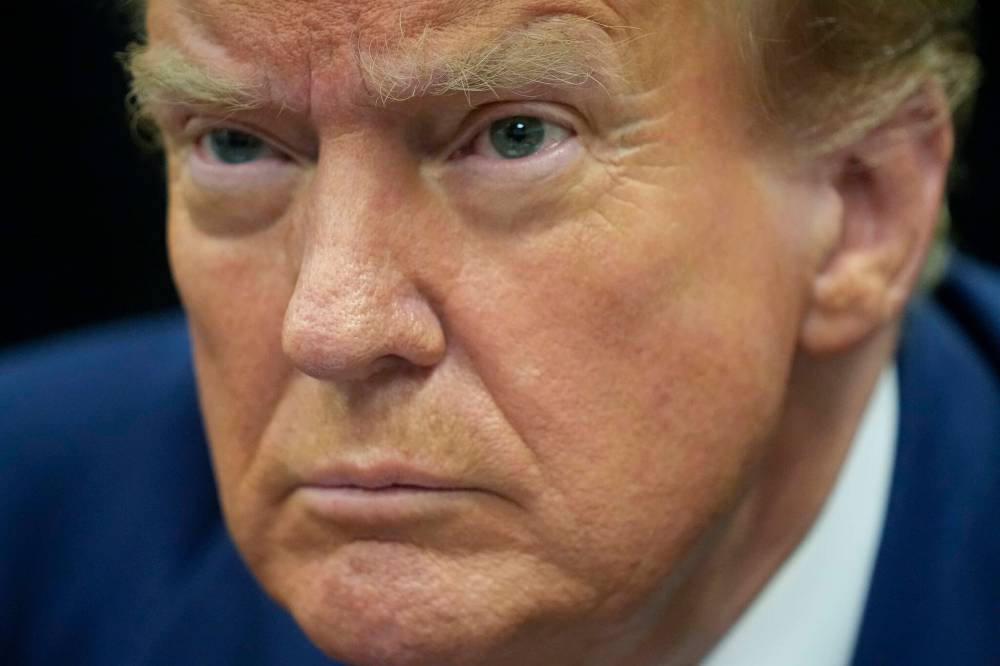
The Associated Press
Former U.S. president Donald Trump awaits the start of proceedings for his trial at Manhattan criminal court on April 23.
Will it hold up well against his seemingly implacable transactional presidency?
The arguments around quiet diplomacy in Canadian-American relations go back at least to the Lester Pearson years. After the stormy personal relations between then-U.S. President John F. Kennedy and Canadian Prime Minister John Diefenbaker — highlighted by sharp differences over the American Bomarc air defence missile system and the Cuban missile crisis — Pearson was determined to repair a badly damaged bilateral relationship. Working more closely with the U.S., rather than merely hampering and haranguing official Washington, would become the order of the day.
But Pearson himself went off script in April 1965 in a speech at Temple University in Philadelphia when he raised some pointed questions about the effectiveness of U.S. President Lyndon Johnson’s controversial “Operation Rolling Thunder” bombing campaign of North Vietnam. Pearson’s then-Secretary of State for External Affairs, Paul Martin Sr., even threatened to resign when he got wind of Pearson’s call for a “pause” in U.S. bombing.
When Pearson met Johnson the next day at the Camp David presidential retreat, it did not go very well. Johnson was out-of-sorts and angry about Pearson publicly interfering in U.S. domestic politics on American soil. Reportedly, he berated Pearson and grabbed him by the lapels of his jacket.
It was an obvious and nearly unforgivable breach of the Canada-U.S. quiet diplomacy modus operandi.
It was also a blatant reminder of a favourably-viewed dictum within the halls of Canada’s Department of External Affairs (DEA) — that is, that Canadian political leaders should not directly insert themselves into highly sensitive U.S. political matters, avoid like the plague blindsiding a U.S. president on American turf and religiously staying away from publicly airing criticisms of U.S. foreign policy.
After that imbroglio, the quiet diplomacy approach seemed to become a cardinal rule in the conduct of bilateral relations. Of course, it hasn’t always been followed wholeheartedly — as when Pierre Elliott Trudeau publicly criticized the policies of U.S. President Ronald Reagan and when Jean Chrétien parted ways with U.S. President Bill Clinton over his 1998 visit to Cuba — but it has certainly remained an enduring guiding principle.
It seems clear that acting quietly in our interactions with the White House has been viewed as the best strategy for fostering profitable relations with Washington and, more important, in securing Canada’s policy aims, both defensive and offensive, in Washington. Many Canadian prime ministers and foreign policy officials believed that a successful U.S. — whether in the diplomatic, economic and security dimensions — meant a successful Canada as well.
But there were those who felt firmly that quiet diplomacy was just a polite Canadian way of saying that the U.S. could do no wrong. That if Canada doesn’t have anything good to say about our friendly neighbour, closest ally and best customer, then we shouldn’t say anything at all.
It’s hard to believe, then, that Canada could turn a blind eye to what could be an increasingly authoritarian and non-democratic Trump Administration. In fact, the opposite of quiet complicity in Trump’s brazen dismantling of U.S. democratic institutions and practices would be called for. I can’t imagine that a Canadian government bent on being quiet would be able to do so without paying a huge electoral price at the polls.

Besides, it’s worth remembering that Trump doesn’t respect quiet acquiescence or the smell of fear. He’s all about seeking advantage, intimidating his detractors into silence and using maximum leverage to get want he wants. I just can’t see how remaining quiet when America is on fire serves Canada’s overall interests.
No one said that dealing with Trump would be easy. But when Canada promised to halt the exports of what went into making pretdonal protective equipment in the U.S. in the early days of the pandemic (when Trump said he would block those products from going to Canada), talked tough and broached the topic of trade penalties against U.S. goods entering Canada (after Trump imposed punitive tariffs on Canadian steel and aluminum), it certainly got Trump’s attention.
In the end, the Canadian government may have to shelve any thoughts of sticking to a Trump strategy of quiet diplomacy. It won’t work — and it would likely be counterproductive and backfire on us.
I’m afraid that confronting a bully like Trump will require Ottawa to stand up, to speak out loudly and, if need be, to threaten meaningful economic retaliation.
Peter McKenna is professor of political science at the University of Prince Edward Island in Charlottetown.