

Cleanup of river sewage met with silence
Advertisement
Read this article for free:
or
Already have an account? Log in here »
To continue reading, please subscribe:

Digital Subscription
One year of digital access for only $205*
- Enjoy unlimited reading on winnipegfreepress.com
- Read the E-Edition, our digital replica newspaper
- Access News Break, our award-winning app
- Play interactive puzzles
*First annual payment billed as $205.00 + GST for one year. This annual subscription will automatically renew at $233.00 + GST every 52 weeks (10% off the regular annual price of $259.35). Offer available to new and qualified returning subscribers only. Cancel any time.
To continue reading, please subscribe:
Add Free Press access to your Brandon Sun subscription for only an additional
$1 for the first 4 weeks*
- Enjoy unlimited reading on winnipegfreepress.com
- Read the E-Edition, our digital replica newspaper
- Access News Break, our award-winning app
- Play interactive puzzles
*Your next Brandon Sun subscription payment will increase by $1.00 and you will be charged $17.95 plus GST for four weeks. After four weeks, your payment will increase to $24.95 plus GST every four weeks.
Read unlimited articles for free today:
or
Already have an account? Log in here »
Hey there, time traveller!
This article was published 22/07/2024 (770 days ago), so information in it may no longer be current.
Winnipeg is experiencing a very wet year, so wet in fact that the rivers are rising and the riverbank vegetation can be described as jungle-like. High water has delivered a current clearly evident in the Red River’s flow to Lake Winnipeg.
Kayaking from the La Salle River in St. Norbert to my home in Wildwood took record time, even accounting for its twists and turns. We cruised past the mostly submerged St. Vital boat launch, landing on my shoreline which required the requisite “bottes en caoutchouc” (rubber boots), to ascend the muddy riverbank. Mosquitoes thrive in this riparian environment but the most significant insect noise is from crickets inside the provincial environment department.
As someone who loves to navigate the rivers in this city, I requested notifications from the city of untreated sewage reports so I could avoid the particularly nasty days. Although I am not coprophobic, I prefer that my paddle contacts the water rather than the ordure spilling from our combined sewers.
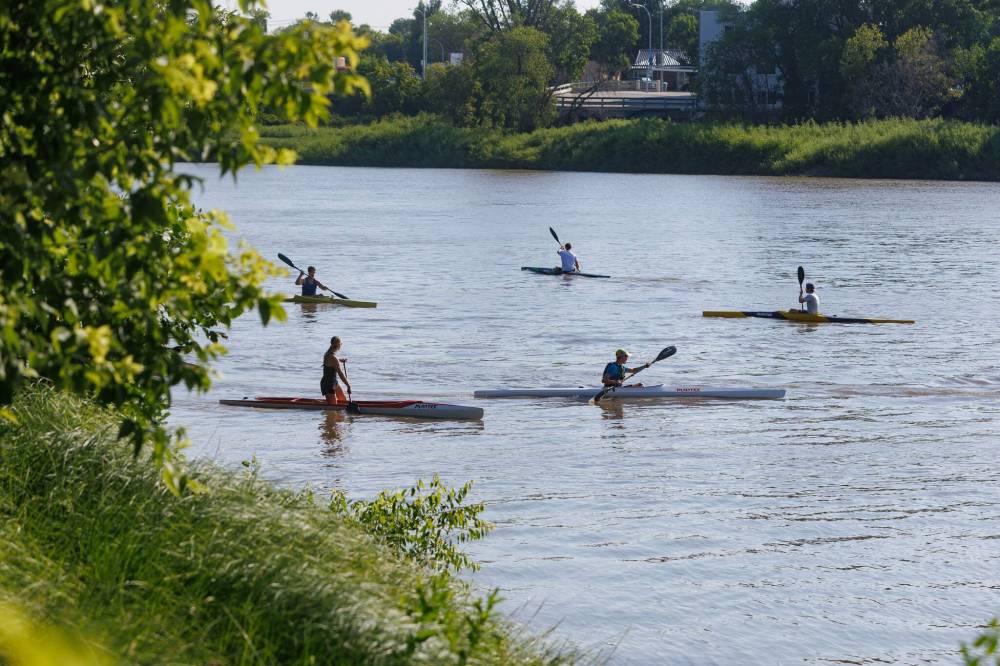
MIKE DEAL / Free Press Files
Kayakers on the Red River during training at the Manitoba Canoe and Kayak Centre.
The whole intention of notifications on one’s phone is to ensure that significant posts on email, text messages or social media are not missed. For all those FOMO (fear of missing out), people who love the rivers, the one notification you don’t want to miss is sewage overflows. My email this spring has been pinging on a regular basis as already 30 entries have been recorded, the total of which may exceed the 5.4 billion litres from last year.
Finding the correct site may be challenging as city communications have moved their untreated sewage reports to a new URL without linking to the established one. “This site can’t be reached,” is all that remains, and data which is important for the public to know have been conspicuously buried with no forwarding address. Lovely diagrams of our sewer system are colourfully presented but the hard cold facts may take some serious sleuthing to find.
The Abinojii Mikanah bypass, which resulted in almost daily spills in February, released millions of litres of untreated toilet water. Heavy rainfall often overwhelms our sewage system which combines with runoff to create spills. These are often due to construction, broken pipes or water mains and power outages, all of which speak to a compromised infrastructure.
As Toronto learned last weekend, climate change has become the Sword of Damocles, ready to smite those municipal structures where paving leaves nowhere for water to go. Estimates of the damage point to more than $1 billion.
This will be the year that the city produces its five-year water quality report to measure the impact of these overflows, yet we already know that beaches at Gimli and Albert Beach are closed due to E. coli and another report isn’t necessary to tell Manitobans that the City of Winnipeg is contributing to the pollution of Lake Winnipeg.
Not only is the fecal coliform count a problem but, according to research from Iowa University, combined sewers contribute a number of constituents that are normally treated, which instead wind up directly in the river — including heavy metals, pathogens, oils and grease, pesticides and herbicides. These are not healthy additions to the aquatic environment and may seriously affect the river’s fauna.
Alternatives to achieve a reduction in these spills can be accomplished by diverting the runoff to tanks or tunnels as a temporary measure until sewage and runoff can be separated.
Cities throughout the U.S have adopted similar methods of storing, settling and disinfecting these runoffs. Grand Rapids, Mich., achieved a significant reduction with a US$30-million investment in the 1990s. Interim measures in Richmond, Va., and San Francisco have also met with remarkable success.
All of these stories are as a result of pressure put upon them by the EPA (the federal Environmental Protection Agency). Even Paris has resorted to a massive underground storage basin in an effort to collect run-off to their combined sewers, allowing Olympic swimming competition to occur in the Seine river.
Both federal and provincial law insist that polluters must be brought to justice. The responsible authorities in Ottawa and on Broadway have failed to act precipitating serious litigation by eight First Nations bands who value our waterways.

Winnipeggers want a solution to this problem that is not simply to either let the sewage flow or trigger sewer back-ups to thousands of basements. The problem is much more nuanced than that and involves a different mindset and alternative planning.
Our minister of environment and climate change needs to quarterback a plan that is well researched with federally leveraged funds. She has been charged by the premier to fulfil a commitment to protect Lake Winnipeg and safeguard the health of all our waterways.
The welcome sound of progress would be music to our ears.
Crickets just won’t do.
Dave Taylor has drawn attention to the pollution of rivers in Manitoba for several decades and is a regular contributor to the Winnipeg Free Press. Please see his blog at https://wpgsewage.wordpress.com