

Would a Trump second term be any different than the first?
Advertisement
Read this article for free:
or
Already have an account? Log in here »
To continue reading, please subscribe:
Monthly Digital Subscription
$1 per week for 24 weeks*
- Enjoy unlimited reading on winnipegfreepress.com
- Read the E-Edition, our digital replica newspaper
- Access News Break, our award-winning app
- Play interactive puzzles
*Billed as $4.00 plus GST every four weeks. After 24 weeks, price increases to the regular rate of $19.95 plus GST every four weeks. Offer available to new and qualified returning subscribers only. Cancel any time.
Monthly Digital Subscription
$4.99/week*
- Enjoy unlimited reading on winnipegfreepress.com
- Read the E-Edition, our digital replica newspaper
- Access News Break, our award-winning app
- Play interactive puzzles
*Billed as $19.95 plus GST every four weeks. Cancel any time.
To continue reading, please subscribe:
Add Free Press access to your Brandon Sun subscription for only an additional
$1 for the first 4 weeks*
*Your next subscription payment will increase by $1.00 and you will be charged $16.99 plus GST for four weeks. After four weeks, your payment will increase to $23.99 plus GST every four weeks.
Read unlimited articles for free today:
or
Already have an account? Log in here »
Hey there, time traveller!
This article was published 23/08/2024 (611 days ago), so information in it may no longer be current.
It may well be true that the electoral tides have shifted appreciably since U.S. Vice-President Kamala Harris entered the presidential election fray. But if we’ve learned anything about former president Donald Trump, it’s that you can never count him out.
If that is so, then it is worth recalling what life was like under the first Trump Administration. Let’s just take the examples of Trump’s bizarre personal relationship with North Korea’s “rocket man,” the ruthless and despotic Kim Jong Un, and his implacable disdain of America’s commitment to stationing 28,000 U.S. soldiers in South Korea.
Unlike his predecessors, Trump was intent on currying favour (including an exchange of so-called “love letters”) with North Korea’s “Dear Leader” and demonstrated a firm willingness to remove the U.S. military’s footprint from the Korean Peninsula. Needless to say, it was totally incomprehensible how these moves would advance U.S. security and commercial interests in the region.

Saul Loeb / AFP / Getty Images
Then-U.S. president Donald Trump (R) walks with North Korea’s leader Kim Jong Un during a break in talks at the second U.S.-North Korea summit at the Sofitel Legend Metropole hotel in Hanoi in February of 2019.
For a moment, fast-forward to Joe Biden’s presidency and his completely different approach to the Korean situation. He wants precious little to do with Kim Jung Un and has no intention of rewarding him for enhancing his ballistic missile capacity. As for the South Koreans, Biden is seeking to expand and deepen political, economic and military relations with its current president, Yoon Suk Yeol.
During the July NATO summit in Washington, both governments strengthened their nuclear deterrence (and U.S. “extended deterrence”) guidelines and warned that any nuclear attack by North Korea would be met by a “swift, overwhelming and decisive” military response. The two sides also agreed to conduct joint military manoeuvres, whole-of-government simulations and regularized tabletop exercises in the coming months.
Furthermore, it is no surprise that the South Koreans are frantically looking to renew a bilateral cost-sharing agreement, the so-called Special Measures Agreement (which is more favourable to them), on the placing of U.S. troops in South Korea so as to deter aggressive acts by North Korea.
With diplomatic talks underway and the current arrangement set to expire in late 2025 — not to mention the very real prospect of a Donald Trump White House in 2025 — the South Koreans are anxious to cut a new deal before the year is out. According to former U.S. ambassador to South Korea Harry Harris, Seoul is “hedging against a possible Trump Two administration — they’ve seen this movie and it was very painful.”
Lately, I’ve been rereading John Bolton’s book, The Room Where It Happened for my course this September in American foreign policy. You may recall that Bolton was Trump’s National Security Advisor and left the administration in a storm of controversy in September 2019. But his chapter dedicated to the two Koreas is particularly illuminating and portentous.
No matter how hard government officials tried, Trump was convinced that the U.S. military commitment to South Korea was a rip-off. “Why are we there?”, he would repeatedly ask. And if the U.S. is going to have a military presence in the region, Trump figured that the South Koreans should at least be paying US$5 billion annually (up from the US$900 million) for that protection.
Bolton was perturbed by the fact that Trump simply wanted to wash his hands of anything that had to do with the Korean Peninsula and Japan. He just couldn’t grasp the geopolitics of the region. Of course, Seoul was understandably horrified and kept trying to explain to Trump that U.S. security interests are inextricably linked to peace and stability on the Korean Peninsula.

In addition, Bolton was particularly worried about Trump meeting face-to-face with Kim Jong Un in Singapore and then in Vietnam (to say nothing of the purely political photo-op of the two leaders at the DMZ at the border in June 2019). He feared most of all that Trump was willing to make far too many concessions to Kim in exchange for weak promises on the denuclearization front. Indeed, it absolutely sickened Bolton to think that Trump would even entertain the thought of inviting Kim to the White House.
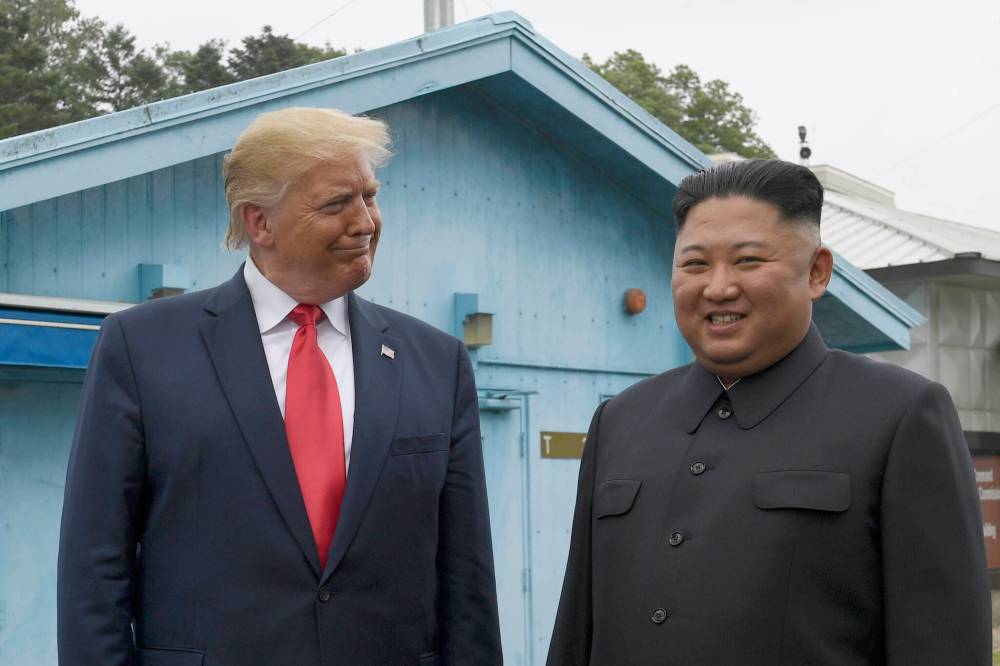
AP Photo/Susan Walsh
U.S. President Donald Trump meets with North Korean leader Kim Jong Un at the border village of Panmunjom in the Demilitarized Zone, South Korea, June 30, 2019.
It was true that Trump did eventually walk away from any “deal” with Kim and remained committed to sanctions and “maximum pressure” against the North Korean regime. But Bolton makes it very clear that he always feared that Trump’s obsession with remaining close friends with Kim would inevitably jeopardize U.S. vital national interests down the road.
What makes Bolton’s account of the Korean Peninsula so significant (and not just because it is coming from a hard-line conservative ideologue) is what it reveals about Trump’s overall approach to matters of U.S. foreign policy.
It was patently clear to Bolton that a transactional Trump was above all motivated by how his decisions would impact him politically, his electoral standing and his presidential re-election prospects. In an especially telling line, Bolton explains: “He (Trump) couldn’t tell the difference between his personal interests and the country’s interests.”
Peter McKenna is professor of political science at the University of Prince Edward Island in Charlottetown.