

Nuclear dreams just aren’t coming true
Advertisement
Read this article for free:
or
Already have an account? Log in here »
To continue reading, please subscribe:
Monthly Digital Subscription
$1 per week for 24 weeks*
- Enjoy unlimited reading on winnipegfreepress.com
- Read the E-Edition, our digital replica newspaper
- Access News Break, our award-winning app
- Play interactive puzzles
*Billed as $4.00 plus GST every four weeks. After 24 weeks, price increases to the regular rate of $19.95 plus GST every four weeks. Offer available to new and qualified returning subscribers only. Cancel any time.
Monthly Digital Subscription
$4.99/week*
- Enjoy unlimited reading on winnipegfreepress.com
- Read the E-Edition, our digital replica newspaper
- Access News Break, our award-winning app
- Play interactive puzzles
*Billed as $19.95 plus GST every four weeks. Cancel any time.
To continue reading, please subscribe:
Add Free Press access to your Brandon Sun subscription for only an additional
$1 for the first 4 weeks*
*Your next subscription payment will increase by $1.00 and you will be charged $16.99 plus GST for four weeks. After four weeks, your payment will increase to $23.99 plus GST every four weeks.
Read unlimited articles for free today:
or
Already have an account? Log in here »
Hey there, time traveller!
This article was published 07/09/2024 (579 days ago), so information in it may no longer be current.
Canada’s so-called clean/green nuclear vision is quickly coming apart at the seams.
Lobbyists and marketing gurus who promised that within 10 years we would have small modular reactors scattered across our northern regions have been hit by the economic reality that nuclear is not affordable, nor is it clean or green.
Those premiers (New Brunswick’s Blaine Higgs, Saskatchewans’s Scott Moe, Alberta’s Danielle Smith and Ontario’s Doug Ford) who jumped on the bandwagon and anted up millions for unproven, untested technology are coming to realize they have been duped, or perhaps they are celebrating this distraction from realistic alternatives in order to keep their carbon economies thriving. The federal government has thrown $175 million into five such projects in the provinces.
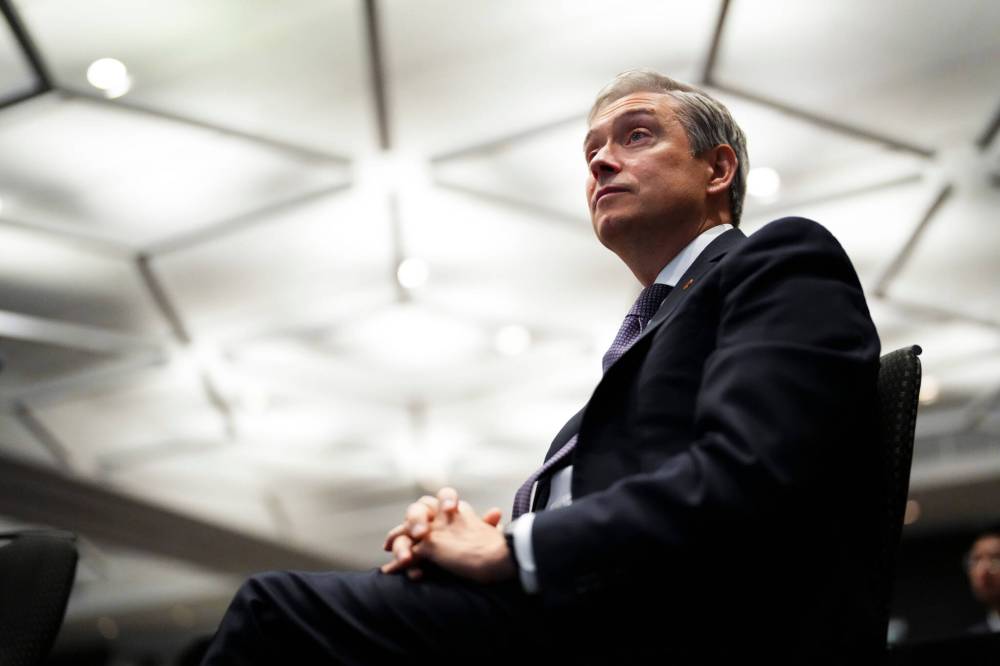
Sean Kilpatrick / The Canadian Press files
Federal Innovation, Science and Industry Minister Francois-Philippe Champagne has said that nuclear power is a key factor in Canada’s shift to renewable energy.
The Canadian plan was to build 85 small modular reactors (SMR) by 2050, at the imprecise cost of $100 billion to $200 billion.
Various players entered the fray with their own unique designs and projections, although most continue to remain on the drawing board. New Brunswick’s proposed Moltex SMR requires an additional $500 million in government funding just to develop its designs.
In the U.S., NuScale had intended on building America’s first SMR, but cost estimates ballooned from $3 billion to $9.3 billion dollars — which quickly terminated the project and resulted in the layoff of 40 per cent of its workforce.
Rolls Royce in the U.K. is selling off a stake in its SMR business. The pipedream of small modular reactors may never be realized, as they rely on the mass production of modular components which would require vast quantities to be sold.
Prudent investors who were invited last March to a Nuclear Energy Summit balked at the ambitious nuclear sales pitch, referring to investor enthusiasm as misguided. The European Investment bank pointed to the risks as very high, ranking nuclear as the last option to fight climate change.
This is nothing new for the industry, as Ontario’s experience is fraught with cost overruns which drive ever-increasing hydro bills. Pickering, for example, is the most expensive and least reliable plant in the world. Without massive government funding, SMRs are doomed.
The resurgence of any nuclear future for Canada depends upon a failsafe solution for the existing nuclear waste which has been accumulating since the early 1960s.
The owners of this waste — Ontario Power Generation, New Brunswick Power Corporation and Hydro-Québec, along with Atomic Energy of Canada Limited — have set aside millions to convince a community to embrace a disposal site where high-level waste can be abandoned.
Potential hosts have been pared down to two, South Bruce on Lake Huron, and Ignace on the Wabigoon watershed that flows into Lake of the Woods, the Winnipeg River and ultimately Lake Winnipeg.
Although the town of Ignace has voted to continue in the siting process, the location is on traditional territory of Wabigoon Lake Ojibway Nation, (Asubpeeschoseewagong Netum Anishinabek), which opposes the concept. This position is not surprising, considering its people are suffering from methylmercury poisoning from abandoned pulp and paper mills. Any further progress in obtaining a site will lie with the First Nation people who are stewards of these lands.
Experiments involving digging a shaft in the Shield were conducted near Lac Du Bonnet, where it soon became apparent that when you drill into rock, water flows endlessly, a major detriment to the concept of deep geological disposal. The AECL Underground Research Laboratory has since been backfilled and the concept unproven, yet this is the same plan on which Canada has put its money.
Nuclear’s clean/green handle is easily refuted by the tons of low and medium waste accumulated over the years in reactors and research facilities. Primitive practices such as burying it in unlined trenches and filling standpipes make restoring these lands virtually impossible, as it is safer to leave the waste “in situ,” or where it lies, than to dig it up and transport it. The proposal to add it to a mound on the Ottawa River at Chalk River is fraught with problems, and opposition has mounted.
Our own Whiteshell Lab at Pinawa was to be “cleaned up,” but between having nowhere to dispose of the years of historical waste, and an incompetence by the consortium hired, progress has ground to a snail’s pace.
The contractors who failed to comply with the Nuclear Safety and Control Act have been unable to fully operate for more than 16 months, although they hope to resume full operations mid-September after a third party assesses their progress. Ironically, Canadian Nuclear Labs, which runs the project, led by Real Atkins (formerly SNC Lavalin), are seeking a new three-year licence.

Considering these factors, a shorter leash makes more sense.
Add it all up, and nuclear is uneconomical, generates radioactive waste toxic to humans virtually forever with no proven solution for getting rid of it, and sites that are already contaminated will not be returned to their original green state.
Dirty, polluting and expensive are more apt descriptions for this dinosaur of an industry that splits atoms to boil water.
Dave Taylor has been a contributor to the Winnipeg Free Press on environmental issues for over 30 years. Please see his blog at:
manitobanuclea.wordpress.com