

Another female premier at the table
Advertisement
Read this article for free:
or
Already have an account? Log in here »
To continue reading, please subscribe:

Digital Subscription
One year of digital access for only $205*
- Enjoy unlimited reading on winnipegfreepress.com
- Read the E-Edition, our digital replica newspaper
- Access News Break, our award-winning app
- Play interactive puzzles
*First annual payment billed as $205.00 + GST for one year. This annual subscription will automatically renew at $233.00 + GST every 52 weeks (10% off the regular annual price of $259.35). Offer available to new and qualified returning subscribers only. Cancel any time.
To continue reading, please subscribe:
Add Free Press access to your Brandon Sun subscription for only an additional
$1 for the first 4 weeks*
- Enjoy unlimited reading on winnipegfreepress.com
- Read the E-Edition, our digital replica newspaper
- Access News Break, our award-winning app
- Play interactive puzzles
*Your next Brandon Sun subscription payment will increase by $1.00 and you will be charged $17.95 plus GST for four weeks. After four weeks, your payment will increase to $24.95 plus GST every four weeks.
Read unlimited articles for free today:
or
Already have an account? Log in here »
Hey there, time traveller!
This article was published 24/10/2024 (670 days ago), so information in it may no longer be current.
Alberta Premier Danielle Smith will now have some company at the first ministers meetings. New Brunswick has just elected its first woman premier — Liberal Susan Holt.
This week has been an exciting week for women’s enfranchisement. Another woman to join the rarified air of first minister in Canada, and in B.C., a record-breaking number of women and gender-diverse representatives elected. Even though there are several seats under recount, at least 40 per cent of those elected are women or gender diverse in B.C. and it’s anticipated that province could be the first to elect a majority of women or gender-diverse candidates when the official count is finalized.
But the big story is the new face as leader in N.B. For a very small window in 2013, it felt like women premiers were in vogue. Eve Aariak in Nunavut; Kathleen Wynne in Ontario; Christy Clark in B.C.; Alison Redford in Alberta; Pauline Marois in Quebec; and Kathy Dunderdale in Newfoundland and Labrador were celebrated in what was called the “year of the women.” It was unprecedented and suggested that the glass ceiling had finally been shattered for women leaders.
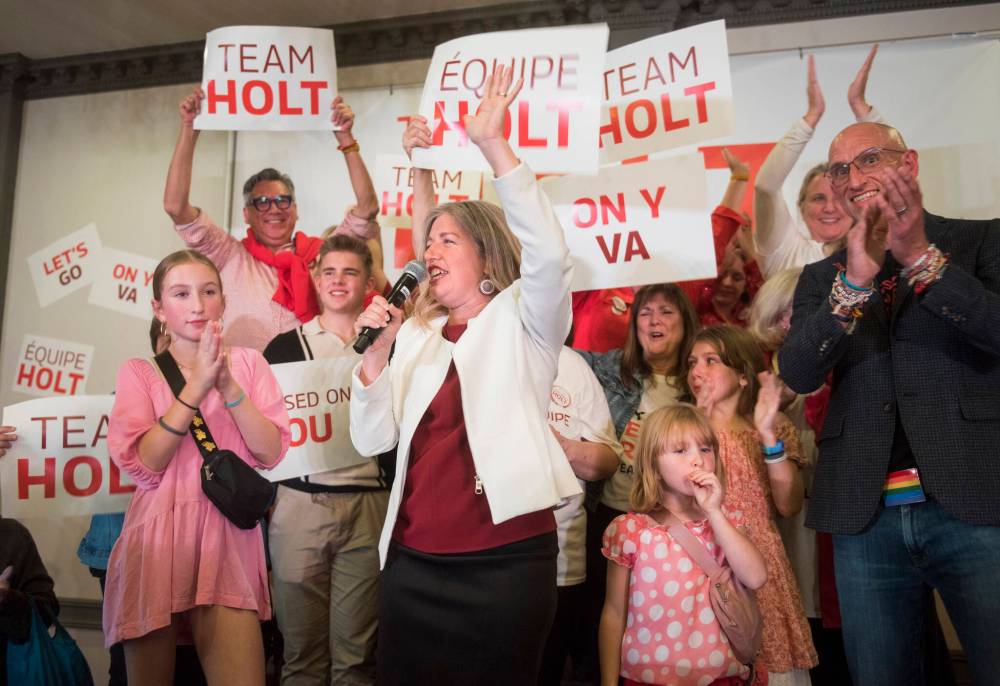
Stephen MacGillivray / The Canadian Press files
New Brunswick Liberal Leader Susan Holt (centre), with daughters, Molly, 12, Brooke, 6, Paige, 10, and husband Jon Holt, addresses supporters after her election win Monday.
And now, there’s but one. Smith stands alone until Holt joins her after her swearing-in ceremony. Yet, it’s how Holt won that could provide a message of hope for success for progressive governments. And there’s also a need for a bit of cynicism, as both Smith and Holt look ahead on their political futures.
First, a word of caution. So far, no woman premier has ever won two successive general elections. The longest tenure of the 15 (soon to be 16) women who have stood as first ministers is Clark, who lasted more than six years after winning one majority and then one minority government in B.C. Aariak was the leader in Nunavut for five years — elected for just one term in the non-partisan government.
There has been a theory that women were elected into the role of party leadership as “sacrificial lambs.” The idea here is that only when the party is in such disarray are men willing to give power away to women and thus, women step in to clean up the mess left behind and pull the party out of the abyss. Usually once the ship has been put to rights, then men rise up from behind the curtain to wrest control away from the woman who has now been deemed incompetent and the leadership returns to the patriarchy.
Many scholars would suggest that is exactly what happened in the case of Canada’s one and only female prime minister Kim Campbell, who was left with a growing deficit created by Brian Mulroney and the disintegration of traditional party politics with the rise of the Bloc Québécois and the Reform Party. Campbell was the quintessential sacrificial lamb — an easy scapegoat to blame for losing an election that wasn’t the Conservatives to win in the first place.
Looking for Manitoba examples: Sharon Carstairs certainly comes to mind. But I could be convinced that former premier Heather Stefanson was a bit of a scapegoat as well. Brian Pallister didn’t exactly do her many favours.
There are several women’s names being bandied about to replace Justin Trudeau as Liberal leader, including Christy Clark and Mélanie Joly, the current foreign affairs minister. Could they too become sacrificial lambs, taking over a party with few viable male candidates interested in taking the lead? Or will former Bank of Canada governor Mark Carney place a bid? It remains to be seen.
One thing is for certain. New Brunswick’s Holt is hardly a sacrificial lamb. She won the Liberal leadership (the first woman to do so) and ousted a 70-year-old Conservative seeking his third term, largely with a message of hope.
That’s the good news in these election stories. Hope can go a long way or at least that’s what U.S. Vice-President Kamala Harris is banking on right about now.

Blaine Higgs came into the national spotlight as N.B. premier when he decided to implement changes to gender identity policies in classrooms, creating a caucus revolt. Among the changes considered was that students under 16 needed to get their parents’ permission to have teachers and staff use their chosen names and pronouns.
Holt pushed back against those changes and made that part of her election platform. The politicos who covered the N.B. campaign suggested her platform offered equality and balance in a direct bid to counter her competitor. Obviously, it resonated with voters.
Saskatchewan goes to the polls next week. Along with Nova Scotia, it has never had a female premier and this election will not change that outcome. It also will not break any records in terms of electing women to the legislature. In that province, it will probably be more of the same. But there’s always next time.
Shannon Sampert is a political scientist and a lecturer at RRC Polytech. She was the politics and perspectives editor at the Free Press from 2014-17.
shannon@mediadiva.ca