

Playing with fire results in misery
Advertisement
Read this article for free:
or
Already have an account? Log in here »
To continue reading, please subscribe:

Digital Subscription
One year of digital access for only $205*
- Enjoy unlimited reading on winnipegfreepress.com
- Read the E-Edition, our digital replica newspaper
- Access News Break, our award-winning app
- Play interactive puzzles
*First annual payment billed as $205.00 + GST for one year. This annual subscription will automatically renew at $233.00 + GST every 52 weeks (10% off the regular annual price of $259.35). Offer available to new and qualified returning subscribers only. Cancel any time.
To continue reading, please subscribe:
Add Free Press access to your Brandon Sun subscription for only an additional
$1 for the first 4 weeks*
- Enjoy unlimited reading on winnipegfreepress.com
- Read the E-Edition, our digital replica newspaper
- Access News Break, our award-winning app
- Play interactive puzzles
*Your next Brandon Sun subscription payment will increase by $1.00 and you will be charged $17.95 plus GST for four weeks. After four weeks, your payment will increase to $24.95 plus GST every four weeks.
Read unlimited articles for free today:
or
Already have an account? Log in here »
Hey there, time traveller!
This article was published 15/11/2024 (636 days ago), so information in it may no longer be current.
It’s painful to read headlines, listing off fires in encampments and rooming houses locally and around the country. Sadly, not many months go by in Canada without another needless death from horrific living conditions.
As well, there has been an increasing number of buildings closed for being deemed unfit for human habitation. Why have such conditions worsened during the last decade despite the commitment of tens of billions of dollars in federal housing funding?
It is critical to frame the collapse of housing safety within a contradictory policy environment. Namely, the 2019 National Housing Strategy Act (NHSA) passed by Parliament which calls on the Government of Canada to “recognize that the right to adequate housing is a fundamental human right affirmed in international law; and recognize that housing is essential to the inherent dignity and well-being of the person and to building sustainable and inclusive communities.”
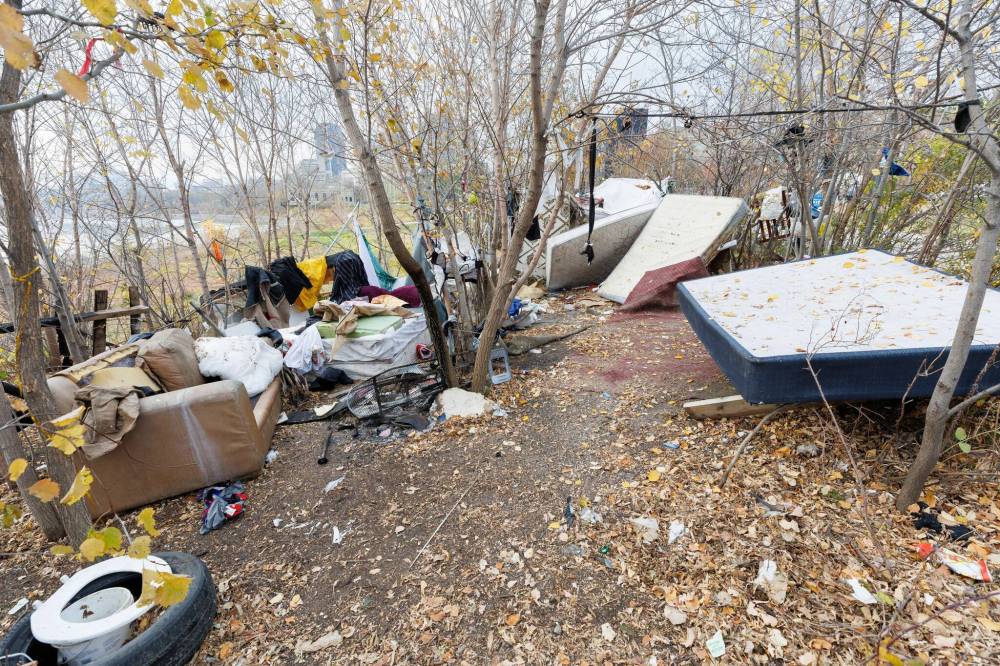
MIKE DEAL / FREE PRESS
The remains of part of an encampment in Fort Douglas Park near Waterfront Drive and Galt Avenue after a recent fire.
The NHSA also created a watchdog in the Federal Housing Advocate to hold government to account for ensuring that NHSA achieves its stated goals. However, the Advocate has been on the fence with encampments, stating in a recent report, “for people living in encampments, every day is a matter of life and death” while also acknowledging that despite the clear threat to life and safety, encampments represent one’s right to housing.
We must move past any ambiguity and focus squarely on a plan that ends encampments.
Yet since the passage of the NHSA, we have collectively failed to address the fact that there is an increasing number of Canadians who lack basic housing. This is evidenced in far too many being relegated to transit shelters, ramshackle encampments, deplorable rooming houses and single-room occupancy hotels. In Winnipeg alone, those in such precarious situations number in the thousands.
What should frighten community organizations and others working to address dire housing conditions is policy tilting toward punitive measures that seek to criminalize homelessness while being lackadaisical in enforcement of basic building standards and codes.
The most stunning was the United States Supreme Court ruling in The City Grants Pass Oregon v. Johnson et al. The outcome granted cities the right to not only ban encampments, but to make living in such a potential criminal act.
It is this kind of policy reaction that is gaining widespread momentum, despite the root causes of the global housing crisis being located in massive shortfall in affordable housing and critical supports.
Closer to home, a group of Ontario mayors recently called on the provincial government to consider invoking the notwithstanding clause to sidestep legal obstacles to closing encampments arising from an earlier court decision that prevented forced eviction. In Vancouver, the fight to forcibly remove hundreds camped on Hastings polarized those favouring enforcement of standards, with others advocating for the right of people to remain.
Such scenarios will continue to play out in absence of building and or allocating more affordable housing.
It is critical to clearly and unequivocally state that encampments are inherently a dangerous form of shelter with most, if not all, lacking sanitation, fire safety or rudimentary occupancy standards. In fact, I will argument that such conditions are much more harm inducing than reducing, regardless of whether they are viewed as affirming one’s right to shelter.
Earlier this month, I attended a workshop hosted by the Mental Health Commission of Canada that launched Housing First in Canada 15 years ago.
The intent of the workshop was to examine the state of addressing mental health and homelessness.
What was clear from the session is Manitoba is viewed as a leader in solutions to end homelessness using a range of tools. This includes the recent provincial allocation of over $4 million to launch new Assertive Community Treatment (ACT) teams and Flexible ACT or FACT teams.
This will go a long way in providing help to those most vulnerable persons. This, coupled with a clear plan to secure quality housing, can be even more impactful.

In addition, Winnipeg has many teams with the skills to transition people from encampments using Housing First models, transitional and supportive housing approaches or ACT and FACT teams.
What remains gut-wrenching is to hear people say over and over that living on the street is safer than what is available.
This should send shivers up all our spines and be a call to build and demand decent housing. I truly believe Winnipeg and Manitoba are leaders in ending homelessness. We need to accelerate our work and not give into the movement that being without shelter is a crime.
What really is a crime is that we have failed far too many for far too long.
Jino Distasio is a professor of urban geography at the University of Winnipeg.