

A graveyard for toppled statues
Advertisement
Read this article for free:
or
Already have an account? Log in here »
To continue reading, please subscribe:

Digital Subscription
One year of digital access for only $205*
- Enjoy unlimited reading on winnipegfreepress.com
- Read the E-Edition, our digital replica newspaper
- Access News Break, our award-winning app
- Play interactive puzzles
*First annual payment billed as $205.00 + GST for one year. This annual subscription will automatically renew at $233.00 + GST every 52 weeks (10% off the regular annual price of $259.35). Offer available to new and qualified returning subscribers only. Cancel any time.
To continue reading, please subscribe:
Add Free Press access to your Brandon Sun subscription for only an additional
$1 for the first 4 weeks*
- Enjoy unlimited reading on winnipegfreepress.com
- Read the E-Edition, our digital replica newspaper
- Access News Break, our award-winning app
- Play interactive puzzles
*Your next Brandon Sun subscription payment will increase by $1.00 and you will be charged $17.95 plus GST for four weeks. After four weeks, your payment will increase to $24.95 plus GST every four weeks.
Read unlimited articles for free today:
or
Already have an account? Log in here »
Hey there, time traveller!
This article was published 25/11/2024 (682 days ago), so information in it may no longer be current.
What should we do with the statues of fallen heroes and the plaques celebrating once commonplace ideologies?
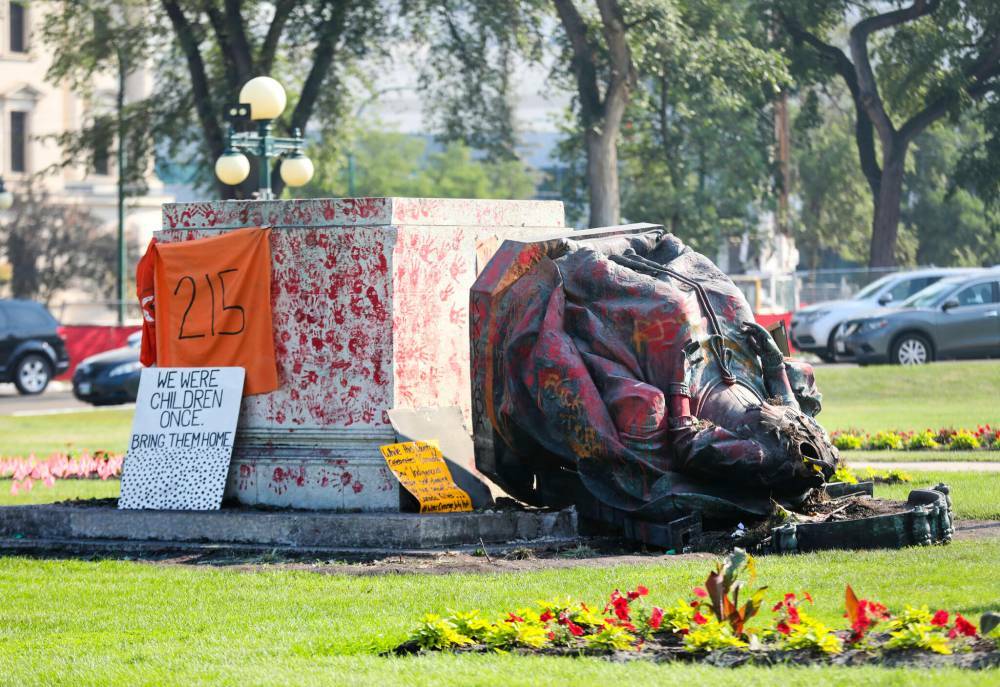
A statue of Queen Victoria, designed by sculptor George Frampton, stood on the grounds of the Manitoba Legislative building since it was unveiled on Oct. 1, 1904. The statue was vandalized amid a wave of anti-racism protests on June 23, 2020, and finally toppled and beheaded by protestors on Canada Day, 2021.
The head, minus its crown, was later recovered from the Assiniboine River.
Free Press/File
Should we find a final resting place for statues that have failed the test of time or overstayed their welcome?
Queen Victoria awaits a new home.
Marcien Lemay designed a brilliant abstract statue of Louis Riel, enclosed within a form created by architect Étienne Gaboury, which was unveiled in 1973 and stood on the grounds of the Legislative Building.
Its representation of torment and pain was controversial, and it was replaced by a more conventional statue of the Métis leader in 1991. The earlier piece found a new home at St. Boniface College where it was unveiled again as part of the 175th anniversary celebrations in 1995.
A stone monument of the ten commandments, donated to the city of Winnipeg by the Fraternal Order of Eagles Aerie 23, stood in Assiniboine Park from 1965 until it was removed in 2017 for the construction of The Leaf.
Should it be replaced?
These monuments and statues are part of our history and yet they hold an uneasy place in our current society.
Do we reinstate them, even if they cause pain for some in a more diverse community than the one in which they were created?
Do we remove them, thereby undervaluing the contributions and histories of so many others?
Whose heroes do we celebrate, and what happens when we are forced to recognize that our great champions had feet of clay?
Statues are not people but their models are, and people invariably have nuance and contours and shadows.
What should we do with the great stone heroes of our past? Is there a way to recognize both their contributions and their limitations?
Since 1993, Memento Park in Budapest has provided a home for the fallen statues of disgraced heroes and plaques commemorating the Communist ideology that ended in 1989.
It is a place of education, but neither reverence nor vilification. Such a memorial represents where we came from and what we were, and visitors can learn about both the unquestioned contributions of these great stone heroes and their limitations. Each statue will necessarily have different meanings for different visitors and, as time passes, each one of us will grow in understanding and value the contributions of the past differently than we do today.
Let us think about how to memorialize our history without destroying it or revering it.
Great museums don’t just celebrate the past; they ask us to think about it and to question it, and to ask ourselves how what we learn changes the ways in which we relate to one another.

One of the greatest museums I ever visited was the Topography of Terror, erected on the site of the former SS-Gestapo headquarters in Berlin. What made it outstanding was its mundane focus on the commonplace bureaucracy of the regime — the motivations and justifications of the people who made it work.
It was impossible not to ask important questions and face uncomfortable answers.
Winnipeg has wonderful parks.
Let us find a corner for the discarded, questioned, toppled, misunderstood, revered, ignored and valued parts of our past, and let us help our children understand that none of us is a hero or villain; we are all flawed, and yet we all have sparks of greatness.
Evelyn L. Forget is a distinguished professor of Community Health Sciences at the University of Manitoba.