

Marco Rubio, Havana and the return of the ‘Cuban problem’
Advertisement
Read this article for free:
or
Already have an account? Log in here »
To continue reading, please subscribe:
Digital Subscription
One year of digital access for only $1.44 a week*
- Enjoy unlimited reading on winnipegfreepress.com
- Read the E-Edition, our digital replica newspaper
- Access News Break, our award-winning app
- Play interactive puzzles
*Billed as $5.77 plus GST every four weeks. After 52 weeks, price increases to the regular rate of $19.95 plus GST every four weeks. Offer available to new and qualified returning subscribers only. Cancel any time.
To continue reading, please subscribe:
Add Free Press access to your Brandon Sun subscription for only an additional
$1 for the first 4 weeks*
- Enjoy unlimited reading on winnipegfreepress.com
- Read the E-Edition, our digital replica newspaper
- Access News Break, our award-winning app
- Play interactive puzzles
*Your next Brandon Sun subscription payment will increase by $1.00 and you will be charged $17.95 plus GST for four weeks. After four weeks, your payment will increase to $24.95 plus GST every four weeks.
Read unlimited articles for free today:
or
Already have an account? Log in here »
Hey there, time traveller!
This article was published 27/12/2024 (518 days ago), so information in it may no longer be current.
Even though Marco Rubio’s Cuban-born parents left the island for the U.S. a few years before the coming to power of Fidel Castro in 1959, the next U.S. Secretary of State has wholeheartedly embraced the hardline anti-Castroism and anti-communism of the exile community in Miami. And as he did during Donald Trump’s first term as a Republican senator, Rubio will soon be in a better position to wield more influence over the contours of U.S. Cuba policy.
With 1.5 million Cuban-Americans living in mostly South Florida — along with a large contingent of other conservative-minded Latinos from a host of countries — Rubio has consistently and aggressively courted their vote with toughly-worded rhetoric about the Cuban government. As opposed to former U.S. president Barack Obama, who sought to normalize relations with Cuba in 2014-15, Rubio is a disciple of estrangement, hostility and economic strangulation.
In August 2024, Rubio issued an official statement that said that the Cuban government is “a direct threat to the national security” of the U.S. and poses “a risk that cannot be ignored.”
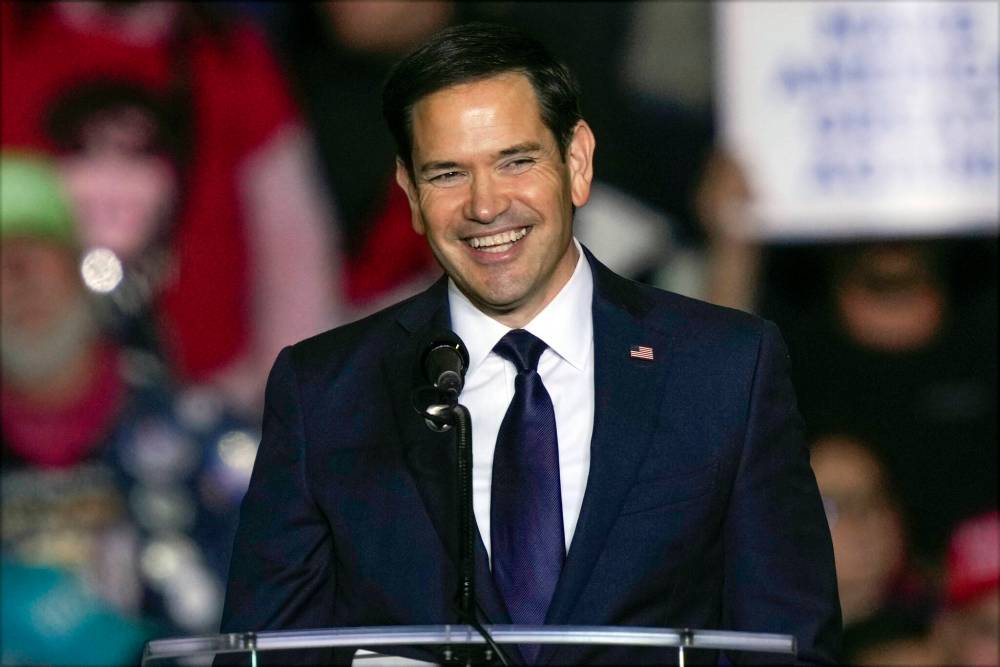
MATT ROURKE / THE ASSOCIATED PRESS FILES
Marco Rubio is expected to bring his opposition to all things Cuban back into the Donald Trump White House.
One month later, he stated the following in a letter to U.S. Secretary of State Antony Blinken: “Rather than compelling the Cuban dictatorship to end its human rights abuses and bring democracy to the island, the Biden-Harris Administration has only looked for opportunities to pacify the regime and mend diplomatic relations.”
Negatively impacted by ideological and psychological blinders, Rubio has never understood that the U.S. has important national interests at stake when it comes to Cuba — an island nation just 145 kilometres from the U.S. Previous American governments have recognized that a co-operative and collaborative Cuba advances key bilateral issues such as migration flows; anti-terrorism and drug interdiction; the environment and fisheries; and maritime boundaries and exchanges with the U.S. Coast Guard.
Instead, Rubio’s singular obsession has always been finding ways to destabilize the Cuban government by invariably punishing ordinary Cubans.
Most importantly, his only answer is to ratchet up the U.S. embargo/blockade of Cuba even further in order to exacerbate an already precarious socio-economic situation on the ground. Only then does he believe that Washington will be in a position to establish a decidedly pro-U.S. government in Havana, a nominal Western-style democracy and a fully functioning market economy.
It bears repeating that when it comes to matters of Cuba, a newly-elected president Donald Trump will listen attentively and dutifully to Rubio’s advice. Indeed, his first term record of imposing some 240 punitive measures against Cuba was a direct result of Rubio’s prodding. So expect to hear over and over again in the next few years the negative Cuba messaging of “regime change,” “maximum pressure” and “state sponsor of terrorism.”
Accordingly, the long-discredited U.S. economic embargo will be reinforced, U.S. travel to Cuba will cut, American pressure on its allies will be intensified and critical U.S. remittances (earmarked for struggling families in Cuba) will likely be curtailed.
In fact, I’m sure that Rubio is working right now on reports that the Cuban military — prohibited from handling the dollars from Cuban-Americans in the U.S. — has been able to circumvent those restrictions and use those funds to prop up the government in Havana.
The major problem with all this talk about isolating and punishing Cuba is that it is demonstrably counter-productive. Would a collapsing Cuba really be in the best interests of the U.S.?

On the thorny issue of migration (especially in Trump’s mind), how exactly does tightening the economic screws serve to keep Cubans in Cuba and away from the U.S. border? As Cuba specialist William LeoGrande of American University in Washington recently explained: “When the Cuban economy is in crisis, Cubans don’t rise up. They leave.”
Moreover, why would the incoming Trump administration believe that making life miserable for Cuba would endear it to other Cuba-friendly countries in the hemisphere (including its top trade partners Canada and Mexico)? And I can’t fathom why it would believe that pushing the Cubans further into the clutches of China and Russia actually promotes U.S. regional security interests.
The Cuban political leadership, of course, has seen this type of aggressive Cuba policy many times before. Yet the country has survived the demise of the USSR in the early 1990s, the onset of an extraordinarily difficult “Special Period” and the vindictiveness of an erstwhile U.S. “hyperpower” — and it will do so again. It most assuredly won’t be easy and it remains to be seen whether it can secure external support (from Russia, China and Iran) and make internal changes to soften the economic blow.
All that Rubio’s ill-conceived and myopic Cuba policy is going to accomplish, then, is to harden the Cuban hardliners, make the lives of average Cubans worse off and increase the likelihood of greater domestic governmental repression. What I don’t understand, though, is why he would think that dusting off a failed 1960s U.S. Cuba approach would precipitate a different result in the 21st century.
Peter McKenna is professor of political science at the University of Prince Edward Island in Charlottetown.