

Remembering Jimmy Carter as a peacemaker
Advertisement
Read this article for free:
or
Already have an account? Log in here »
To continue reading, please subscribe:

Digital Subscription
One year of digital access for only $205*
- Enjoy unlimited reading on winnipegfreepress.com
- Read the E-Edition, our digital replica newspaper
- Access News Break, our award-winning app
- Play interactive puzzles
*First annual payment billed as $205.00 + GST for one year. This annual subscription will automatically renew at $233.00 + GST every 52 weeks (10% off the regular annual price of $259.35). Offer available to new and qualified returning subscribers only. Cancel any time.
To continue reading, please subscribe:
Add Free Press access to your Brandon Sun subscription for only an additional
$1 for the first 4 weeks*
- Enjoy unlimited reading on winnipegfreepress.com
- Read the E-Edition, our digital replica newspaper
- Access News Break, our award-winning app
- Play interactive puzzles
*Your next Brandon Sun subscription payment will increase by $1.00 and you will be charged $17.95 plus GST for four weeks. After four weeks, your payment will increase to $24.95 plus GST every four weeks.
Read unlimited articles for free today:
or
Already have an account? Log in here »
Hey there, time traveller!
This article was published 31/12/2024 (617 days ago), so information in it may no longer be current.
Jimmy Carter, the 39th president of the United States, recently passed away in his hometown of Plains, Ga. At the age of 100, he was the oldest living president in U.S. history.
The peanut farmer, former U.S. Navy submariner and former Georgia governor was known affectionately by the citizens of Plains as simply “Mr. Jimmy.” Apparently, local residents would often tell visitors that the town has two famous exports: peanuts and a peanut farmer-turned president.
After becoming president in early 1977, Carter pledged to incorporate human rights considerations into the conduct of American foreign policy. In his May 1977 commencement address at the University of Notre Dame, Carter remarked: “I believe we can have a foreign policy that is democratic, that is based on fundamental values, and that uses power and influence, which we have, for humane purposes.” With an eye toward the U.S. failure in Vietnam, he would go on to add: “For too many years, we’ve been willing to adopt the flawed and erroneous principles and tactics of our adversaries, sometimes abandoning our own values for theirs.”
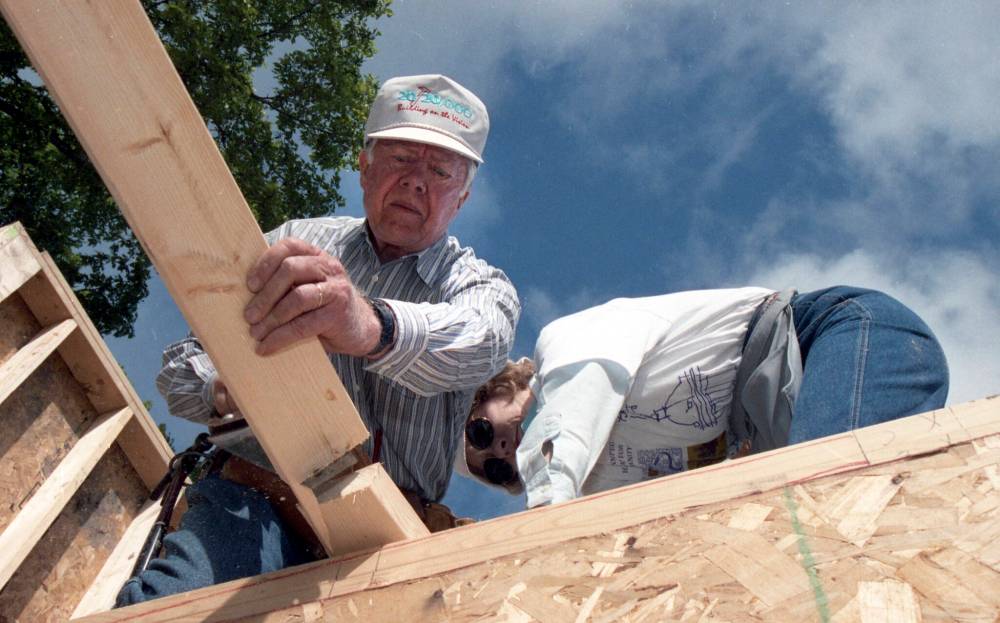
WENDELL PHILLIPS / FREE PRESS FILES
Former U.S. President Jimmy Carter in Winnipeg for Habitat for Humanity in July 1993.
In a particularly pertinent part of the speech, Carter reminded the students that his administration has “reaffirmed America’s commitment to human rights as a fundamental tenet of our foreign policy.” It’s worth pointing out that he did have some notable setbacks along the way in downplaying rights abuses in countries such as the Philippines, China and the Soviet Union. But he also made some real progress on the human rights front in the 1970s when it came to brutal military governments in South America.
Still, the one-term president was defeated by Republican Ronald Reagan in the November 1980 general election. He was the victim of a series of international events that were mostly beyond his grasp — the November 1979 crisis involving American hostages in Iran, the December 1979 Soviet invasion of Afghanistan and the economic recession of the early 1980s — and all clearly spun out of control. Reagan capitalized on a public perception of the Carter presidency as weak, indecisive and paralyzed, and was rewarded with a massive Electoral College victory (489 to 49) against Carter.
In some ways, Carter would become better known for his body of work after leaving the White House. He established the Carter Center in Atlanta, which would go on to do heroic work in advancing democratization (through its excellent election-monitoring efforts), preventing disease in the Global South and engaging actively in conflict resolution. There was no doubt that his unstinting commitment in all of these areas was a function of his deep Southern Baptist faith.
Carter also worked tirelessly to resolve deadly internal conflicts in many parts of the world. Among several peace missions, he sought to end the civil war between the Ethiopian government and Eritrean rebels in the late 1980s, to revitalize peace efforts in Bosnia in the early 1990s and even met with North Korean leaders in 2010.
His work as a roving diplomatic trouble-shooter would highlight his skills as a dedicated negotiator, peacemaker and statesman. For example, Carter came close in the mid-1970s to negotiating a normalization of relations with Fidel Castro’s Cuba. Moreover, he played an instrumental role in averting a bloody U.S. military invasion of Haiti in 1994 by forcing a group of rogue Haitian generals from power.

Of course, one of Carter’s major foreign policy achievements was his securing of a peace agreement (the Camp David Accords) between Israel and Egypt in 1978. He would go on to be awarded the Nobel Peace Prize in 2002 for shepherding peace negotiations and advocating for human rights.
His acceptance speech in Oslo, Norway was memorable for a number of poignant, penetrating and powerful lines. Perhaps the one paragraph that stands out the most was the following: “War may sometimes be a necessary evil. But no matter how necessary, it is always evil, never a good. We will not learn how to live together in peace by killing each other’s children.” Well said.
Interestingly, Carter never paid an official visit to Canada during his tenure as U.S. president. But he was certainly a friend of Canada’s and began the early work on a bilateral acid rain accord. He was also an honorary pallbearer at Pierre Elliott Trudeau’s funeral in October 2000 in Montreal — where for the first time a U.S. president, past or present, had spoken directly with Fidel Castro.
Former U.S. President Jimmy Carter was obviously many things to many people: a peacemaker, a politician, a partner with Habitat for Humanity and a prolific writer. But he should be remembered most for his unflinching belief in the value of human life. When asked by one of his children why he didn’t attack and destroy Iran during the hostage crisis, Carter said calmly: “My family tied me back to the human element in the most important international, diplomatic and military decisions I had to make.” As the U.S. Navy blessing notes: “fair winds and following seas,” Mr. Jimmy.
Peter McKenna is professor of political science at the University of Prince Edward Island in Charlottetown.
Related Articles
Jimmy Carter sought to expand democracy worldwide long after he left the White House

Advertisement Advertise With Us
Advertisement Advertise With Us