

Is Pierre Poilievre Canada’s Donald Trump? No.
Advertisement
Read this article for free:
or
Already have an account? Log in here »
To continue reading, please subscribe:
Monthly Digital Subscription
$1 per week for 24 weeks*
- Enjoy unlimited reading on winnipegfreepress.com
- Read the E-Edition, our digital replica newspaper
- Access News Break, our award-winning app
- Play interactive puzzles
*Billed as $4.00 plus GST every four weeks. After 24 weeks, price increases to the regular rate of $19.95 plus GST every four weeks. Offer available to new and qualified returning subscribers only. Cancel any time.
Monthly Digital Subscription
$4.99/week*
- Enjoy unlimited reading on winnipegfreepress.com
- Read the E-Edition, our digital replica newspaper
- Access News Break, our award-winning app
- Play interactive puzzles
*Billed as $19.95 plus GST every four weeks. Cancel any time.
To continue reading, please subscribe:
Add Free Press access to your Brandon Sun subscription for only an additional
$1 for the first 4 weeks*
*Your next subscription payment will increase by $1.00 and you will be charged $16.99 plus GST for four weeks. After four weeks, your payment will increase to $23.99 plus GST every four weeks.
Read unlimited articles for free today:
or
Already have an account? Log in here »
Hey there, time traveller!
This article was published 17/01/2025 (435 days ago), so information in it may no longer be current.
The election of an unpredictable, autocratic, conservative Donald Trump threatening to annex Canada is alarming to most Canadians.
The question for Canadians is what would happen under a Conservative Pierre Poilievre administration that might mimic the policies unfolding south of the border.
Poilievre’s pre-election campaign has a Trump-like conspiratorial tone courting the anti-vaccine, climate-change-denial, anti-trans crowds and for good measure, anti-rich/elites.
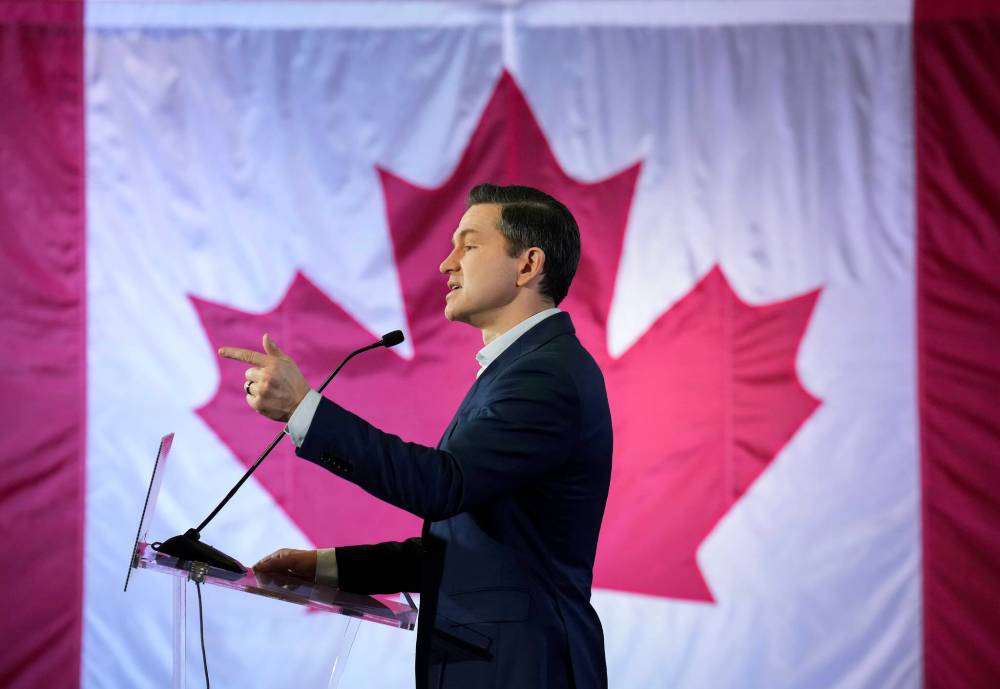
Nathan Denette / The Canadian Press files
Conservative Leader Pierre Poilievre’s pre-election campaign has a Trump-like conspiratorial tone, but that doesn’t necessarily mean he’ll govern the same way as Trump.
For proof of his sincerity, Poilievre tells us neither he nor any of his staff will be attending the Davos annual meetings of the World Economic Forum, an organization funded by its 1,000-member multinational corporations.
Like-minded politicians are invited to the annual meeting. Poilievre’s former boss — former prime minister Stephen Harper — has been a guest and speaker at the conference, preaching to the converted promoting conservative economics policy.
The question remains how Poilievre will differentiate himself from the attendees other than as an anti-elitist election ploy.
Once in office, the evidence suggests a Poilievre government could turn out to be culturally rather benign and economically radically neoliberal, much like post-1980, pre-Trump U.S. Republican presidents.
Ronald Reagan and George W. Bush used racism to court the so-called white working class while acting as pitchmen for the corporate rich who prospered with tax cuts, deregulation, free trade and anti-union labour market policies with the resulting remarkable increase in U.S. inequality.
Tariffs, along with rounding up and exporting immigrants, is bad for business and would likely not be on Poilievre’s agenda. Like Reagan and Bush, Poilievre is using the culture war to attract popular support for a party whose prime interest is to defend wealth inequality, in this case in the form of a petrostate.
He and his wife Ana identify as “pro-choice.” While he visits Christian fundamentalist churches, he also shows up at mosques. He is just a conventional Canadian conservative who will introduce tax cuts for the rich, cuts to social spending, deregulation and free trade.
Poilievre voted against environmental protection 400 times and identifies efforts to regulate the environmental as “government controlling our lives” and an assault on “our freedom and prosperity.” The one thing his government will do is support the building of pipelines in Canada: “south, north, east, and west.”
While he claims to be representing the interests of the “working class” against “elites” like “politicians and bankers,” according to PressProgress, Poilievre — when serving as Harper’s jobs minister — pushed hard for U.S.-style anti-union “right to work” laws.
Unions increase wages for themselves and others and defend the Canadian welfare system. His trade policy is free market, putting Canadian workers in competition with low-wage workers in developing countries.
It is clear that he will end the Liberal/NDP tentative plan for a single-payer system for pharmaceuticals, complaining that it is inferior to the private plan that Canadians cherish.
The fact is that all the sectors in the Canadian health-care system under the single payer system have been remarkably more effective at cost controls and equitable access than those still dominated by the for-profit private sector.
Katrina Miller, the executive director of Canadians for Tax Fairness, identifies Poilievre’s anti-tax agenda as rooted in a fundamentally false narrative.
He claims government collects too many taxes, spend the money poorly and we get inflation. The truth is taxes for middle to low-income Canadians are about the same rate as it was in Harper’s time.
Poilievre wants to eliminate the carbon tax because of the burden it has on working families. The problem with this argument is that 80 per cent of Canadian families will get back more in rebates than they pay.
Gas taxes are used to fund public infrastructure. The payroll taxes he wants to cut pay for the services that working families and seniors depend on for their quality of life.

He will not follow through on Prime Minister Justin Trudeau’s plan to increase capital gains taxes. This kind of tax has served to enrich the top one per cent of Canadians without evidence of contributions to investment or growth.
The Financial Post headline from March 13, 2013 reads ‘Not much bang for the buck’: Harper’s $60-B corporate tax cuts under fire. According to the parliamentary budget office, the top one per cent of Canadian households hold a quarter of all the wealth, while the bottom 40 per cent hold about one per cent.
Instead of antidemocratic chaos, Canadian institutions under Poilievre would be redirected away from social democracy and a government that takes responsibility for citizens economic welfare and environmental health and towards one that leaves them to their fate in the marketplace, resulting in inequality and a decline in their life chances.
Like his predecessor Harper, he’s not an anti-establishment figure but one happy to serve its upper class. And like Harper, he would likely keep the socially conservative issues that might offend too many Canadians off the agenda in order to serve mammon.
Robert Chernomas is a professor of economics at the University of Manitoba whose forthcoming book is Why America Didn’t Become Great Again.