

What’s up with Trump’s approach to Venezuela?
Advertisement
Read this article for free:
or
Already have an account? Log in here »
To continue reading, please subscribe:

Digital Subscription
One year of digital access for only $205*
- Enjoy unlimited reading on winnipegfreepress.com
- Read the E-Edition, our digital replica newspaper
- Access News Break, our award-winning app
- Play interactive puzzles
*First annual payment billed as $205.00 + GST for one year. This annual subscription will automatically renew at $233.00 + GST every 52 weeks (10% off the regular annual price of $259.35). Offer available to new and qualified returning subscribers only. Cancel any time.
To continue reading, please subscribe:
Add Free Press access to your Brandon Sun subscription for only an additional
$1 for the first 4 weeks*
- Enjoy unlimited reading on winnipegfreepress.com
- Read the E-Edition, our digital replica newspaper
- Access News Break, our award-winning app
- Play interactive puzzles
*Your next Brandon Sun subscription payment will increase by $1.00 and you will be charged $17.95 plus GST for four weeks. After four weeks, your payment will increase to $24.95 plus GST every four weeks.
Read unlimited articles for free today:
or
Already have an account? Log in here »
Hey there, time traveller!
This article was published 04/04/2025 (479 days ago), so information in it may no longer be current.
I’m having a hard time figuring out what U.S. President Donald Trump’s plan is for relations with the Venezuelan government of Nicolás Maduro. It appears to be an on-again, off-again diplomatic approach that changes from one week to the next.
In his first term, Trump was dead set on punishing Venezuela through his “maximum pressure” strategy that sanctioned the country’s critical crude oil sector.
When that mostly proved to be ineffective, the White House sought to covertly remove Maduro in April 2019 through an internally assisted coup d’état (though it failed miserably). For its last year in office, the Trump administration essentially froze relations with Caracas and turned its attention to other matters.
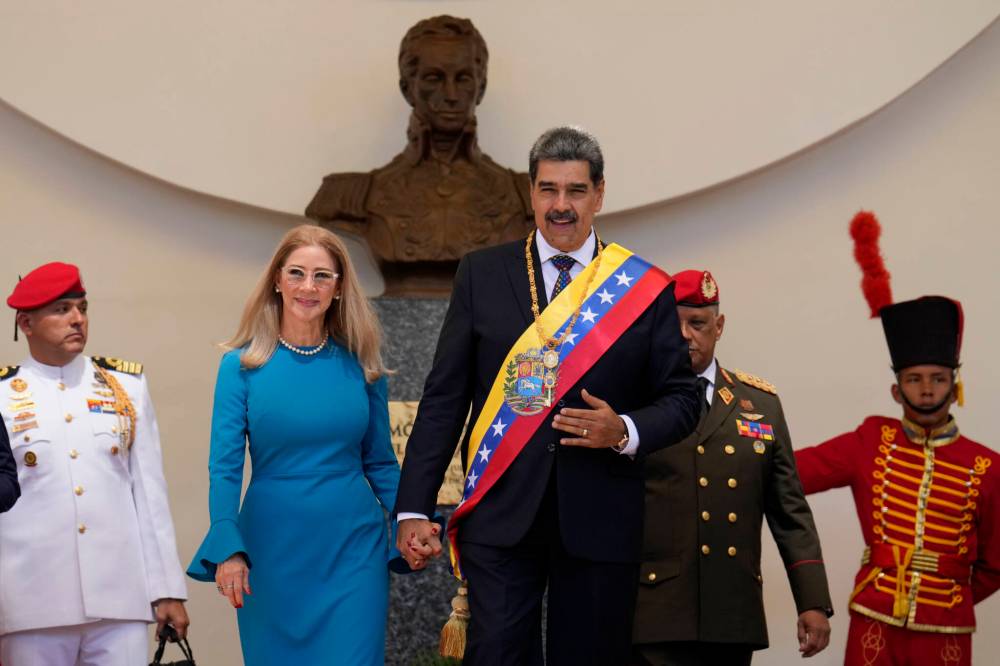
Ariana Cubillos / Associated Press Files
Venezuelan President Nicolás Maduro and his wife Cilia Flores. U.S. President Donald Trump recently rescinded the oil licence Maduro was hoping to extend, apparently as punishment for Venezuela not accepting any more deportees.
For the most part, Trump’s hardline approach to Venezuela was driven by domestic electoral considerations in Florida (which has a large Venezuelan diaspora) and anti-Cuba sentiments (which appealed to the 1.3 million Cuban expats living in the state).
It didn’t hurt that many of his foreign policy advisers, including Trump’s hawkish then-national security adviser John Bolton, were strongly urging him to overthrow Maduro.
Since assuming the presidency once again in January, though, Trump has looked to cultivate closer relations with Maduro’s Venezuela (notwithstanding his fraudulent presidential election victory in July 2024). In February, Trump sent Richard Grenell, Trump’s U.S. envoy for special missions, to Venezuela to meet with government officials and even Maduro himself.
Interestingly, Caracas has characterized the meeting as the beginning of a “new chapter” in U.S.-Venezuela relations.
Ostensibly, the unusual trip to Caracas was to discuss Trump’s endless obsession with migration issues and numbers. There are hundreds of thousands of Venezuelans living in the U.S. under various immigration arrangements (including Temporary Protective Status or TPS), and some with temporary legal status.
To smooth things over diplomatically, Maduro agreed to hand over six American citizens who were held in Venezuelan detention. More important, the Venezuelan government pledged to resume deportation flights (with Venezuela providing the transportation services) and even to accept vicious Tren de Aragua criminal gang members.
Though it is not clear what concessions that the Trump team made to Maduro, there’s a good chance that it was tied to continuing U.S. corporate activity in Venezuela’s oil sector. Indeed, the Venezuelans have been signalling to Washington that they would like to see Chevron Corp.’s oil licence extended — and perhaps even expanded — which it was on Feb. 1.
It’s pretty obvious that Maduro is trying to use Trump’s migration preoccupation to secure the unravelling of U.S. sanctions against Venezuela’s state-owned oil company, PDVSA. He is also angling to nix a U.S. federal indictment involving drug-trafficking against Maduro and a US$25-million reward offered for information leading to his apprehension.
Subsequently, Trump decided to rescind the oil licence in Venezuela for Chevron Corp. and then to tariff those countries which purchase Venezuelan oil.
The licence cancellation was apparently because Maduro has been dragging his feet (after initially allowing a few planeloads of Venezuelan deportees to return) on accepting any more U.S. deportation flights.
But what happens when Maduro changes his mind (which he did in mid-March) and decides to turn the deportation tap back on?
Is Trump going to play along and accept more Venezuelan demands?
Curiously, Trump has also opted, I’m assuming for political reasons, to punish his Venezuelan voters in Florida, perhaps 300,000 or so, by removing their TPS. This move has triggered considerable angst, anger and agitation within the Venezuelan community in South Florida, which can’t believe that Trump would treat his supporters in such a disgraceful manner.
What was so troubling to the Venezuelan community was that U.S. Homeland Security Secretary Kristi Noem has maintained that the circumstances on the ground in Venezuela have now improved to such an extent as to make the termination of TPS justified.
But any reasonable assessment of the situation in Venezuela today would raise serious doubts about such a rendering.
It’s hard to imagine, then, why Trump would betray his voters in such a cavalier way and in such an electorally important state. He obviously wants to send a message that unauthorized migrants — no matter their voting preferences — are not welcome in Trump’s America.
But wouldn’t Republican members in Florida need them for the U.S. midterms in November 2026?

By the time you’re reading this, it’s possible that Trump has reversed his stance on TPS and Venezuela once again. There is just no way of knowing what exactly is driving Trump’s thinking here.
I’m reminded of something that Bolton, who should know, said recently about Trump’s thought process. He was adamant that Trump has no foreign policy rationale or cost-benefit analysis underpinning any of his executive decisions.
That’s why I can’t discern if Trump is simply coddling another dictator (whom he evidently admires irrespective of their ideological dispositions) or seeking to undermine the Venezuelan regime.
So when it comes to grappling with Trump and the Maduro government, your guess is as good as mine.
Peter McKenna is professor of political science at the University of Prince Edward Island in Charlottetown.