

Ruminations on life and death

Advertisement
Read this article for free:
or
Already have an account? Log in here »
To continue reading, please subscribe:
Monthly Digital Subscription
$1 per week for 24 weeks*
- Enjoy unlimited reading on winnipegfreepress.com
- Read the E-Edition, our digital replica newspaper
- Access News Break, our award-winning app
- Play interactive puzzles
*Billed as $4.00 plus GST every four weeks. After 24 weeks, price increases to the regular rate of $19.95 plus GST every four weeks. Offer available to new and qualified returning subscribers only. Cancel any time.
Monthly Digital Subscription
$4.99/week*
- Enjoy unlimited reading on winnipegfreepress.com
- Read the E-Edition, our digital replica newspaper
- Access News Break, our award-winning app
- Play interactive puzzles
*Billed as $19.95 plus GST every four weeks. Cancel any time.
To continue reading, please subscribe:
Add Free Press access to your Brandon Sun subscription for only an additional
$1 for the first 4 weeks*
*Your next subscription payment will increase by $1.00 and you will be charged $16.99 plus GST for four weeks. After four weeks, your payment will increase to $23.99 plus GST every four weeks.
Read unlimited articles for free today:
or
Already have an account? Log in here »
Hey there, time traveller!
This article was published 16/04/2025 (347 days ago), so information in it may no longer be current.
The older I get, the closer I come to death.
Now, that may sound obvious — with each passing year we grow nearer to the end of life.
But I mean it in another way, as well. The older I get, the more I think about death; feel its presence; ponder its many guises and means of approach.
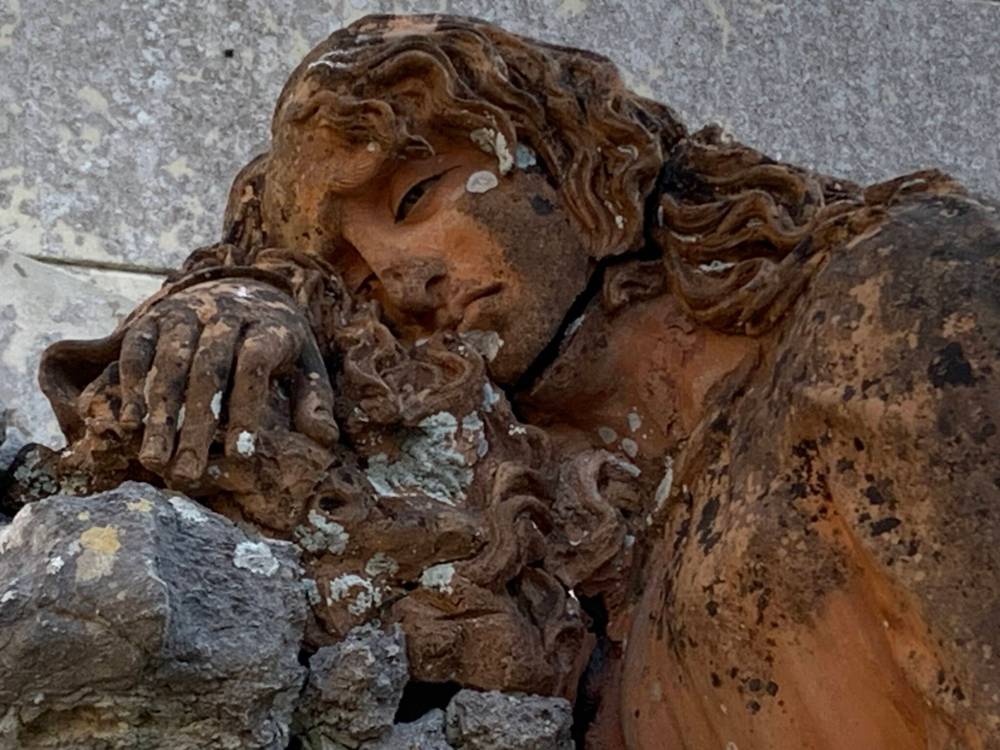
Pam Frampton photo
Cemetery statue, Lecce, Italy. Columnist Pam Frampton has lately found herself pondering the inevitability of death.
I wonder how and when it will come to me and if I will be ready for it.
Because, unless you have the deep pockets and unflagging optimism required to take your chances with the Big Freeze — cryogenics — it is inevitable that at some point you will meet your maker, or nullifier, depending on your religious faith or lack thereof. (According to the website for vitalityPro, an English company that makes longevity supplements, “Currently, there are about 500 people who have had themselves cryonically preserved in the world. There are 300 in cryosleep in the U.S., 50 people in Russia, around 100 in Europe, and more than 30 pets in Arizona.” Expect that U.S. number to rise while Trump’s in the White House.)
That snide comment about the American president aside, death is no joking matter — at least not to me.
It’s something I think about often, particularly in the middle of the night when my brain seems intent on tackling life’s deep questions.
As a child, death is a sharp lesson to learn, particularly if your parents don’t prepare you for it. The sudden knowledge that, while life seems to stretch out infinitely in front of you, it could in fact be obliterated at any point due to illness, injury, violence or plain bad luck is a shock to the system.
When I was seven or eight, I accompanied my dad to a church service he was presiding over in another town. I sat alone in a pew only to find myself staring at an open casket containing an old man who had clearly seen better days.
Realizing he was deceased — the congregation of sombre mourners may have given it away — I had to stifle my urge to scream in horror.
My father, wonderful man that he was, had forgotten to mention that I was accompanying him to a funeral.
Perhaps that’s why when my father’s own death was approaching, he did not see the need to recreate one of those clichéd movie scenes where there is a neat summing up and each family member gets to say a personalized and loving farewell. To him, death was just a part of life.
In thinking about death and trying to understand why I dread it so, I have sought the insights of authors who are likewise fascinated by the final curtain.
Katie Roiphe, author of The Violet Hour: Great Writers at the End, writes that, “while nearly everyone has a fantasy of a ‘last conversation,’ very few people actually have it.”
“We are, most of the time,” she writes, “left with this wild irresolution, this lack of an ending, which may be part of our investment in this mythical conversation, as if things ever end and are not simply cut off.”
This idea of being “simply cut off” is what frightens me even more than the thought of mortal pain and anguish. I have spent my career as a journalist who always meets a deadline, and the thought of leaving loose ends for someone else to deal with fills me with anxiety.
I’m not a control freak who needs to orchestrate every moment of my life (and death), but I hate to leave things without a tidy resolution.
The other thing about death that strikes terror in my heart is that I don’t want to die. I haven’t known anyone yet who died and truly wanted to.
I still have family and friends and am in good health. But I realize perspectives and circumstances change.
Julian Barnes, in his witty and insightful meditation on death Nothing to Be Frightened Of, writes that life and death are irrevocably intertwined.
“For me,” he writes, “death is the one appalling fact which defines life; unless you are constantly aware of it, you cannot begin to understand what life is about; unless you know and feel that the days of wine and roses are limited, that the wine will maderize and the roses turn brown in their stinking water before all are thrown out for ever — including the jug — there is no context to such pleasures and interests as come your way on the road to the grave.”
So, life and death. You can’t have one without the other.
But knowing it intellectually is far from absorbing it emotionally.

Will I gain greater wisdom and move towards acceptance as I age? Or will all of this mental hand-wringing be shown to be a complete waste of time when my number comes up without warning?
To be continued.
Pam Frampton is a writer and editor in St. John’s.
pamelajframpton@gmail.com
X: pam_frampton | Bluesky: @pamframpton.bsky.social
Pam Frampton is a columnist for the Free Press. She has worked in print media since 1990 and has been offering up her opinions for more than 20 years. Read more about Pam.
Pam’s columns are built on facts, but offer her personal views through arguments and analysis. Every column Pam produces is reviewed by an editing team before it is posted online or published in print — part of the Free Press‘s tradition, since 1872, of producing reliable independent journalism. Read more about Free Press’s history and mandate, and learn how our newsroom operates.
Our newsroom depends on a growing audience of readers to power our journalism. If you are not a paid reader, please consider becoming a subscriber.
Our newsroom depends on its audience of readers to power our journalism. Thank you for your support.
Pam Frampton is a columnist for the Free Press. She has worked in print media since 1990 and has been offering up her opinions for more than 20 years. Read more about Pam.
Pam’s columns are built on facts, but offer her personal views through arguments and analysis. Every column Pam produces is reviewed by an editing team before it is posted online or published in print — part of the Free Press‘s tradition, since 1872, of producing reliable independent journalism. Read more about Free Press’s history and mandate, and learn how our newsroom operates.
Our newsroom depends on a growing audience of readers to power our journalism. If you are not a paid reader, please consider becoming a subscriber.
Our newsroom depends on its audience of readers to power our journalism. Thank you for your support.
Advertisement Advertise With Us
Advertisement Advertise With Us