

Creating opportunities through housing
Advertisement
Read this article for free:
or
Already have an account? Log in here »
To continue reading, please subscribe:
Monthly Digital Subscription
$1 per week for 24 weeks*
- Enjoy unlimited reading on winnipegfreepress.com
- Read the E-Edition, our digital replica newspaper
- Access News Break, our award-winning app
- Play interactive puzzles
*Billed as $4.00 plus GST every four weeks. After 24 weeks, price increases to the regular rate of $19.95 plus GST every four weeks. Offer available to new and qualified returning subscribers only. Cancel any time.
Monthly Digital Subscription
$4.99/week*
- Enjoy unlimited reading on winnipegfreepress.com
- Read the E-Edition, our digital replica newspaper
- Access News Break, our award-winning app
- Play interactive puzzles
*Billed as $19.95 plus GST every four weeks. Cancel any time.
To continue reading, please subscribe:
Add Free Press access to your Brandon Sun subscription for only an additional
$1 for the first 4 weeks*
*Your next subscription payment will increase by $1.00 and you will be charged $16.99 plus GST for four weeks. After four weeks, your payment will increase to $23.99 plus GST every four weeks.
Read unlimited articles for free today:
or
Already have an account? Log in here »
Hey there, time traveller!
This article was published 14/08/2025 (227 days ago), so information in it may no longer be current.
Chief Maureen Brown of Opaskwayak Cree Nation (OCN) describes the decision to build houses off-reserve as visionary (‘Huge step for us’: Opaskwayak opens downtown apartment building, July 4).
Let’s hope she is right and that it represents a new trend in looking for housing solutions. OCN’s announcement follows on the heels of a decision made in January 2025 by the Roseau River Anishinaabe First Nation. They committed to building a 99-unit apartment building in Winnipeg with another large project in the planning stages.
Both First Nations have recognized that their members are heading to Winnipeg and other centres for more than housing. What we are seeing appears to be a strategic shift in the thinking of First Nations leaders and their communities. It is likely to be followed by many more First Nations housing initiatives in larger centres for two reasons.
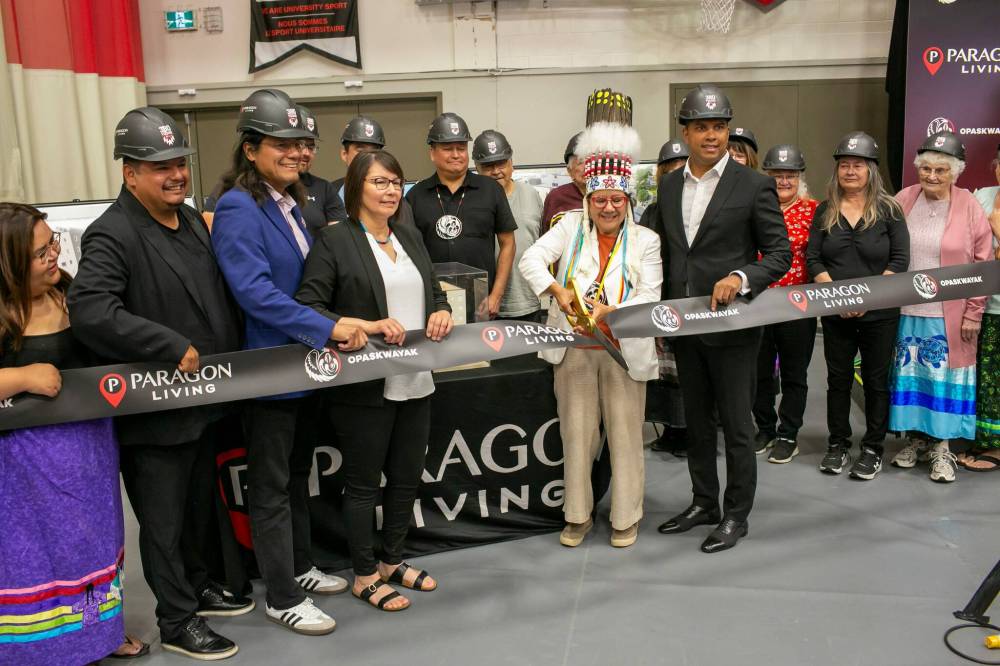
Brook Jones / Winnipeg Free Press files
Opaskwayak Creen Nation Chief Maureen Brown cuts the ribbon while Paragon Living president and CEO Nigel Furgus looks on during a ribbon-cutting ceremony for 380 Young St. on July 4.
First, although OCN has its own long-established and successful business community, their announcement reflects both the need for housing and the need for its members to have broader opportunities for jobs, housing and other services beyond their community. The chief and council’s decision is a logical and forward-thinking move.
First Nations are facing growing populations and limited housing options. In addition, many remote and isolated First Nations communities have limited job and employment opportunities. For most isolated Manitoba First Nations communities, that reality hasn’t changed in decades. In remote communities like Pukatawagan, the unemployment rate has remained around 75 per cent for the past 40 years and there is nothing on the horizon that suggests that will change.
Tapping in to the Affordable Housing Fund’s $14.8 billion is clearly part of OCN’s ambitious plans. OCN committed $1.8 million towards the project and $15.6 million came from the federal AHF. OCN hopes to build a 129-unit apartment block in St. Boniface in 2026, and a third major project of 240 units in south Winnipeg in 2028 using the same approach.
The new approach is good for First Nations members and it is good for the city of Winnipeg. It takes advantage of a new federal housing initiative and it will ultimately be part of the solution for some of the homeless and unhoused living on our river banks and taking shelter where they can find it. Brown has noted that this will solve the housing problem for some OCN members, but it will also be a significant investment and help diversify OCN’s already impressive business holdings.
The Roseau River Anishinaabe First Nation and OCN leadership are responding to the fact that across the country, more than 50 per cent of First Nations people live off reserve. First Nations young people, particularly, are voting with their feet. OCN has acknowledged that half of its population already lives off-reserve. This is familiar to most First Nations leaders and the provincial and federal governments.
The second reason is that life outcomes for people living in isolated communities, Indigenous and non-Indigenous, are compromised everywhere. Statistics Canada reported many years ago that about 60 per cent of the disparity in individual income, educational attainment, health and life expectancy could be accounted for by a community’s isolation. Living in communities a long way away from a major centre is a risk factor. There is evidence that isolation and limited opportunities are likely to contribute to the high suicide rate, high levels of addiction, drug problems and the various forms of violence and self-abuse that reflect the despair that result from having limited opportunities.
Overcrowding in the houses that are habitable add to growing discontent among its youth, who face adulthood in their communities with no work, little income and few recreational facilities or other social services. These are not conditions where young people thrive. A healthy community is not possible when most 15-to-30-year-olds have no work, no prospects of work, few recreational options and little available by way of physical or mental health services if they need help.
The multiple challenges that face First Nations leaders are exacerbated by the fact that existing housing in the most remote communities is inadequate, dilapidated and falling further into disrepair. Living in overcrowded conditions is hard on people and the houses. Making minor or major repairs in a home in a remote or isolated community poses its own problems. Doing major renovations is complicated by the absence of building supplies, hardware or trades people necessary to complete the repairs. The end result is that fixing houses in most First Nations is a long, elaborate and frustrating exercise. And it’s expensive.

Everyone needs to have a place to live, a place to raise a family, a place to feel secure. Like too many other First Nations, Pukatawagan leadership has struggled for decades to meet the demand for housing in their communities. Unfortunately, the prohibitive cost of building, certainly in remote communities, limits their ability to respond to the need and results in overcrowding, and often deteriorating housing conditions. That is why Pukatawagan, too, has been exploring housing options in larger urban centres.
The involvement of First Nations in the development of housing should be seen as a welcome trend. As OCN Chief Maureen Brown suggests, projects like the new apartment development in Winnipeg demonstrates the power of inclusion. She noted that, “When we invest in Indigenous-led projects, we are investing in sustainable growth for everyone.”
Housing is the foundation for healthy families and healthy children. When the OCN chief notes that the projects they are starting in Winnipeg are a necessary part of meeting both their housing needs and their goal of economic diversification, other levels of government should step up to facilitate this new approach. Urban off-reserve housing can solve many problems. It is not only an opportunity for economic growth for First Nations, but an opportunity to create spaces for young people transitioning from remote communities to larger communities. Places that can sustain them. Urban places that can offer them hope for a better future.
It is a way forward for all of us, and the benefits will extend not only to those who engage in making the transition to the city and supporting their families in affordable housing, but will enrich us all over the long-term. Governments at all levels and First Nations need to be encouraged and supported in finding ways to move this housing agenda forward.
Ralph Caribou lives in Pukatawagan and is a University College of the North (UCN) regional community co-ordinator, former Mathias Colomb band chief, and education director. Jerry Storie is a former Flin Flon MLA and represented Pukatawagan for many years.