

Minerals-for-security deals gain popularity
Advertisement
Read this article for free:
or
Already have an account? Log in here »
To continue reading, please subscribe:
Digital Subscription
One year of digital access for only $1.44 a week*
- Enjoy unlimited reading on winnipegfreepress.com
- Read the E-Edition, our digital replica newspaper
- Access News Break, our award-winning app
- Play interactive puzzles
*Billed as $5.77 plus GST every four weeks. After 52 weeks, price increases to the regular rate of $19.95 plus GST every four weeks. Offer available to new and qualified returning subscribers only. Cancel any time.
To continue reading, please subscribe:
Add Free Press access to your Brandon Sun subscription for only an additional
$1 for the first 4 weeks*
- Enjoy unlimited reading on winnipegfreepress.com
- Read the E-Edition, our digital replica newspaper
- Access News Break, our award-winning app
- Play interactive puzzles
*Your next Brandon Sun subscription payment will increase by $1.00 and you will be charged $17.95 plus GST for four weeks. After four weeks, your payment will increase to $24.95 plus GST every four weeks.
Read unlimited articles for free today:
or
Already have an account? Log in here »
Hey there, time traveller!
This article was published 22/08/2025 (284 days ago), so information in it may no longer be current.
“If I were named Obama I would have the Nobel Prize given to me in 10 seconds,” Donald Trump complained at a rally in Detroit last year.
The president’s fixation on the award has recently produced hastily organized, high-level talks to halt fighting in Ukraine.
But his administration has another motivation. As long as the war rages on, the minerals-for-security deal it signed in May with Ukraine will be unworkable.
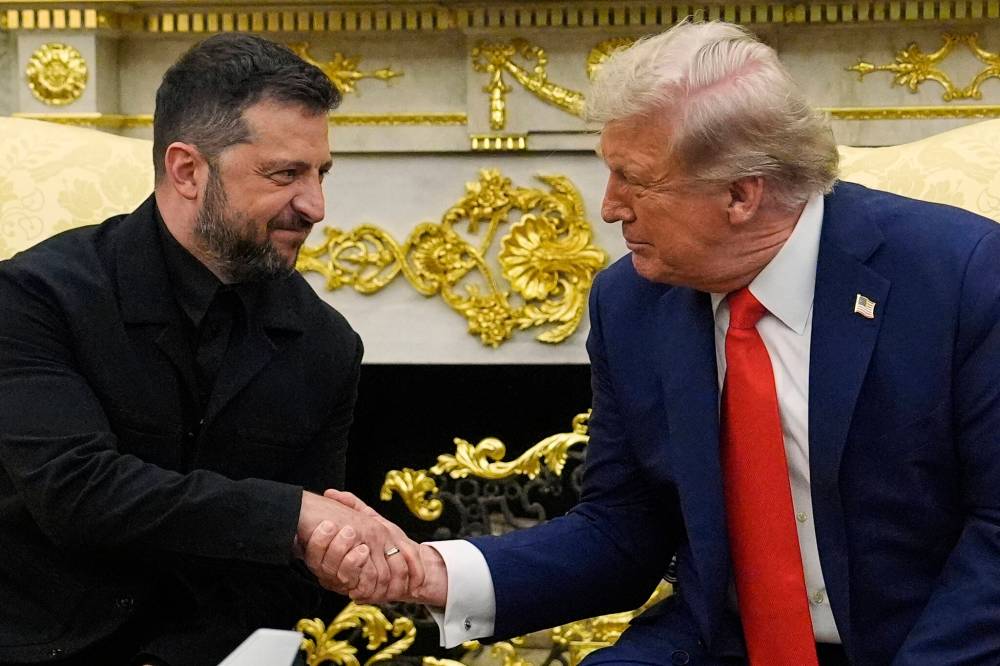
Kyiv devised the pact as a way to sustain American military aid. The overall concept, however, aligns perfectly with Trump’s unsubtle approach to foreign policy. Other actors are now queuing up with offers of their own.
Critical minerals — cobalt, copper, graphite, lithium, neodymium, nickel and more — are vital to cutting-edge technologies. And not only consumer devices, but also medical equipment, advanced weaponry and the supercomputers that run AI.
Yet critical minerals, while geologically abundant, are hard to come by — especially rare-earth elements. These 17 metallic substances are used sparsely but cherished for being extremely lightweight and heat-resistant. Refining them from raw ore dug out of the earth is an inherently toxic and environmentally hazardous process. Plus, demand is skyrocketing. The International Energy Agency forecasts that installing enough green energy systems to keep average global warming below two degrees Celsius above pre-industrial temperatures alone will quadruple demand for critical minerals by 2040.
Nations worldwide have feverishly embarked on a new global arms race, too. Mammoth investments are pouring into artificial intelligence infrastructure. Meanwhile, via its role as the world’s factory over the past quarter-century, China has come to dominate critical mineral supply chains.
Hence why Western countries are now scrambling for new suppliers. One of these could be Ukraine. Kyiv’s agreement with Washington, among other things, gives American companies preferential mining rights to Ukraine’s sizable mineral reserves. But it’s not that simple. “The paradox of the situation,” Ukrainian journalist Anna Romandash wrote in June for the Centre for International Governance Innovation, a think tank, “is that it is security guarantees, on which both parties rely, that allow for the possibility of the extraction of minerals.”
But Trump’s view on security guarantees for Ukraine — something European allies by themselves can’t provide — constantly changes. And Russia’s foreign minister calls security talks that don’t involve Moscow “a road to nowhere.”
“A significant portion of the deposits of titanium, lithium, graphite and other elements are in eastern Ukraine as well as in some places on the front line or in occupied areas,” Romandash adds. “Without a just and stable peace, the extraction of such resources will be impossible, because no investor will enter a territory where there is no confidence in the legal, military and political protection of assets.”
A similar scenario is playing out in the Democratic Republic of Congo (DRC). The central government in Kinshasa is battling a Rwanda-backed rebel insurgency in the vast nation’s resource-rich eastern provinces. The well-armed and organized group, known as M23, since February has taken over the area’s two largest cities, seized control of mines and set up checkpoints along main traffic routes to tax mineral exports.

“As the world’s largest supplier of cobalt and a major producer of lithium, tantalum and uranium, the DRC’s resources are integral to U.S. industrial competitiveness and national security,” reads a letter sent in February to U.S. Secretary of State Marco Rubio on Kinshasa’s behalf.
However, despite the U.S. subsequently brokering a peace agreement between the DRC and Rwanda in June, a durable supply chain may never materialize. That’s because M23 is just one of over 100 active militant groups nearby, each vying for a share of the booming illicit trade in critical minerals.
The deal “seems to operate in a world in which the conflict in eastern Congo is fundamentally between two opposing sides — the Congolese government and the Rwanda-backed rebels,” says Michelle Gavin, a former U.S. diplomat in Africa. “But scores of armed groups operate in the region, and the notion that command and control of all of these entities leads back to Kinshasa or Kigali is fanciful.” Elsewhere, the breakaway territory of Somaliland is now dangling access to a Red Sea military base and critical minerals if Washington formally recognizes its de facto independence from Somalia. Myanmar’s government-in-exile has told U.S. lawmakers that American companies could mine areas currently controlled by ethnic militias if the country’s military dictatorship collapses.
These scenarios underscore the immense economic and political value of critical minerals in the 21st century. But also, a mounting distrust of America’s willingness to resolve conflicts unless it explicitly gets something in return.
Kyle Hiebert is a Montreal-based political risk analyst and former deputy editor of the Africa Conflict Monitor.