

Patrimonialism: global phenomenon, American threat
Advertisement
Read this article for free:
or
Already have an account? Log in here »
To continue reading, please subscribe:

Digital Subscription
One year of digital access for only $205*
- Enjoy unlimited reading on winnipegfreepress.com
- Read the E-Edition, our digital replica newspaper
- Access News Break, our award-winning app
- Play interactive puzzles
*First annual payment billed as $205.00 + GST for one year. This annual subscription will automatically renew at $233.00 + GST every 52 weeks (10% off the regular annual price of $259.35). Offer available to new and qualified returning subscribers only. Cancel any time.
To continue reading, please subscribe:
Add Free Press access to your Brandon Sun subscription for only an additional
$1 for the first 4 weeks*
- Enjoy unlimited reading on winnipegfreepress.com
- Read the E-Edition, our digital replica newspaper
- Access News Break, our award-winning app
- Play interactive puzzles
*Your next Brandon Sun subscription payment will increase by $1.00 and you will be charged $17.95 plus GST for four weeks. After four weeks, your payment will increase to $24.95 plus GST every four weeks.
Read unlimited articles for free today:
or
Already have an account? Log in here »
Hey there, time traveller!
This article was published 04/12/2025 (297 days ago), so information in it may no longer be current.
A both new and old form of government is experiencing a revival globally. Its advocates are well known and easily identified by their common approach to their political positions, which is that they are the state and the rule of law, both domestically and internationally, must bow to their fabricated reality.
People of my vintage remember the old: Haile Selassie, Rafael Trujillo, Ferdinand Marcos, and Nicolae Ceausescu, among others. Selassie, as emperor, ruled Ethiopia for 44 years with an iron fist, inserting himself brutally into every aspect of Ethiopian life. Trujillo dictatorially ruled the Dominican Republic for 31 years, renamed its mountain and numerous buildings after himself and had multiple statues raised in his honour. Marcos, as president of the Philippines, ruled for 21 years and was known for constitutional authoritarianism, and Ceausescu, a communist dictator who ruled Romania for 15 years, was known for his severe oppression and human rights violations. The first two were assassinated, the third died in exile, and the last was executed.
Aside from their ignominious deaths, all are known for: their views that they, and only they, were the saviours of their respective countries; their nepotism, cronyism, and demands for recognition, loyalty and gratitude; their demonization of any opposition; the penchant for force and violence to eliminate any challengers; their corruption in pillaging their country to enrich themselves; their propaganda and repression of the media; and their disdain for the rule of law and independent judiciaries. As Stephen Hanson and Jeffrey Kopstein in The Assault on the State: How the Global Attack on Modern Government Endangers our Future noted, they substituted the rule of man for the rule of law.
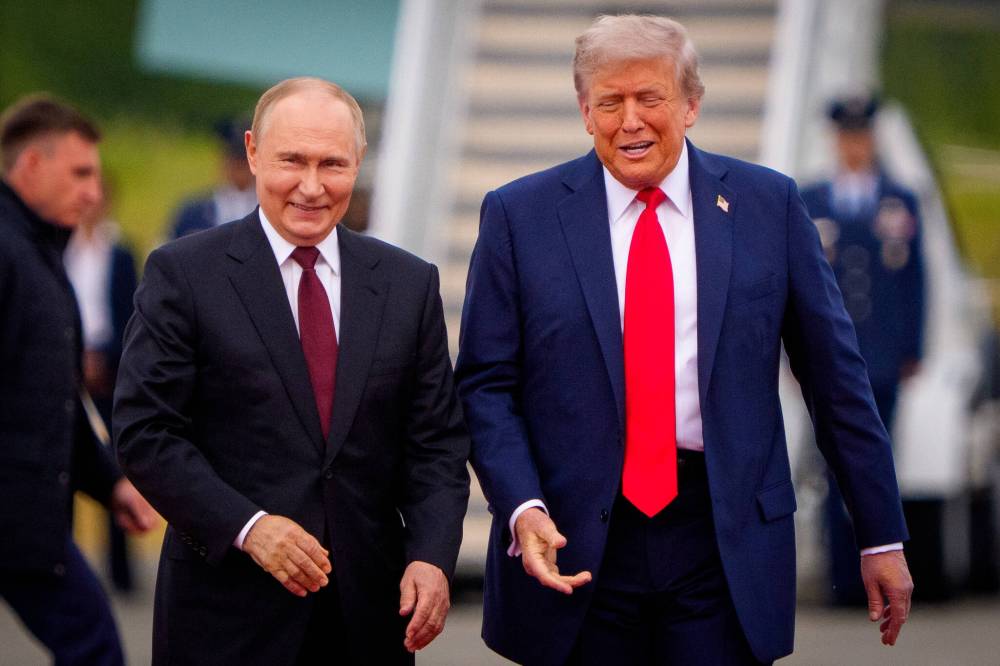
Andrew Harnik/Getty Images/TNS
U.S. President Donald Trump and Russian President Vladimir Putin are two examples of the growing list of patrimonialist government leaders.
Patrimonialism is a term first coined by Max Weber, a world-famous sociologist, in the 1920s as his positive response to rational-legal bureaucracies, which he deemed a threat to authentic politics. It best describes what some governments are starting to look like in several Western “democracies.” It poses a long-term threat to democracy and its support systems. Weber seemed unaware that his solution was worse than the problem.
It is my view that Russian President Vladimir Putin is the father of this latest round of patrimonial governments, and his exploits have encouraged a whole new round of wannabe patrimons (fathers of their countries) — Recep Tayyip Erdogan in Turkey; Viktor Orban in Hungary; Benjamin Netanyahu in Israel; Narendra Modi in India: and Donald Trump in the U.S. stand out — with more threatening to join the club with each change in government in the Western world.
What they have in common is a disdain for the rule of law manifested in attacks on the administrative structures of their countries, particularly targeting independent judiciaries and social services. And their solutions are dismantling all the agencies which protect and provide services to their citizens.
They accomplish this in three ways: by appointing unqualified, incompetent sycophants to leadership positions in government departments and agencies; by firing professional experts; and by slowly dismantling them by cutting positions and funding to the point where they lose any regulating or stabilizing capacity.
The other things they have in common is their arbitrary choices of enemies of the state — other politicians, immigrants, non-Christians, the gender diverse, the media especially women — and their remedies which mainly include eliminating them by quasi-legal, or sometimes legal but questionably moral, means. Following Putin’s example, they suggest, and sometimes do, end-run matters like free elections and terms of office, inventing emergencies which require them to remain in power.
Some have set themselves up as saviours in a mortal conflict with a phantom deep state. Others join them in invoking, without evidence, a mysterious but overweening global conspiracy of powerful and corrupt elites which maintains its power through interconnected clandestine professional bureaucracies — an elite which must be conquered and eradicated. Their claim is that only they are up to that task, in spite of the facts that they themselves have repeatedly been shown to be completely untrustworthy and corrupt.
In their self-serving arrogance, unlimited hubris, and illegal power grabs they are threatening the short and long-term health, safety and well-being of their citizens.
Conventional notions of morality, democracy and justice hold no sway over them. Various degrees of patrimonialism inform their speeches and their actions. Their families and cronies, usually ultra-wealthy friends, are appointed to positions of power or granted tax relief. And their propaganda, lies and threats keep both their allies and foes in check.
What’s unfolding in America is the archetypal patrimonial narrative. A politicized justice system, dependent on presidential approval and serving his imperialistic ambitions and an enlisting of the military as domestic law enforcement. A weakening of all health, food safety, environmental, and educational safeguards by attacks on the Centers for Disease Control and Prevention, the Food and Drug Administration and the Supplemental Nutrition Assistance Program, the Environmental Protection Act, and the Department of Education to name just a few.
In other words, a dismantling of the administrative systems which protect people from political overreach, while ironically looking for deference, praise and gratitude from the victimized.
The reality is that American self-importance and conceit is reaching into every corner and every household in the world, simultaneously taking no responsibility for conflicts fuelled by their military industrial complex or people dying from hunger because their international aide has been discontinued.
The intent seems to be to consolidate power and eliminate critique and pushback, remove protections, and give his rich friends free rein in those areas while relieving them of any responsibility for the general welfare of ordinary citizens or people in other parts of the world. Contrary to the claims, people are more divided, less safe and less healthy, more impoverished and less informed and engaged — all of which are huge threats to their freedom, happiness and general well-being — and a democracy which makes a better life possible.

Patrimonialism is not an inevitable consequence of weak democracies, but it is a possibility if we don’t stand up for it or if we ignore the signs of its demise.
For example, a would-be prime minister claiming, and believing, that only he can make Canada affordable again should be cause for sober second thought. Politicians regularly criticizing the judiciary should be another, as should the proclivity for almost every politician promising to cut the civil service as a cost-cutting measure.
The U.S. experience should be a reminder and a wake-up call to Canadians and those politicians who uncritically seek to control an independent judiciary, consider government bureaucracies an unwarranted and unnecessary cost, who wish to eliminate the CBC, who wish to privatize health care and education, ignore global warming, reduce environmental protections, and do their best to emulate, defer to and align with American politics.
May we remain vigilant, conscientious — cautious but engaged!
John R. Wiens is dean emeritus at the faculty of education, University of Manitoba.