

Robert Archambeau and the value of artistic legacy

Advertisement
Read this article for free:
or
Already have an account? Log in here »
To continue reading, please subscribe:

Digital Subscription
One year of digital access for only $205*
- Enjoy unlimited reading on winnipegfreepress.com
- Read the E-Edition, our digital replica newspaper
- Access News Break, our award-winning app
- Play interactive puzzles
*First annual payment billed as $205.00 + GST for one year. This annual subscription will automatically renew at $233.00 + GST every 52 weeks (10% off the regular annual price of $259.35). Offer available to new and qualified returning subscribers only. Cancel any time.
To continue reading, please subscribe:
Add Free Press access to your Brandon Sun subscription for only an additional
$1 for the first 4 weeks*
- Enjoy unlimited reading on winnipegfreepress.com
- Read the E-Edition, our digital replica newspaper
- Access News Break, our award-winning app
- Play interactive puzzles
*Your next Brandon Sun subscription payment will increase by $1.00 and you will be charged $17.95 plus GST for four weeks. After four weeks, your payment will increase to $24.95 plus GST every four weeks.
Read unlimited articles for free today:
or
Already have an account? Log in here »
Hey there, time traveller!
This article was published 11/12/2025 (303 days ago), so information in it may no longer be current.
When I last visited Robert Archambeau’s ceramics studio in Bissett — long after the kiln had cooled and after Robert himself had left us — I found myself standing in a place that felt both haunting and profoundly alive.
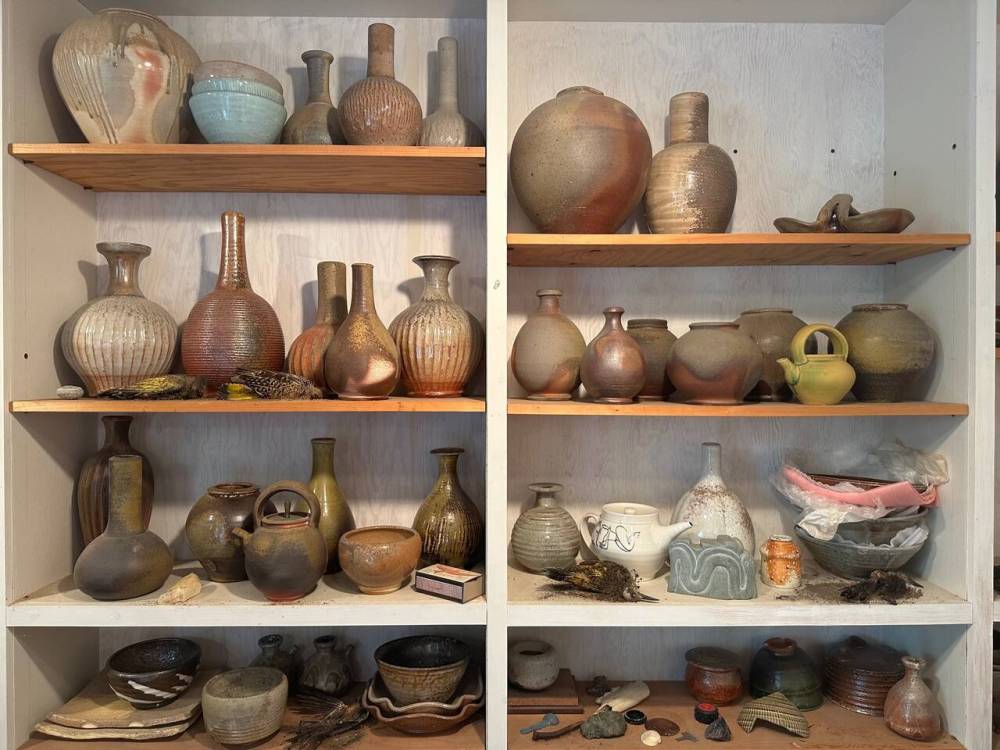
The long wooden tables were still covered with finished and unfinished vessels, shelves lined with hundreds of books and walls carrying drawings, notes, photographs and the ephemera of a life devoted to clay. It was as if the studio were holding its breath, waiting for the next firing.
Robert died in 2022, at the age of 89. I had known him for more than 15 years — first as director of the Winnipeg Art Gallery and as a curator, but ultimately as a friend. Our relationship was shaped around the presence of his ceramics: the bowls and vases, the jars and plates, the quietly powerful forms that bore the unmistakable imprint of a master potter fully in command of his craft.
And I made him a promise: that I would produce the major book his life and work deserved. I only wish I could have placed a finished copy in his hands.
Robert Archambeau (1933–2022) remains one of Canada’s most distinguished ceramic artists — a figure whose discipline, formal clarity and deep engagement with the vessel form shaped generations of makers. His practice drew upon the ceramic traditions of Japan, Korea and China while absorbing the rugged geology, forests and granite outcroppings of northern Manitoba. His wood-fired vessels, with their natural ash glazes and smoky tonalities, possess a presence that feels both ancient and utterly contemporary.
He was also one of the finest teachers the University of Manitoba’s School of Art has ever known. His influence stretches across Canada and the United States, carried forward in the work of the many artists he taught and inspired.
During my years at the Winnipeg Art Gallery, I oversaw the acquisition of many of his works for the permanent collection and organized the 2018 exhibition Robert Archambeau: A Conversation in Clay, bringing together close to 50 works spanning five decades.
Yet, the most meaningful moments were not in the gallery, but in his studio — the quiet conversations, the stories, the dry humour, the way he held a vessel and turned it slowly, as if discovering it anew.
In the past two years, I’ve made several trips back to Robert’s rural studio and summer home in Bissett — the place he loved, and the site of so much of his most important work. These visits have taken place not alone but alongside my friend Alan Lacovetsky, another gifted ceramic artist and one of Robert’s closest colleagues and confidants.
The long road trips became, in their own way, an extension of my earliest conversations with Robert. Alan and I would talk about Robert’s life and work, his teachers and influences, the students he mentored, and the vast community of makers shaped by his vision. In the quiet studio, standing among Robert’s vessels, Alan often completed stories Robert had once begun, filling in subtle histories and shared experiences that only a friend of many decades could offer. Those conversations have sustained my spirit and strengthened the resolve needed to write this book. They reminded me that Robert’s legacy is found not only in the vessels he left behind, but in the people who continue to carry his story forward.
Walking through those rooms is like entering a living archive. Here are the thrown forms waiting for trimming; there are the teapots with lids still unfitted. Shelves hold treasures: early experiments, test tiles, finished masterworks and pieces he simply wasn’t ready to let go.
Among the pots are books and diaries filled with sketches — the contours of a life devoted to inquiry. Robert never stopped refining his understanding of form, balance and material.
His drawings reveal the same disciplined investigation as his ceramics: rhythmic graphite work and paper collages that echo the movement of flame and the unpredictability of the wood-fired kiln.
Standing there, I was struck again by how vital it is that we document lives like Robert’s. For every major exhibition, acquisition or award, there are years — decades — of work: patient, quiet, unseen. Legacies need caretakers.
The book I promised Robert is now well underway, scheduled for release in summer 2026. It will feature more than 150 of his ceramic works from public and private collections across North America, along with essays by leading scholars and artists. It will offer a full portrait of an artist who helped shape the identity of Canadian studio ceramics.

Producing a volume of this scale is a significant undertaking. But it is also an act of stewardship — one that preserves an artist’s life for future generations, ensuring that students, collectors, historians and makers have access to the breadth of his career.
In support of the book, the Archambeau estate has made available a selection of 100 ceramic works from his studio — vases, bowls, jars, teapots and plates, many never before seen. Civic Muse Inc. (civicmuse.ca) is facilitating the sale of these pieces on behalf of the estate, with all proceeds supporting the book project. The pieces capture the breadth of Robert’s practice: refined forms, quiet surfaces and the deep material presence that defined his work.
We talk often in the arts about legacy — what endures, what is remembered, what is passed on. But legacy doesn’t preserve itself. It must be tended, researched, published, exhibited — and shared.
This book, and the opportunity to acquire and live with one of his vessels, is part of that larger work of honouring a life that shaped our cultural landscape. I am grateful to keep this promise to him.
Stephen Borys is president and CEO of Civic Muse, and former director and CEO of the Winnipeg Art Gallery.
Our newsroom depends on a growing audience of readers to power our journalism. If you are not a paid reader, please consider becoming a subscriber.
Our newsroom depends on its audience of readers to power our journalism. Thank you for your support.
Our newsroom depends on a growing audience of readers to power our journalism. If you are not a paid reader, please consider becoming a subscriber.
Our newsroom depends on its audience of readers to power our journalism. Thank you for your support.
Advertisement Advertise With Us
Advertisement Advertise With Us