

Now is the time for humane intervention in Darfur
Advertisement
Read this article for free:
or
Already have an account? Log in here »
To continue reading, please subscribe:

Digital Subscription
One year of digital access for only $205*
- Enjoy unlimited reading on winnipegfreepress.com
- Read the E-Edition, our digital replica newspaper
- Access News Break, our award-winning app
- Play interactive puzzles
*First annual payment billed as $205.00 + GST for one year. This annual subscription will automatically renew at $233.00 + GST every 52 weeks (10% off the regular annual price of $259.35). Offer available to new and qualified returning subscribers only. Cancel any time.
To continue reading, please subscribe:
Add Free Press access to your Brandon Sun subscription for only an additional
$1 for the first 4 weeks*
- Enjoy unlimited reading on winnipegfreepress.com
- Read the E-Edition, our digital replica newspaper
- Access News Break, our award-winning app
- Play interactive puzzles
*Your next Brandon Sun subscription payment will increase by $1.00 and you will be charged $17.95 plus GST for four weeks. After four weeks, your payment will increase to $24.95 plus GST every four weeks.
Read unlimited articles for free today:
or
Already have an account? Log in here »
Hey there, time traveller!
This article was published 19/12/2025 (257 days ago), so information in it may no longer be current.
The United Nations maintains that the worst humanitarian crisis in the world today is taking place in the African nation of Sudan.
Over 150,000 people have been killed since 2022 in a country where sexual violence against women and girls is rampant, and many others are going without food, water and medicine. In the southwestern region of Darfur, a genocide is once again unfolding in slow motion — as it did 20 years ago.
The Rapid Support Forces or RSF (formerly the Arab Janjaweed), which are backed by the United Arab Emirates and other countries, are systematically murdering, raping and torturing hundreds of thousands of African Darfuris.
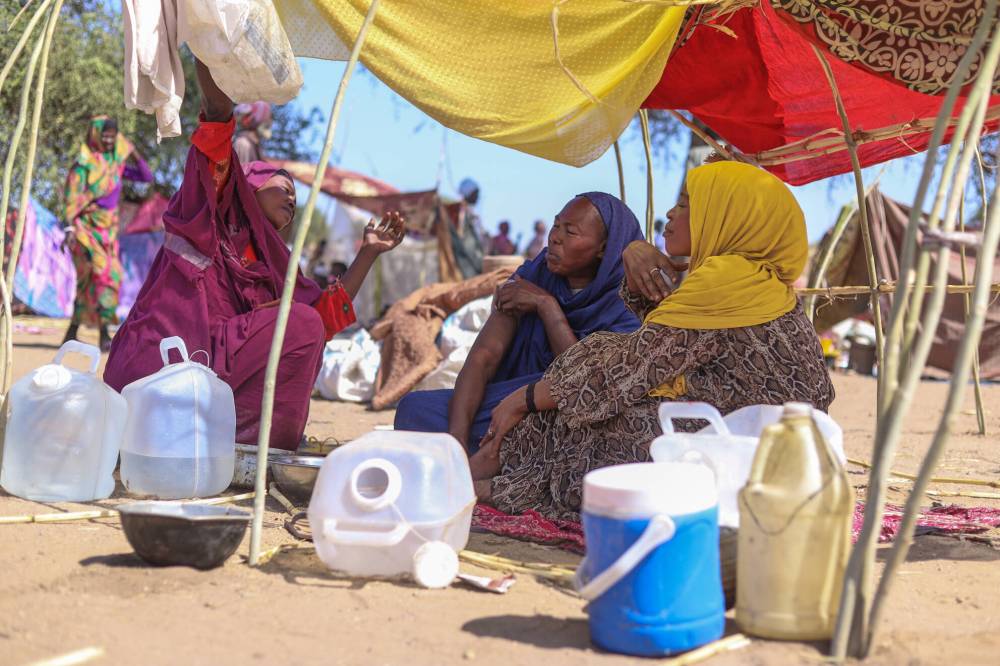
Muhnnad Adam / The Associated Press
Sudanese who fled el-Fasher, after Sudan’s paramilitary forces killed hundreds of people in the western Darfur region, speak at their camp in Tawila, Sudan.
Sudanese who fled el-Fasher city, after Sudan's paramilitary forces killed hundreds of people in the western Darfur region, speak at their camp in Tawila, Sudan, Wednesday, Oct. 29, 2025. (AP Photo/Muhnnad Adam)
Unfortunately, much of the global community — including Canada and large parts of Europe — is pretending to look the other way and to cover its ears.
I just completed a course this semester on International Human Rights and how best to advance a human rights agenda. Overwhelmingly, students in the small seminar class endorsed outside intervention to halt the genocidal acts of the RSF. The last thing that they wanted is for Darfur to turn into another Rwanda — where almost one million innocent Tutsi and moderate Hutu were slaughtered by the out-of-control Hutu extremists.
This is now happening, or threatening to happen, in the city of El Fasher in north Darfur, where 100,000 or so Darfuris are still awaiting their fate. The BBC recently interviewed one of those who escaped the city and is presently staying in a displaced persons camp in al-Dabbah. “(The RSF) shot some people directly in front of us and then carried them and threw them far away. And on the road, we saw dead bodies out in the open, unburied,” he said haltingly.
Another survivor from El Fasher made his way to a medical clinic in Tawila that is being run by Doctors Without Borders. But what he experienced on his journey — which cost him his wife and daughter and took four days to walk some 60 kilometres in the heat — is almost impossible to comprehend. He and too many others to count witnessed mass murder, horrendous torture and kidnappings for purposes of extortion.
He went on to explain that the RSF soldiers were raping women and girls and engaging in other forms of sexual violence. While he didn’t actually see the rapes and sexual assaults himself, he said that he did hear one woman shout: “Help me, help me. They raped me.’”
Is the international community going to leave these desperate Darfuris without help? Or are we going to do something to stop this madness? Indeed, this is the time for serious and meaningful actions.
You can be sure that economic sanctions, threats of arrest warrants from the International Criminal Court and diplomatic isolation and arms embargoes are not going to stop the killing. What about humanitarian military intervention? Is it not time to invoke the Canadian-infused doctrine of a “Responsibility to Protect” or R2P?
Simply put, humane or principled intervention involves the threat or use of military force by an international organization, a state or a group of countries to protect civilians at imminent risk and to end mass atrocities. It is about dissuading governments from killing their own people (and thus abdicating their responsibilities) and from engaging in genocide, crimes against humanity and war crimes. In short, it is surely about saving lives.
While it is most assuredly controversial, and should be viewed as a last resort and the nuclear option, it should also be considered part of the international human rights toolkit. It is controversial because it entails putting the interests of human beings before the interests of states, of striving to close the impunity and accountability gaps and emphasizing human suffering over state sovereignty.
The people of Darfur need us to set aside long-standing international legal precepts about territorial integrity and non-intervention and to come to their defence. Yes, it is going to involve putting military personnel in harm’s way, the potential loss of civilian lives and a stiff international spine that has staying power (and a strong commitment to post-conflict stabilization and rebuilding).
The West could begin by enforcing a no-fly zone over parts of Darfur and repelling the RSF forces, seeking the co-operation of member states of the African Union and, if need be, putting military boots on the ground.

The RSF forces need to know that they will face a ferocious military response if they don’t halt their genocidal slaughter.
No one is saying that this is going to be easy. But we all know that doing nothing is only going to result in hundreds of thousands more Darfuri deaths.
So this is definitely not the time for issuing meaningless governmental statements, invoking realpolitik thinking, fearing possible political fallout and hiding behind principles of national sovereignty. It is absolutely critical that the community of states demonstrates concretely the requisite political will to intervene forcefully.
Lives are at stake.
Peter McKenna is professor of political science at the University of Prince Edward Island in Charlottetown.