

Inaccurate budget projections and a big deficit
Advertisement
Read this article for free:
or
Already have an account? Log in here »
To continue reading, please subscribe:

Digital Subscription
One year of digital access for only $205*
- Enjoy unlimited reading on winnipegfreepress.com
- Read the E-Edition, our digital replica newspaper
- Access News Break, our award-winning app
- Play interactive puzzles
*First annual payment billed as $205.00 + GST for one year. This annual subscription will automatically renew at $233.00 + GST every 52 weeks (10% off the regular annual price of $259.35). Offer available to new and qualified returning subscribers only. Cancel any time.
To continue reading, please subscribe:
Add Free Press access to your Brandon Sun subscription for only an additional
$1 for the first 4 weeks*
- Enjoy unlimited reading on winnipegfreepress.com
- Read the E-Edition, our digital replica newspaper
- Access News Break, our award-winning app
- Play interactive puzzles
*Your next Brandon Sun subscription payment will increase by $1.00 and you will be charged $17.95 plus GST for four weeks. After four weeks, your payment will increase to $24.95 plus GST every four weeks.
Read unlimited articles for free today:
or
Already have an account? Log in here »
Hey there, time traveller!
This article was published 23/12/2025 (259 days ago), so information in it may no longer be current.
Last week, the Manitoba government finally admitted what many Manitobans had suspected for weeks, if not months. It revealed that the estimated deficit for the current 2025-26 fiscal year will be far higher than the $794 million deficit projected in Budget 2025.
In late September, Finance minister Adrien Sala said the shortfall would be $890 million, $96 million higher than the initial figure. Eleven weeks later, however, he now says the deficit will be a staggering $1.661 billion — $867 million more than the initial deficit estimate.
That huge change, over such a short period of time, raises some obvious questions: How could the shortfall climb so high, so quickly? If the projected deficit amount was so wrong less than three months ago, how can we trust the accuracy of the new, bigger figure?
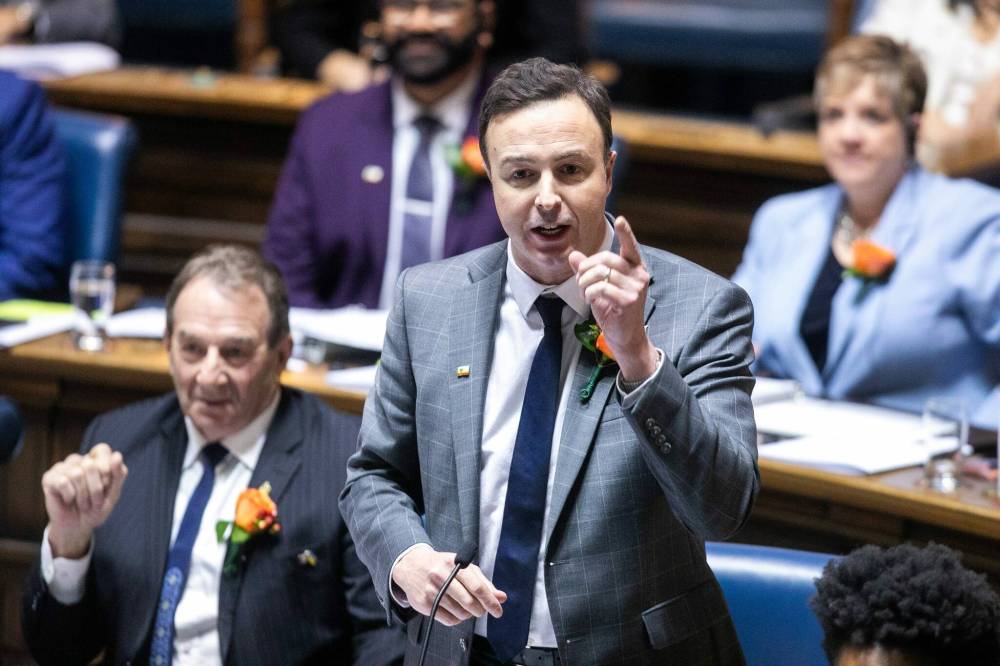
MIKAELA MACKENZIE / FREE PRESS
Finance minister Adrien Sala speaks during question period in the legislative chamber on budget day at the Manitoba Legislative Building on March 20, 2025.
In September, the government said the $890 million projected deficit was “primarily driven by wildfires costs,” but the fiscal and economic update issued at that time identified three key factors — transfers from the federal government were $105 million lower than budgeted, net income from government business entities was $77 million below estimates and emergency expenditures were $129 million higher than projected.
Last week’s economic update paints a much gloomier picture than in September, revealing that federal transfers are now projected to be $283 million below estimates, net income from government business entities is estimated to be $725 million lower than budgeted, while “net wildfire expenses” have climbed to $174 million more than budgeted.
Offsetting those notable items, the government projected in September that it would receive a whopping $215 million extra in “own source revenue” than the original budgeted amount. Last week’s report cuts that figure by more than half, however, to just $102 million.
Sala told the media last week that “Aside from the pressures of drought and wildfires, we would be within our deficit targets,” but that spin obscures what’s really happening here.
After two consecutive years of lower-than-expected Manitoba Hydro revenues due to low water levels, it was reckless for the government to base its Budget 2025 revenue projections on the assumption that the low-water problem would not occur this year, and that Hydro would turn a profit. To the surprise of perhaps only Sala, that hasn’t happened.
Similarly, after two straight years of higher-than-expected costs associated with wildfire suppression and evacuation efforts, the government cannot credibly claim it was blindsided by this year’s expense.
Based on its wildly inaccurate budget forecasts for those two items alone, the government set itself up for a much higher deficit than projected. Those aren’t its only blunders, however.
Last week’s economic update also reveals that “Individual Income Tax is forecast to decrease by $270 million, reflecting lower 2024 gross tax assessments, slower projected labour income growth and weaker projected employment growth compared to the assumptions used in Budget 2025.”
That’s on top of the estimated $283 million shortfall in federal transfer revenues. On those two items alone, the government admits it over-estimated revenues by more than a half-billion dollars.
On the other side of the ledger, the government also under-estimated some revenues. It now expects to receive $95 million more in corporate income tax revenue than originally budgeted, and says that “Education Property Taxes is forecast to increase by $77 million reflecting growth in school taxes collected by school divisions.”
If you wondered where your much-higher school property taxes went, now you know the answer.

Last year, Manitoba Auditor General Tyson Shtykalo blasted the government for an “unprecedented number of errors that required correction” during the preparation of its financial report for the 2023/24 fiscal year. Those errors included the failure to obtain all relevant information, as well as failing to ensure all information was accurate.
That same problem appears to have impacted the government’s budget-making process. In both Budgets 2024 and 2025, revenue and expense projections were unrealistically high in some areas and unreasonably low in others. Those errors have resulted in much higher deficits for those fiscal years than initially projected; super-sized shortfalls that were as foreseeable as they were inevitable.
Given that history of error and inaccuracy, Manitobans — and credit rating agencies — have ample reason to question if these guys really know what they’re doing.
Deveryn Ross is a political commentator living in Brandon.
deverynrossletters@gmail.com X: @deverynross