

Why Handel’s Messiah still matters

Advertisement
Read this article for free:
or
Already have an account? Log in here »
To continue reading, please subscribe:
Digital Subscription
One year of digital access for only $1.44 a week*
- Enjoy unlimited reading on winnipegfreepress.com
- Read the E-Edition, our digital replica newspaper
- Access News Break, our award-winning app
- Play interactive puzzles
*Billed as $5.77 plus GST every four weeks. After 52 weeks, price increases to the regular rate of $19.95 plus GST every four weeks. Offer available to new and qualified returning subscribers only. Cancel any time.
To continue reading, please subscribe:
Add Free Press access to your Brandon Sun subscription for only an additional
$1 for the first 4 weeks*
- Enjoy unlimited reading on winnipegfreepress.com
- Read the E-Edition, our digital replica newspaper
- Access News Break, our award-winning app
- Play interactive puzzles
*Your next Brandon Sun subscription payment will increase by $1.00 and you will be charged $17.95 plus GST for four weeks. After four weeks, your payment will increase to $24.95 plus GST every four weeks.
Read unlimited articles for free today:
or
Already have an account? Log in here »
On a cold evening earlier this month, with winter firmly holding Winnipeg in its grip, 2,300 people gathered inside the Centennial Concert Hall for a sold-out performance of George Frideric Handel’s Messiah. As the final notes faded and the audience rose — many smiling, some visibly moved — it was hard not to feel that something more than a concert had taken place.
Messiah is one of those rare works that seems to belong to everyone. Performed year after year, usually in December, it remains deeply loved across generations, faiths, cultures and backgrounds. You don’t need to be very religious — or religious at all — to feel its power. Nearly 300 years after its premiere, this music still brings people together in ways that feel increasingly profound.
I’ve attended many performances of Messiah over the years, in different cities and countries. Yet this year’s Winnipeg Symphony Orchestra performance felt especially meaningful. Perhaps it was the collective mood of the moment. Maybe it was the unmistakable sense of local pride, or simply the reminder — at the end of a long and complicated year — of what art can give us when we need it most.
Stephen Borys photo
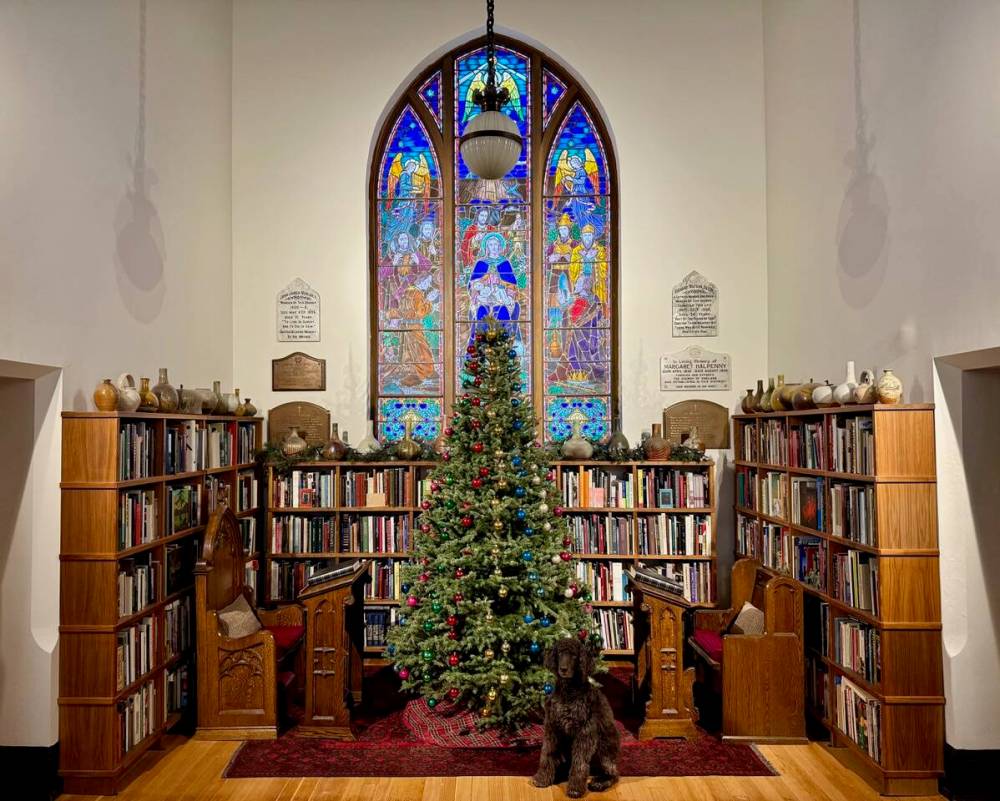
The library at Philips Square
The German-British Handel composed Messiah in just over three weeks in 1741 in London, setting biblical texts from the Old and New Testaments to music of astonishing emotional range. The work moves effortlessly from sorrow to hope, from reflection to celebration. While its text is sacred, its message is universal: longing, consolation, justice, resilience and renewal. That breadth of human experience helps explain why audiences of all beliefs continue to find meaning in it.
What is often forgotten is where Handel was in his own life at the time. By the early 1740s, his popularity in London had waned. He was facing financial uncertainty, professional setbacks and declining health, having already suffered a stroke. Messiah emerged not from a position of triumph, but from one of vulnerability. According to early accounts, he was so deeply moved while writing the Hallelujah chorus that he reportedly exclaimed, “I did think I did see all Heaven before me.” Whether literal or apocryphal, the story captures something essential about the spirit in which the work was created.
Its first performance, in Dublin in 1742, was mounted as a charitable event, raising funds for debtors’ prisons and hospitals. Women were asked to leave off their hoop skirts, and men their swords, so that more people could be admitted. From the outset, Messiah was tied not only to beauty and belief, but to compassion and the dignity of shared humanity.
This year’s Winnipeg performance was distinguished by its cohesion and sense of shared purpose. The four soloists — Ana Toumine, Lizzy Hoyt, Nolan Kehler and Dariyan Dubik — were beautifully matched, creating a balanced vocal palette rather than a series of individual showcases. Under the leadership of maestro Daniel Raiskin, the orchestra and soloists moved as one, supported by the precision of the CMU Festival Chorus guided by Janet Brenneman.
Yet what stayed with me long after the ovation was not any single aria or musical moment, but a larger question: why does a work composed in the early 18th century, drawing entirely on biblical texts, still move people so deeply today? Why does Messiah continue to fill concert halls across the continent and beyond, year after year?
Part of the answer lies in how profoundly Handel’s music carries the text. The words speak of suffering, hope, justice, consolation and renewal — experiences that are as present now as they were nearly three centuries ago. Even for those who do not approach the work from a place of faith, the emotional truth embedded in the music is unmistakable. Messiah does not demand belief; it invites reflection.
I suspect its enduring power also has something to do with the world we are living in right now. We are surrounded by uncertainty, division, fatigue and anxiety — politically, socially, environmentally and personally. In such times, people are drawn to works that offer not escape but meaning. Messiah does not ignore darkness or struggle, but neither does it end there. It insists — quietly and persistently — on the possibility of light.
There is a deep humanity in this music. Moments of sorrow are never the final word; they are held within a larger arc that bends toward dignity, resilience and joy. That arc still matters. It reminds us that suffering is not new, that hope has always been fragile and that renewal has always required faith — whether spiritual, human or communal.
The way Messiah is experienced also matters. Sitting with 2,300 people, I was struck by how rare and valuable such collective moments have become. For a few hours, phones were silenced, worries set aside and strangers were united by listening. In a fragmented world, that kind of shared attention feels almost radical.
Through my work with Civic Muse, I often write about the power of art to lift, inspire, heal and bring people together. This performance of Messiah embodied all of that. It reminded me that art is not a luxury or an afterthought, but a necessity — especially during times of uncertainty, division and weariness.

Productions like this require extraordinary skill, infrastructure and sustained public support. Yet their value cannot be measured solely in ticket sales or budgets. You cannot put a price on an evening like Dec. 13 — on the shared silence, the collective breath and the expressions on people’s faces as they stepped back into the cold night.
As this marks my final column of the year, I offer it as a gift to readers: a reminder to seek out moments like these, to cherish them, and to support the artists and institutions who make them possible.
In a world that often feels fragmented, Messiah continues to offer something quietly radical — a space for shared humanity.
That, perhaps, is why it still matters. And why, on a cold December night in Winnipeg, it felt like one of the highlights of my year.
Stephen Borys is president and CEO of Civic Muse, and former director and CEO of the Winnipeg Art Gallery.
Our newsroom depends on a growing audience of readers to power our journalism. If you are not a paid reader, please consider becoming a subscriber.
Our newsroom depends on its audience of readers to power our journalism. Thank you for your support.
Our newsroom depends on a growing audience of readers to power our journalism. If you are not a paid reader, please consider becoming a subscriber.
Our newsroom depends on its audience of readers to power our journalism. Thank you for your support.
Advertisement Advertise With Us
Advertisement Advertise With Us