

China, pragmatism and federal politics

Advertisement
Read this article for free:
or
Already have an account? Log in here »
To continue reading, please subscribe:

Digital Subscription
One year of digital access for only $205*
- Enjoy unlimited reading on winnipegfreepress.com
- Read the E-Edition, our digital replica newspaper
- Access News Break, our award-winning app
- Play interactive puzzles
*First annual payment billed as $205.00 + GST for one year. This annual subscription will automatically renew at $233.00 + GST every 52 weeks (10% off the regular annual price of $259.35). Offer available to new and qualified returning subscribers only. Cancel any time.
To continue reading, please subscribe:
Add Free Press access to your Brandon Sun subscription for only an additional
$1 for the first 4 weeks*
- Enjoy unlimited reading on winnipegfreepress.com
- Read the E-Edition, our digital replica newspaper
- Access News Break, our award-winning app
- Play interactive puzzles
*Your next Brandon Sun subscription payment will increase by $1.00 and you will be charged $17.95 plus GST for four weeks. After four weeks, your payment will increase to $24.95 plus GST every four weeks.
Read unlimited articles for free today:
or
Already have an account? Log in here »
Hey there, time traveller!
This article was published 17/01/2026 (225 days ago), so information in it may no longer be current.
One of the most popular movies in 1979 was The China Syndrome. This fictional thriller tells the tale of a runaway nuclear reactor accident in the United States threatening a catastrophic meltdown of the fuel. So hot it would break free of the containment structures and burrow deep into the Earth with nothing to stop it, all the way, you guessed it, to China.
Today, there’s a new China Syndrome causing a political meltdown, in Canada and the West. A fear of expansive, disruptive Chinese political, economic, and military influence in Canada and other western industrialized democracies. There’s good reason for concern.
In 1979, China was just beginning its path of normalizing relations with the West and implementing the first economic reforms that led to it becoming the global power it is today. That was the year America granted full diplomatic recognition to China. It was also the year China invaded Vietnam in a brief punitive war. Openness to trade on the one hand and belligerence to neighbours on the other have been complementary hallmarks of Chinese foreign policy for some time.
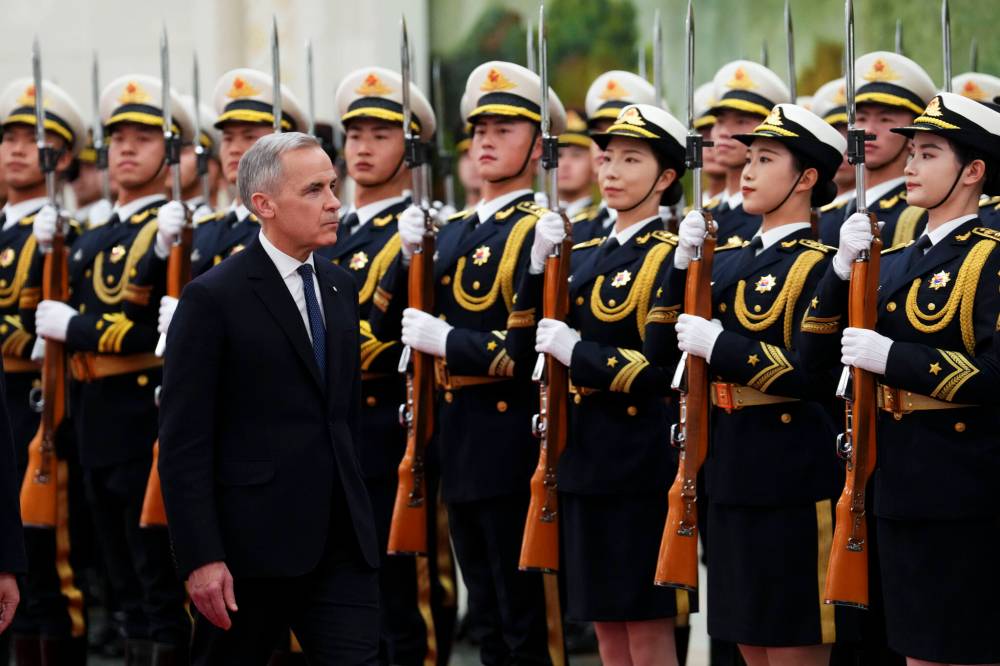
THE CANADIAN PRESS/Sean Kilpatrick
Prime Minister Mark Carney inspects an honour guard during an official welcoming at the Great Hall of the People in Beijing, China on Jan. 15.
Last year’s report of the Public Inquiry into Foreign Interference in Federal Electoral Processes and Democratic Institutions called the People’s Republic of China “the most active perpetrator of foreign interference targeting Canada’s democratic institutions.” The United States’ new National Security Strategy refers to “mistaken American assumptions about China” and the need to “rebalance” the country’s economic relationship with China to the U.S.’s benefit.
So, what the hell is Prime Minister Mark Carney doing in China this week, a country our own Indo-Pacific Strategy calls “an increasingly disruptive global power”? Simple; he has no choice.
Beijing is where he’s travelling, but between a rock and a hard place is where he’s at. The rock is Washington; the hard place is Beijing. America has been Canada’s vital economic rock for over a hundred years. U.S. President Donald Trump has upended that relationship casting our historic free trade status into grave doubt. Canadians are now contemplating the harsh but necessary economic reality of securing alternative foreign markets for our resources and manufacturing.
China is the hard place, a burgeoning hegemonic power no country can afford to ignore. Already our second-largest trading partner, although far behind the U.S. in value, Carney is knocking on the Heavenly Kingdom’s door in Beijing seeking renewed entry into the Forbidden Kingdom’s precincts for maple leaf logoed products like LNG and canola.
This is not a fully baked geopolitical pivot strategy away from the U.S. as much as a trade and investment offset strategy to help make up the economic difference. In truth, the prime minister had no option but to personally reengage China after the mutual frostiness of recent years. Its trading heft and ability to inflict heavy, arbitrary damage on key Canadian commodities need to be countered with state-to-state engagement.
So, he is paying the first prime ministerial visit since 2017 and, so far, it is paying off. He met with China’s top three leaders, Chairman Zhao Leji of the National People’s Congress, Premier Li Qiang, the head of the Chinese government, and, most importantly, President Xi Jinping, the head of state. For Sinologists, this is a big deal.
Both the Liberals and Conservatives suffer from their own respective China Syndromes. Historically, the Liberal’s has been positive towards China; the Conservatives, negative.
Opposition Leader Pierre Poilievre has said the prime minister is financially beholden to China via his past duties as chair of Brookfield Investment Management. He has decried Chinese retaliatory tariffs on western canola and demanded that the federal government withdraw its $1-billion loan from the Canada Infrastructure Bank to support B.C. Ferries’ purchase of four Chinese-built ferries. He has called for the federal government to “…stand up to the Communist government in Beijing” on human rights violations.
Trump’s disruption of the old international order is being felt inside the Conservative party. While most Canadians hold negative views towards the U.S. president and his policies, that is not the case for a significant number of conservatives including its leader. Few Canadians were sorry to see Venezuelan leader Maduro seized and spirited to the U.S. by its military, but only Poilievre publicly congratulated Trump for doing so.

Carney’s China Syndrome is outward-looking, leading him to triangulate against a Trump-dominated economic order by seeking a Canadian rapprochement with China. Poilievre’s China Syndrome is inward-looking, leading him in the direction of a Canadian rapprochement with Trump — restored free trade in exchange for a joint “security partnership.” This would link us tighter with the U.S., the very opposite of what Carney is seeking.
“We can’t ignore the fact that American capitalism is the most powerful economic force in the history of the world and they’re right next door,” Poilievre has said. Carney, meanwhile, has declared, “This decades-long process of an ever-closer economic relationship between the Canadian and U.S. economies is now over.”
These are very different foreign policy worldviews with very big consequences for Canada.
Cue the China meltdowns from both sides.
David McLaughlin is a former clerk of the executive council and cabinet secretary in the Manitoba government.
Our newsroom depends on a growing audience of readers to power our journalism. If you are not a paid reader, please consider becoming a subscriber.
Our newsroom depends on its audience of readers to power our journalism. Thank you for your support.
Our newsroom depends on a growing audience of readers to power our journalism. If you are not a paid reader, please consider becoming a subscriber.
Our newsroom depends on its audience of readers to power our journalism. Thank you for your support.
Related Articles
Carney courts investment at World Economic Forum in Switzerland

Advertisement Advertise With Us
Advertisement Advertise With Us