

Is the concept of Canada as a ‘middle power’ meaningless?
Advertisement
Read this article for free:
or
Already have an account? Log in here »
To continue reading, please subscribe:
Digital Subscription
One year of digital access for only $1.44 a week*
- Enjoy unlimited reading on winnipegfreepress.com
- Read the E-Edition, our digital replica newspaper
- Access News Break, our award-winning app
- Play interactive puzzles
*Billed as $5.77 plus GST every four weeks. After 52 weeks, price increases to the regular rate of $19.95 plus GST every four weeks. Offer available to new and qualified returning subscribers only. Cancel any time.
To continue reading, please subscribe:
Add Free Press access to your Brandon Sun subscription for only an additional
$1 for the first 4 weeks*
- Enjoy unlimited reading on winnipegfreepress.com
- Read the E-Edition, our digital replica newspaper
- Access News Break, our award-winning app
- Play interactive puzzles
*Your next Brandon Sun subscription payment will increase by $1.00 and you will be charged $17.95 plus GST for four weeks. After four weeks, your payment will increase to $24.95 plus GST every four weeks.
Read unlimited articles for free today:
or
Already have an account? Log in here »
Hey there, time traveller!
This article was published 05/02/2026 (263 days ago), so information in it may no longer be current.
Does the middle power concept have any relevancy today?
When you read through Prime Minister Mark Carney’s notable Davos speech, he makes a number of references to the term “middle power.” This was no accident for sure.
Government officials, commentators and journalists often refer to Canada as a middle power as if it’s supposed to mean something important. But it is really little more than a term of convenience — and a self-serving one for Canada.
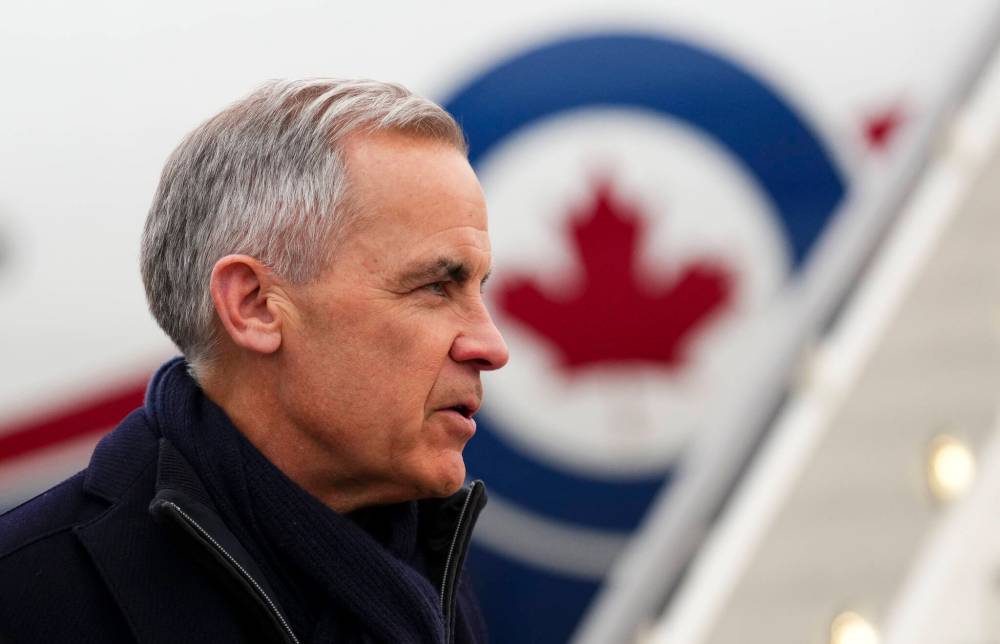
The Canadian Press
Prime Minister Mark Carney arriving in Zurich, Switzerland, to attend the World Economic Forum in Davos.
Does the concept still have any meaning today? Does it denote a certain status, influence or position in the international hierarchy of states? More to the point, what makes Canada a so-called middle power?
At one time, the Canadian government — along with Canada’s emerging foreign policy establishment — could lay claim to Canada’s “privileged” status after the Second World War. It made some sense given Canada’s sizable military capacity (a large navy, army and air force) and a robust economy (especially when compared to a war-ravaged European continent). Occasionally, Canada’s then-prime minister Mackenzie King would be allowed into the room to join the other principals: Franklin Roosevelt, Winston Churchill and Joseph Stalin.
The real prize for Canada was to have its voice heard on shaping the post-1945 world order — instead of being sidelined once again as it was during the wartime years.
It wanted to have a seat at the high table, to be granted special privileges and to have its vital interests advanced and respected. It most assuredly did not want to be dominated by a small group of aspiring “great powers.”
More importantly, it wanted to carve out some space for “middle powers” (which were more significant than “small” or “lesser” powers) so as to establish international peace and security as a top priority. Make no mistake, Canadian officials hoped to use their newfound middle-power status to push for global order and stability, maintaining the rules-based system and preventing war — which were all in accordance with Canada’s core national interests.
But there was another side to this pursuit of middle power status for Canada. It would appeal to Canadian sensibilities and pride (separating us from the likes of Panama and Tunisia, as it were) and dampen expectations of what Canada was capable of accomplishing since it was not a major power.
I suspect that many of these middle power policy drivers are still in place today. This explains why Carney referenced the term so often in his World Economic Forum speech. But does the term actually have any relevance anymore?
There were always definitional problems and an absence of clarity in what the concept really meant. Was it about Canada’s raw power inventory or capabilities and capacity? Or, did it allude to certain responsibilities or roles that Canada performed in the global arena?
As an esteemed political science professor of mine at Dalhousie University, Denis Stairs, once wrote: “Foreign policy, in short, has many more roots than one, and the empirical version of the middle-power thesis is simply a mistake. It would do much for clarity in the field if it were put permanently to rest.”
In his Davos speech, Carney called upon middle powers to work together to constrain the United States, to enhance trade relations amongst themselves and to strengthen the international architecture of world politics. “It means building what we claim to believe in. Rather than waiting for the old order to be restored, create institutions and agreements that function as described,” he said pointedly.
The truth is that Canada isn’t a middle power and has not had a signature foreign policy achievement since Pierre Elliott Trudeau’s ill-fated “peace initiative” of the early 1980s. And most of what Carney spoke about in his speech has been precisely what Canada has been doing for the last 40 years or more.
The central aims of international stability and order, system maintenance and war-avoidance — co-operating with other countries, utilizing multilateralism and bridge-building and conflict resolution — have not changed since the mid-1940s.

Nor is there any evidence that some new galvanizing of a middle power cohort of states would be any more successful than it has been over the last 80 years. Indeed, the same problems that plagued lesser or like-minded powers in the past — self-interest and a lack of political will, domestic political realities and resource constraints — haven’t suddenly disappeared. Moreover, I didn’t hear anything about Carney signalling his willingness to actually lead such a group.
Canada, and the rest of the world, is just going to have to tough it out, stiffen its spine and muddle through the next three years of Trumpism. We should certainly explore other trade partners, make our presence felt in international fora and bolster our military capabilities.
But I think it would be better for all concerned if Carney would simply drop the middle power label and focus on coalition-building with like-minded countries, foreign policy niche-playing and reviving multilateralism and regional institutions.
At this stage of Canada’s existence, the Liberal government needs to concentrate on finding reliable friends, enhancing our diplomatic and military assets and making itself useful on the world stage.
Peter McKenna is professor of political science at the University of Prince Edward Island in Charlottetown.