

Gimme shelterbelts — a needed natural safety feature
Advertisement
Read this article for free:
or
Already have an account? Log in here »
To continue reading, please subscribe:

Digital Subscription
One year of digital access for only $205*
- Enjoy unlimited reading on winnipegfreepress.com
- Read the E-Edition, our digital replica newspaper
- Access News Break, our award-winning app
- Play interactive puzzles
*First annual payment billed as $205.00 + GST for one year. This annual subscription will automatically renew at $233.00 + GST every 52 weeks (10% off the regular annual price of $259.35). Offer available to new and qualified returning subscribers only. Cancel any time.
To continue reading, please subscribe:
Add Free Press access to your Brandon Sun subscription for only an additional
$1 for the first 4 weeks*
- Enjoy unlimited reading on winnipegfreepress.com
- Read the E-Edition, our digital replica newspaper
- Access News Break, our award-winning app
- Play interactive puzzles
*Your next Brandon Sun subscription payment will increase by $1.00 and you will be charged $17.95 plus GST for four weeks. After four weeks, your payment will increase to $24.95 plus GST every four weeks.
Read unlimited articles for free today:
or
Already have an account? Log in here »
Hey there, time traveller!
This article was published 12/02/2026 (210 days ago), so information in it may no longer be current.
Last week I awoke to news that three young hockey players were tragically killed yesterday in Alberta while driving to practice … and though I do not yet know if weather was a factor, I’d be surprised if it wasn’t.
Recently, I drove to St. Jean Baptiste to watch my son, now 24, play for the Carman Beavers in the Manitoba Senior Hockey League. It’s been great to watch him play again, as his Junior A hockey playing days came to an abrupt end when he aged out at 21.
The Beavers gave up a 3-1 lead to lose 4-3 on a late goal, so it was a good game but a tough loss in a tough season.
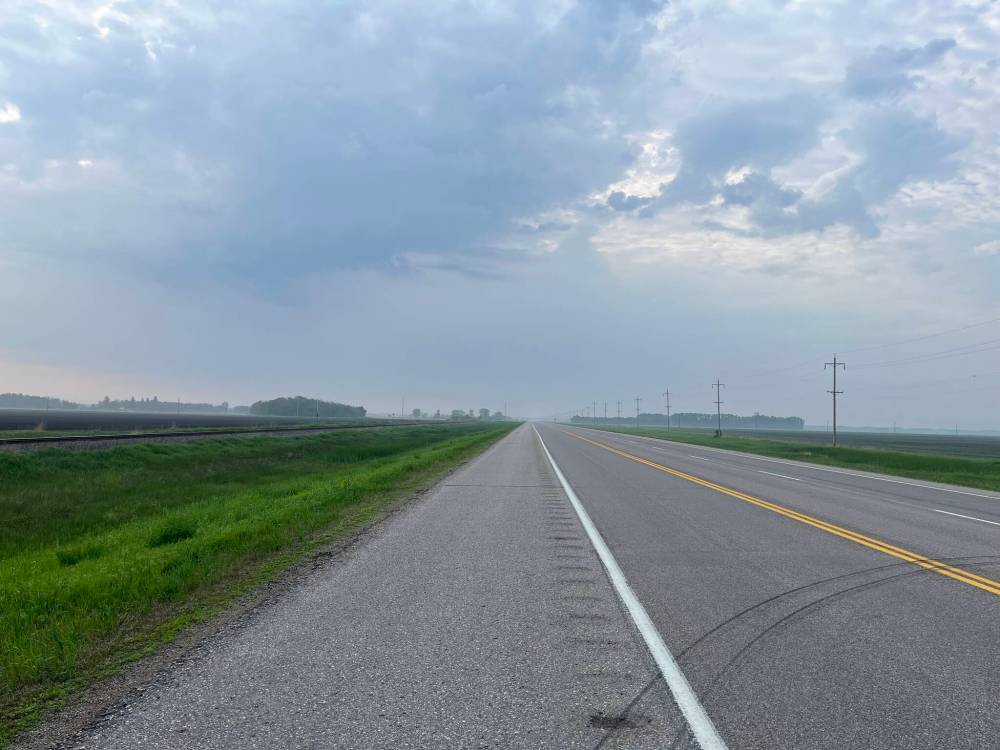
But even tougher was the drive back home. Well past sunset, I had driven from Winnipeg down Highway 75, heading to the third of the “three Saints,” St. Adolphe, Ste. Agathe, then past Morris to St. Jean.
Road conditions and visibility were poor driving out, but worse coming back: very high winds and lots of snow, blowing and drifting … so much that on that dark highway, upon leaving the few lights of St. Jean, there were much-too-long moments when nothing was visible but the white swirls of the storm — I was just floating along, far below the 100 k/h speed limit, and trying to “track straight” between the lines I had barely been able to make out a few long seconds before … so that I didn’t hit either ditch.
When I felt my tires bumping over the relatively rougher surface of the right shoulder of the highway, I stopped on the shoulder, activated my hazard flashers to alert the headlights in my rear-view mirror in hopes they would avoid hitting me, and gathered my wits. I realized I would have to slow even more, close to a crawl, so I could detect the different feel of the shoulder to avoid driving blindly off the shoulder and into the ditch lurking close in the black/white void on my right, and also to avoid veering left, back on to one of the two northbound lanes between the east and median ditches, and either being hit from behind by larger/higher vehicles that could either see a bit better and/or felt more sure of their ability to stay out of the ditches by extrapolating from the white lines glimpsed just before those dreaded moments of whiteout blindness, and therefore going faster.
I let some trucks and SUVs go past my relatively low slung Mazda sedan, then eased in behind to follow their red tail lights.
Many long minutes later, I suddenly recognized that I was at the place where the highway curves left, near St. Adolphe, I had sped up because the visibility had improved somewhat, but I suddenly felt the sickening pull of the sinister small drift that had formed along the raised right edge of the curving lane, and I steered carefully but firmly against that pull, and avoided careening over the edge like a runaway bobsled … an instant later, appearing suddenly out of the storm to my right front I glimpsed several trucks and SUVs, lights on, stuck motionless and askew, down in the ditch, almost certainly the ones who had passed me outside St. Jean.
Stopping on that long curve would have invited collision/death, so I continued on, knowing those ditched folks surely all had cellphones.
Just a stormy January Saturday night on the Manitoba prairie farmlands? I suppose … decide whether you are up for the risk and go or stay. It wasn’t my first such storm rodeo, so I chose to go.
It doesn’t have to be this way.
Wherever a driver, in conditions like these, gets to finally pass through many kilometres of open farmland, with not a tree or bush in sight on the windward side, and then finally drives past even a modest stand of a few bushes and trees, it is incredible how the raging storm suddenly and dramatically abates … just for a few moments, till you pass that copse of bush/trees and are once again enveloped by the unimpeded fury of the snow storm barreling across many kilometres where there is nothing on the ground of those empty windswept farm fields but a few inches of stubble from last summer’s crop.
Why are we as Manitobans unable to set aside .001 per cent or so of the margins of farm fields to encourage and allow strips of native prairie grass, bush and trees to grow?
There was a government effort a few decades ago along the notoriously bad Trans-Canada Highway stretch between Winnipeg and Portage la Prairie to plant a single continuous line of trees and a single continuous line of shrubs, of varying species, to reduce the storm effect I’ve described.
It has met with only modest (but still significant) success, mostly because of plant mortality. As I recall, one of the biggest problems was herbicide overspray/drift from farmers dousing their fields against invasive weeds that would cut into their crop yield.
Why are we unable as Manitobans to allow thin but significant lines of native species to grow on the margins of most farm fields, both to provide this life-saving safety element from winter storms, but also, even more crucially long term, to strengthen our mostly stripped farmlands against the effects of climate change (including drying soils and winds, too-high heat that wilts the crops, an absence of habitat for the original species of flora and fauna that help the prairie maintain its health)?

I understand that farmers feel obliged to use every square metre of arable land to ensure a living (or increasingly, as family farms disappear into the maw of massive corporate farms, profits), but surely government can come up with something more effective than whatever exists now to really start actually greening the thin edges of the vast winter dead zones of wind-scoured stubble.
There is a shelter belt just east of Carman that runs perpendicular to the highway that leads east towards Winnipeg. It is a glorious ecological treasure — at least 10 metres wide, flowing far towards the northern horizon. It’s a slice of native prairie forest/bush: an ancient burr oak spine crowning it, with a thick native understory of food-bearing bushes (such as wild rose, saskatoon, nannyberry) and many wildflowers and grasses thriving at its edges. Kudos to the farming families who have allowed it to remain and flourish, true stewards of our land.
That would be the platinum standard, as it would take many decades of assisting but mostly just allowing nature to remain/re-establish such a cathedral of native plant magnificence.
Surely we can aspire to allowing bronze silver and gold-level shelterbelts to grow for the future.
G.T. Jowett writes from Winnipeg.