

Increased taxation requires thorough justification
Advertisement
Read this article for free:
or
Already have an account? Log in here »
To continue reading, please subscribe:
Digital Subscription
One year of digital access for only $1.44 a week*
- Enjoy unlimited reading on winnipegfreepress.com
- Read the E-Edition, our digital replica newspaper
- Access News Break, our award-winning app
- Play interactive puzzles
*Billed as $5.77 plus GST every four weeks. After 52 weeks, price increases to the regular rate of $19.95 plus GST every four weeks. Offer available to new and qualified returning subscribers only. Cancel any time.
To continue reading, please subscribe:
Add Free Press access to your Brandon Sun subscription for only an additional
$1 for the first 4 weeks*
- Enjoy unlimited reading on winnipegfreepress.com
- Read the E-Edition, our digital replica newspaper
- Access News Break, our award-winning app
- Play interactive puzzles
*Your next Brandon Sun subscription payment will increase by $1.00 and you will be charged $17.95 plus GST for four weeks. After four weeks, your payment will increase to $24.95 plus GST every four weeks.
Read unlimited articles for free today:
or
Already have an account? Log in here »
Hey there, time traveller!
This article was published 12/02/2026 (253 days ago), so information in it may no longer be current.
This year, the City of Winnipeg sent me two “love letters.”
The first arrived in May, informing me that it (the city) was “delivering affordability,” with the lowest municipal property tax rates in Canada, the lowest municipal fees on new housing, and the lowest garbage and recycling fees in Canada. Well, to quote Shania Twain, “that don’t impress me much.
Before I explain, let me tell you about the second letter, which has triggered indigestion among some homeowners.
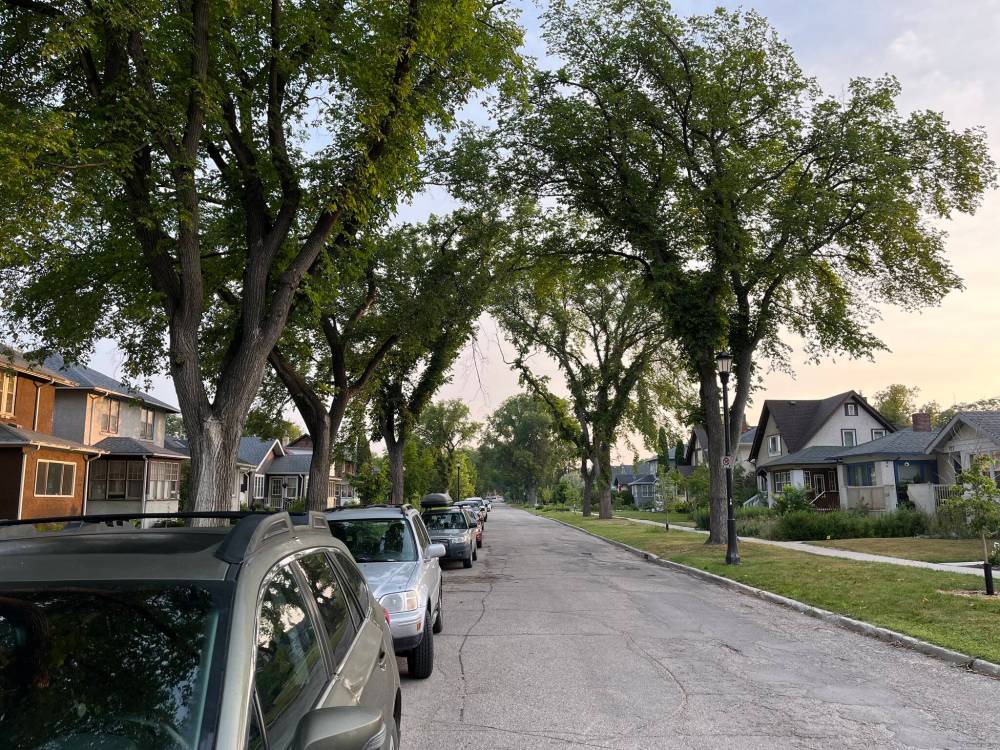
Russell Wangersky/Free Press
Before increasing residential property taxes, Winnipeg City Council should have to show how its benchmark performance matches up with other comperable Canadian cities.
This communicated my proposed 2027 assessed value, which has risen by about five per cent from the 2025 assessed value, or slightly less than the inflation rate over that period. It is common for assessed values to understate actual market value, so I expect (hope) that when I put my home up for sale, I will receive an offer 10-15 per cent higher than the assessed value.
Welcome to the shell game of municipal finance.
Some homeowners have experienced large jumps in assessed value and have stated their intent to “fight city hall” and appeal the valuation. It helps to understand how the city calculates property taxes and where they fit within the overall budget.
The City of Winnipeg’s revenues derive from seven sources: taxation at 46 per cent of which property taxes are by far the most important; sales of services and regulatory fees (14 per cent); utility and enterprise revenues (14 per cent); federal/provincial transfers at 13 per cent; developer and capital fees at seven per cent; and investment and other income fees (six per cent).
Very simplistically, to determine the “mill rate,” namely, the percentage of the assessed value that is your actual property tax, the city budget office must forecast or be certain of all revenue sources other than the property tax. The difference between these other sources and the total budgetary requirement determines the target revenue needed from property taxes. The total assessed value divided by the property tax target revenue yields the mill rate. Applying the mill rate to an individual assessment determines the property taxes due.
Of course, considerable finagling (a technical economic term) occurs as budgetary planners reconcile fees, grants, and political promises to hold the line on property tax increases.
If a single homeowner successfully appeals to lower their assessed value, their taxes will fall. However, imagine the assessment fairy (a second cousin of the tooth fairy) waved their wand and assessed values fell by 50 per cent. Would property taxes fall? No such luck. The mill rate would simply rise to meet the target-value property tax revenues.
Commercial property owners often dispute the assessed value of their properties, but because they often own many properties, it is rational for them to attempt an appeal. I have served as a professional expert in these quasijudicial appeals and can attest that they are complex and lengthy.
A single homeowner must search for recent sales of comparable properties, pay for an independent assessment from a broker, make the case that the property has unrecorded deficiencies that reduce its value (collapsed weeping tiles) and then present the evidence before the Board of Revision during a specified period. If many homeowners appeal, the city might have to review its overall assessment process, but keeping assessed values systematically below market values reduces the likelihood of that.
The assessment process is complex and costly. One option is the Harberger model (named for the Chicago economist Arnold Harberger) for asset valuation. In this scheme, the property owner self-assesses and completes a form with their own valuation of the property. The devious idea is that this form is also legally an offer to sell the property to the city at the stated assessed value. In its even more diabolical form, it is an offer to sell to anyone. Of course, this idea is theoretical because its application might cause mayhem, but it does offer one way to short-circuit the bi-annual assessment drama.
But back to Shania. Why am I not impressed by the city delivering affordability? Quite simply, affordability is not the issue. I want value for money.
In recent years, we have had the case of absentee building inspectors in 2024 and the sudden resignation of the chief administrative officer in June 2024. In the latter instance, no formal reason was offered for the resignation, but it immediately followed an audit that revealed very casual employee performance management and accountability practices.

One common approach to assessing value for money is benchmarking, in which a group of firms uses common performance measures. This principle applies to cities, and several methods exist, including Statistics Canada’s municipal financial and socioeconomic data dashboard, the Municipal Benchmarking Network, World Council on City Data, and the Federation of Canadian Municipalities. For example, from the Municipal Benchmarking Project, we learn that Winnipeg’s fire station notification response time (the time from fire station notice to arrival on scene) was 8.53 minutes in 2022, the most recent year available, and the slowest response across the seven cities in the benchmark group.
Such metrics are easy to misconstrue and misinterpret. Each city has different topography, fire station siting constraints, and fire risks. Furthermore, the information requires consistent participation by cities and the data are usually two or three years old, just to cite two challenges. However, we need a unified system, and the Federal government should fund Statistics Canada to lead such an initiative, rather than relying on incomplete and imperfect models.
With my assessment notice, if I were to receive a one-page summary report on key benchmarks, with links to the full report, and commentary on how the city intends to improve, I would begin to believe I was receiving value for money.
The snippet of self-serving comparison on the property tax rates and fees that I received in May, well, it don’t impress me much.
Gregory Mason is an associate professor of economics at the University of Manitoba.