

The quiet, sustaining architecture of volunteer leadership

Advertisement
Read this article for free:
or
Already have an account? Log in here »
To continue reading, please subscribe:

Digital Subscription
One year of digital access for only $205*
- Enjoy unlimited reading on winnipegfreepress.com
- Read the E-Edition, our digital replica newspaper
- Access News Break, our award-winning app
- Play interactive puzzles
*First annual payment billed as $205.00 + GST for one year. This annual subscription will automatically renew at $233.00 + GST every 52 weeks (10% off the regular annual price of $259.35). Offer available to new and qualified returning subscribers only. Cancel any time.
To continue reading, please subscribe:
Add Free Press access to your Brandon Sun subscription for only an additional
$1 for the first 4 weeks*
- Enjoy unlimited reading on winnipegfreepress.com
- Read the E-Edition, our digital replica newspaper
- Access News Break, our award-winning app
- Play interactive puzzles
*Your next Brandon Sun subscription payment will increase by $1.00 and you will be charged $17.95 plus GST for four weeks. After four weeks, your payment will increase to $24.95 plus GST every four weeks.
Read unlimited articles for free today:
or
Already have an account? Log in here »
Hey there, time traveller!
This article was published 19/02/2026 (219 days ago), so information in it may no longer be current.
When news broke that William (Bill) Loewen had passed away, Winnipeg lost more than a successful business leader and philanthropist. We lost one of those rare figures whose generosity shaped the cultural life of this city quietly and without fanfare.
Bill’s civic life was never his alone. Together with his wife Shirley, who passed away in 2022, he formed one of those steadfast partnerships that shaped a city over decades. Their support extended across the arts, education, and community — often without publicity and always with care. Winnipeg’s cultural landscape carries their imprint in ways both visible and unseen.
On the very day I launched Civic Muse last summer, Bill wrote to congratulate me. His email began: “What a brilliant idea. And what courage to take such a challenge on!” It was brief, energizing, forward-looking. In that same note, he outlined an arts initiative he hoped I might help bring to life. That was Bill: affirmation paired with action.
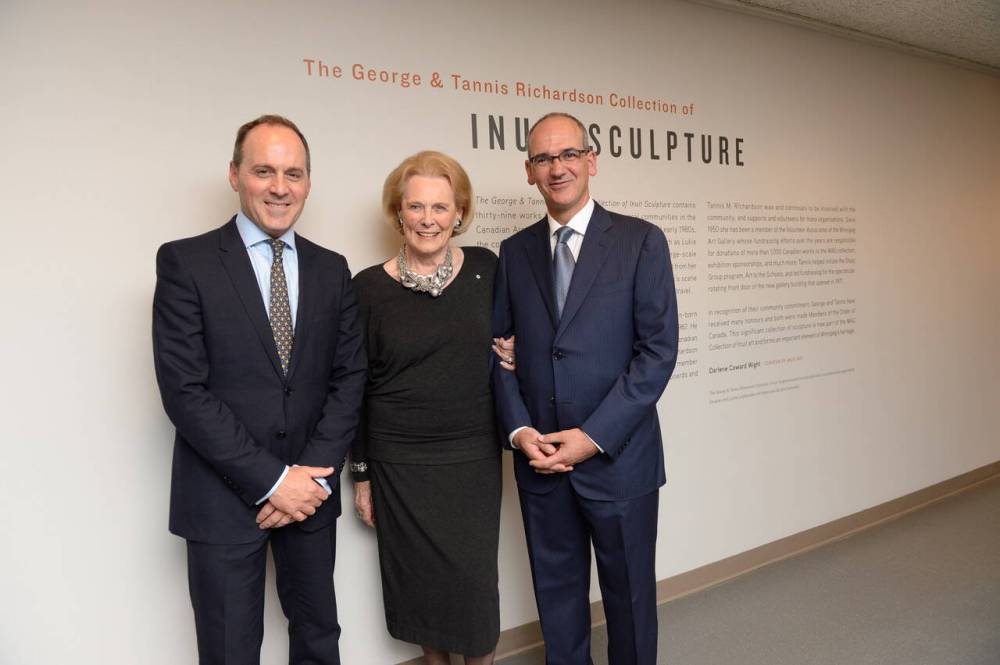
Supplied
(Left to right) Stephen Borys, Tannis Richardson and Ernest Cholakis marking the donation and exhibition of the George & Tannis Richardson Collection of Inuit Sculpture during Borys’ directorship.
Over the following months, we met to explore the proposal — sometimes over lunch, sometimes by phone or email. The plan was ambitious, rooted in the belief that Winnipeg’s visual and performing arts communities could aim higher. He joined me last fall at Government House at an event honouring my tenure at the Winnipeg Art Gallery, and our conversation continued. Sadly, time was not on our side. Bill died before we could see the project realized.
In one of his longer notes, he wrote: “So have a go at something that may even have some semblance of what I hope could be the beginning of something great.” What remains with me is not the unfinished plan, but Bill’s spirit — purposeful and generous. His support was constant, never performative.
That quiet strength is the hallmark of exemplary public stewardship.
In the arts sector, we often celebrate artists, performers, donors, and CEOs. Less visible, but equally consequential, are those who sit at board and committee tables — individuals who lend expertise, judgment, networks, and credibility to organizations serving the common good.
At its best, this is service in its highest form.
The partnership between a board chair and a CEO is among the most critical relationships in the non-profit world. When it functions well, it creates clarity and assurance. A strong chair stewards mission, safeguards governance integrity, and protects long-term sustainability. They ask hard questions without undermining trust. They offer counsel without crossing into operations.
I experienced the power of that partnership during my years as director and CEO of the Winnipeg Art Gallery. This included the realization of Qaumajuq, the largest Inuit art centre in the world. Raising over $75 million, aligning three levels of government, and engaging Inuit artists and advisors across the country required ambition — and steady guidance at the board table.
During that period, Dr. Ernest Cholakis served as chair of the WAG Board. His oversight provided the stability the undertaking required. He brought business acumen to cultural aspiration, respected the boundaries between board and management, and understood that public trust is a civic obligation.
Projects on the scale of Qaumajuq are never the achievement of one person. They build on decades of continuity and collective commitment — staff, boards, donors, and governments collaborating closely. Governance creates the framework; community investment sustains it. I had the privilege of working alongside many board and public leaders during the building campaign — individuals who understood that major initiatives require both discipline and belief.
Among them was Tannis Richardson, whose decades of philanthropy have strengthened the creative landscape across Winnipeg. Together with her late husband George and their family, she has been a steadfast supporter of the arts, education, and health sectors. Their generosity to the WAG long predated the Inuit art centre, and their example helped expand the circle of conviction around the project.
Through my experience with Tannis, I saw how thoughtful giving combines discernment with encouragement — leadership expressed through confidence rather than control. Philanthropy, at its best, is relational. When respected citizens step forward with fervour, others follow. In fundraising, one gift often begets another.
True organizational strength emerges from alignment — governance, donors, and board and management moving in shared purpose.
Today, Ernest Cholakis brings those same qualities to his new role as chair of the Royal Winnipeg Ballet. Together with artistic director Christopher Stowell and executive director Elena Tupyseva, he helps maintain harmony between artistic vision, operational strength, and sustainability. When roles are complementary and clearly defined, the enterprise moves forward with resolve. It is an auspicious moment for the RWB.
Work at this level demands more than time alone. It requires judgment, stamina, and belief in mission. It requires holding complexity — artistic ambition alongside fiscal responsibility, innovation alongside prudence.
It also requires humility.
The best stewards do not seek visibility. They seek impact. They strengthen institutions so they can endure and evolve.
Last week, I had lunch with Cholakis — something we have done regularly for years. When he was chair, it was a monthly ritual. We would talk about mission, strategy, stakeholders, fundraising. Those lunches were not ceremonial. They were partnership.
And, unfailingly, he insisted on picking up the tab.
That small gesture is symbolic. It reflects a willingness to assume responsibility — sometimes visible, often invisible — so others can fulfill their roles well.

Bill Loewen did that through ideas and encouragement offered at precisely the right moment. Tannis Richardson — alongside her family’s enduring generosity — has done it over decades, with quiet confidence that inspires others to step forward. Cholakis continues to do it through clear judgment and unwavering commitment to institutions that shape our cultural life.
All three embody a deeper civic ethic: a belief that success carries obligation, that expertise should be shared, and that community matters.
Sometimes the most important architecture is not made of steel or stone, but of trust, generosity, and stewardship built patiently over time by those willing to serve without spectacle.
That is the real practice of volunteer leadership.
Stephen Borys is president and CEO of Civic Muse, and former director and CEO of the Winnipeg Art Gallery–Qaumajuq.
Our newsroom depends on a growing audience of readers to power our journalism. If you are not a paid reader, please consider becoming a subscriber.
Our newsroom depends on its audience of readers to power our journalism. Thank you for your support.
Our newsroom depends on a growing audience of readers to power our journalism. If you are not a paid reader, please consider becoming a subscriber.
Our newsroom depends on its audience of readers to power our journalism. Thank you for your support.
Related Articles
Matriarch of Richardson family dies at 99
Advertisement Advertise With Us
Advertisement Advertise With Us