

Data centres and Manitoba: a cautionary tale
Advertisement
Read this article for free:
or
Already have an account? Log in here »
To continue reading, please subscribe:
Digital Subscription
One year of digital access for only $1.44 a week*
- Enjoy unlimited reading on winnipegfreepress.com
- Read the E-Edition, our digital replica newspaper
- Access News Break, our award-winning app
- Play interactive puzzles
*Billed as $5.77 plus GST every four weeks. After 52 weeks, price increases to the regular rate of $19.95 plus GST every four weeks. Offer available to new and qualified returning subscribers only. Cancel any time.
To continue reading, please subscribe:
Add Free Press access to your Brandon Sun subscription for only an additional
$1 for the first 4 weeks*
- Enjoy unlimited reading on winnipegfreepress.com
- Read the E-Edition, our digital replica newspaper
- Access News Break, our award-winning app
- Play interactive puzzles
*Your next Brandon Sun subscription payment will increase by $1.00 and you will be charged $17.95 plus GST for four weeks. After four weeks, your payment will increase to $24.95 plus GST every four weeks.
Read unlimited articles for free today:
or
Already have an account? Log in here »
Hey there, time traveller!
This article was published 27/02/2026 (232 days ago), so information in it may no longer be current.
Alongside the rapidly expanding use of AI in everyday life, there’s a growing awareness that the technology also comes with extreme, big-picture threats to the things we need more: fresh water, affordable clean energy and a healthy information ecosystem.
Data centres housing the racks of computer servers that enable virtual assistants, software tools and other AI uses, are being planned and built across the world.
In Manitoba, two firms recently partnered to purchase land in Île-des-Chênes, planning a hyperscale facility, and at 141 hectares (350 acres) the site would be among the largest in the world.
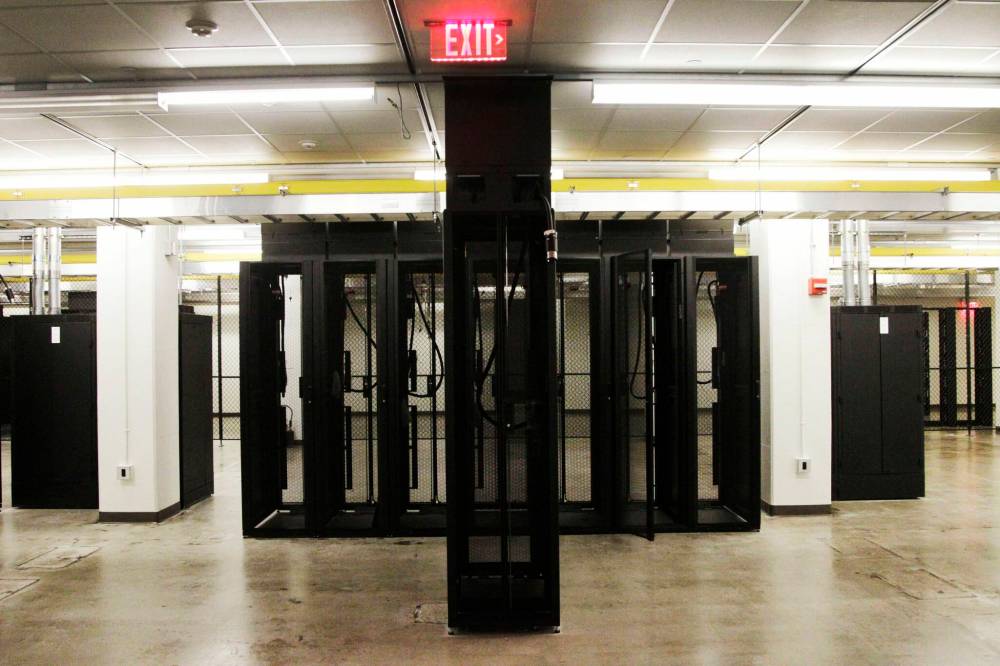
Mark Lennihan / The Associated Press
Massive new data centres have massive new needs, both for electricity and for water. But are they worth the cost?
Based on the release of an innovation report and statements by the premier, the provincial government is eager to roll out the welcome mat. That would be a mistake.
While we don’t know every detail of the planned centre here, what we can see is the consequences other “AI factories” are now having across Canada and around the world.
AI is arguably the most power-hungry technology ever created. From a question to a bot to generating a video, AI uses tens to thousands of times more electricity than the web or software.
Like electricity generation, data centre usage is measured in megawatts (MW). The project reportedly seeks to grow to 500 MW, accessing Manitoba Hydro’s nearby high-voltage line and adding gas turbines.
To put that in perspective, that’s enough to power 400,000-500,000 homes, or almost double the power currently generated for the city of Brandon and surrounding region. The net capability of the Keeyask project, which cost at least $8.7 billion, is 617 MW.
The province’s supply of low-emission, relatively low-cost electricity has been seen as an advantage, but that’s about to end (by 2029-30).
Hydro has already warned that “severe drought” has crushed their financial health, triggering a series of significant rate increase requests. The utility does not have the debt room to build any more dams and is poised to re-invest in fossil fuels.
How does the province plan to solve this issue, let alone provide for data centres?
AI is also very thirsty for clean water. Based on estimates by the International Energy Agency, a 500 MW centre would use 10 million litres of water per day. That’s in line with a Microsoft build in Etobicoke, approved to use 1.2 billion litres per year for a far smaller project.
The proposed Île-des-Chênes factory is not a project in a vacuum either. Just 10 kilometres west at Daman Farm, residents, developers and city staff have been arguing over drying-up groundwater and salty wells, and 40 kilometres east is the Vivian sand development and proposed nexus of the Sio Silica fracking extraction plan that residents oppose due to the fragility of the aquifer on which they rely.
Even if we want to consider allocating these resources in the name of development, there are also key questions of the purpose and benefits.
Local economies would benefit during construction, but industry figures show a massive centre like this, once built, would employ only 50-200, commonly featuring precarious arrangements with subcontractors or temporary gig workers.
Politicians are posturing about the need for “sovereign AI,” a fine idea and convenient catchphrase. Yet it doesn’t matter if a data centre is located here if there aren’t sufficient laws in place to require Canadians’ data and privacy be protected.
If there are no enforced consequences for predatory algorithms, willful disinformation, sneaky collection of biometrics, or even any digital taxation, so what if a company is Canadian?
The true winners are primarily the world’s largest tech companies, who trained AI models by “scraping” (often copyrighted) human work off the internet for free before flooding it with “slop” content.
Should we be enabling X’s Grok to create nude videos of scorned ex-partners and even more convincing deepfakes of public figures?
How about the companies investing billions in AI-led autonomous weapons and cyberattack systems for war?
Any of the above factors should be enough to draw a line, let alone the collection. The Government of Manitoba should immediately institute a multi-year moratorium on the expansion and construction of AI data centres in our province.
That means no subsidies, no tax incentives, no supply commitments from hydro, no emissions offsets, no drinking water from municipalities.
There’s a current political precedent for such a stand. In 2022, the province advanced a moratorium on cryptocurrency data mining by directing Hydro not to connect new operators to the grid. (The NDP extended this until April 2026.)

It’s not hard to imagine that AI can create benefits for society. But that’s not the scenario we’re drawing up.
Despite warnings from early proponents, leading developers and conscientious experts quitting the industry saying that it’s too much AI too fast, neither individuals nor governments — nor the companies themselves — have proved willing and able to create social and environmental guardrails.
If we don’t allow more data centres to enable more AI, not only can we protect our air, water and affordability, it’s a way to slow the pace of technological change — to help us as a society locate the brakes.
Like to many of the chaotic ideas and practices being unleashed from the United States, we must say not here, not now.
Joel Trenaman writes from Winnipeg.

Advertisement Advertise With Us
Advertisement Advertise With Us