

Choose safety over convenience
Advertisement
Read this article for free:
or
Already have an account? Log in here »
To continue reading, please subscribe:

Digital Subscription
One year of digital access for only $205*
- Enjoy unlimited reading on winnipegfreepress.com
- Read the E-Edition, our digital replica newspaper
- Access News Break, our award-winning app
- Play interactive puzzles
*First annual payment billed as $205.00 + GST for one year. This annual subscription will automatically renew at $233.00 + GST every 52 weeks (10% off the regular annual price of $259.35). Offer available to new and qualified returning subscribers only. Cancel any time.
To continue reading, please subscribe:
Add Free Press access to your Brandon Sun subscription for only an additional
$1 for the first 4 weeks*
- Enjoy unlimited reading on winnipegfreepress.com
- Read the E-Edition, our digital replica newspaper
- Access News Break, our award-winning app
- Play interactive puzzles
*Your next Brandon Sun subscription payment will increase by $1.00 and you will be charged $17.95 plus GST for four weeks. After four weeks, your payment will increase to $24.95 plus GST every four weeks.
Read unlimited articles for free today:
or
Already have an account? Log in here »
Hey there, time traveller!
This article was published 13/03/2026 (195 days ago), so information in it may no longer be current.
Why not choose safety first?
At the recent City of Winnipeg public works committee meeting, the decision was made to request the Province of Manitoba to amend the Highway Traffic Act to permit the City of Winnipeg to change the default speed limit in our city from 50 km/h and 40 km/h.
It needs to be made clear this would only apply to residential streets and some feeder routes, not the main thoroughfares.
While this is being regarded as a win by some for safer streets, it needs as well to be made clear that it is only a half measure, and to some degree, a compromise on safety. Assuming that the province agrees to allow the default speed limit to be changed — which the premier has already balked at — a default speed limit of 40 km/h is not the truly “safe speed.”
Study after study and report after report clearly show that 30 km/h is a significantly safer speed. It is why we adopt it in school zones.
If 30 km/h is the safe speed in school zones, why would it not also be the safe speed on residential streets where we hope to make them calmer, safer and more livable?
There are certainly variations in the multiple studies, however most agree that there is a least a 20 per cent increase in death or serious injury between 30 and 40 km/h. The difference between one versus four deaths/serious injuries should be enough for the city to rethink their recommendation of a default 40 km/h limit. The fact is that one death is too many.
The City of Winnipeg has a goal to reach 50 per cent of trips taken by transit, bike, foot, carpool and ride-share by 2050.
To do this, we need to provide Winnipeggers with safer streets to walk and bike.
This especially holds true for giving school age children the freedom and independence of being able to walk or bike to school.
The report indicates that the 40 km/h half measure recommendation is both more acceptable to Winnipeggers and will promote better compliance.
The Neighbourhood Pilot Executive Summary contradicts this indicating “speeds dropped significantly in most areas, especially in neighbourhoods with a 30 km/h limit. Richmond West did not see much change, even after the speed limit was reduced to 40.” A reduction to 40 km/h does not represent a significant change, and clearly it will result in at best, marginal compliance, which in turn means unsafe speeds on our streets.
The executive summary also indicates that “when asked if they would accept longer travel times due to the speed limit changes, most people were unwilling to deal with even a 60-second increase in travel time” and “most people in the survey said Winnipeg should keep the speed limit for residential streets at 50 km/h.”
While it is no surprise that people don’t like change, it’s equally clear that most people do not understand or accept that the delay to their travel time would be measured in mere seconds.
This represents a failure on the part of the city to truly educate people on the actual impacts and even more importantly, the safety and neighbourhood benefits of slower speeds.
We elect our mayor and councillors to make decisions that are in the best interests of all Winnipeggers, not to simply try to find middle ground between drivers and vulnerable road users. Assuming the province agrees, it will take quite some time and effort to get approval of a revised default speed limit.
Why would we not use that time to promote the benefits and make that request for the truly safe speed of 30 km/h?
Dave Elmore is with Safe Speeds Winnipeg.
Related Articles
Speed limits and safety — follow the science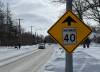
Advertisement Advertise With Us